
Re:noted #3: Claiming to be a public good isn't good enough
There’s a lot of talk right now about how to make the case for journalism’s value. It’s tempting to argue from intrinsic worth, especially if your rent is paid by making such claims.
Don’t get us wrong. Documentation has value. But who chooses what gets documented? Who receives the benefits, and when and where: immediately, years later, or somewhere else in the ecosystem?
Undifferentiated claims that all acts of journalism are inherently valuable answer none of that. Which is why inherent value is a non-starter, not just a weak business model, and why a generation of journalists has gone broke defending a craft for what it should be rather than what it does, and for whom.
The ad money didn’t leave because our arguments were weak, but our response to losing it has been to make the same argument louder.
Value comes from what a thing does for people, not from what it is in the abstract or what the intention of its creators was. Crude oil was a nuisance to salt drillers until refining turned it into lamp fuel.
The same test runs in both directions: psychotherapy could have rested on the idea that self-knowledge is inherently worthwhile. Instead, it got tested. In 1952, Hans Eysenck claimed patients recovered just as well with no therapy at all. Later reviews of clinical trials proved him wrong. That evidence, not the appeal of abstract insight, secured therapy’s place in modern health systems.
The “public good” argument is typically where we go astray, comparing journalism to other “civic infrastructure”, like roads and parks. Yet even they need to be used to be of value.
Economists apply the same criteria, non-excludable and non-rivalrous, to the holiday lights on a neighbor’s house and to the ones a city posts across its shopping street. Both qualify. One gets a hefty budget line, the other doesn’t.
The difference is what breaks without the holiday lights: when the street goes less festive, every shop on it loses something, and no single shopkeeper would ever pay to light the whole street. That’s what makes it public money. It’s a claim about consequences, and it’s the claim we’ve never actually tested.
(This isn’t a test that only service work can pass. A story that deters a fraud nobody ever hears about is also a claim about what breaks without it, and someone can go check whether it held.)
We expect to be funded like the lights across the shopping street. What we mostly do is hang them on our own house and add a sign that says democracy dies in darkness: lovely, admired by some, paid for out of our own pocket.
That’s where we get to be martyrs without nobility or security, people spending years claiming a usefulness we haven’t shown. As we’ve written before: your suffering is not a public service, and precise claims beat broad bets every time.
You can build a public good that’s useful now.
It takes more than calling your holiday lights “civic”: get to know the people you serve, find a functional, emotional, or social friction, remove it, then test whether you did.
A look from our service evaluation
On our strategy gut check, practitioners split most on what counts as evidence that you built something that works.
Since our last update on the 12-question survey, we’re at 135 complete submissions, most from senior editorial and audience roles in grant- and reader-funded newsrooms.
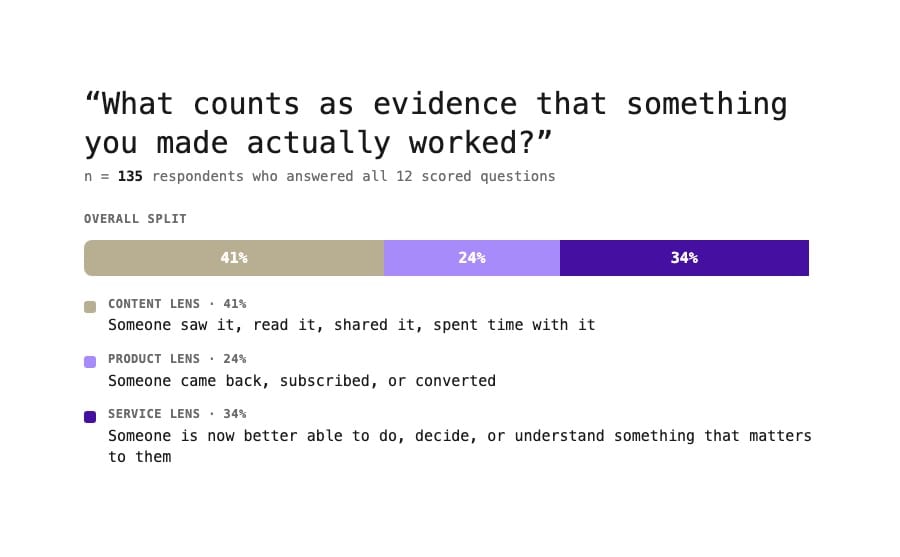
Attention and appreciation put us at the corner-house end of the scale. Something that enhances what someone can do moves us toward utility.
Next issue: what demonstrated utility can look like, and some success criteria for journalism and information services.
Until next time, you can:
- Take our gut check self-evaluation. It now shows how you compare to others who have taken it.
- Browse our updated resources.
- Write to us at servicedesk@gazzetta.xyz with feedback or questions.
Patrick & Madison
P.S.: In October, we’ll launch a free resource with The Lenfest Institute for Journalism that walks through building an information service step-by-step. At the LION Summit in San Diego, Sept. 9 to 11, you can get an early edition.