
Re:noted #2: We know who we’re competing against. So what do we do about it?
Initial survey results show newsroom mindsets are shifting toward service, but reliance on generic value claims still holds us back.

Two weeks ago, we asked you to take our five-minute self-evaluation and pass it on. Many of you did. Thank you.
Here's a first reading, based on 104 respondents, journalists and creators in North America, Asia, and Europe who answered all questions.
If you haven't yet taken it (you can do so here), we ask twelve questions on where your strategy instincts lie between content-centered, product-focused and service-first strategy.
Before we get into the early results: this is not a ranking. Editorial strategy, product strategy, and service strategy are three legitimate disciplines, and every organization needs all three.
The test assesses where your instincts come from when setting strategy and whether a service one exists beyond your content and product strategy.
We wrote more about the difference here, and built it around the service questions because those are the fundamentals of why we exist: what job do we do, for whom, and how we would know if we're doing it well.
If these aren't explicit in your strategy, it's because they don't exist.
A first read on where we stand
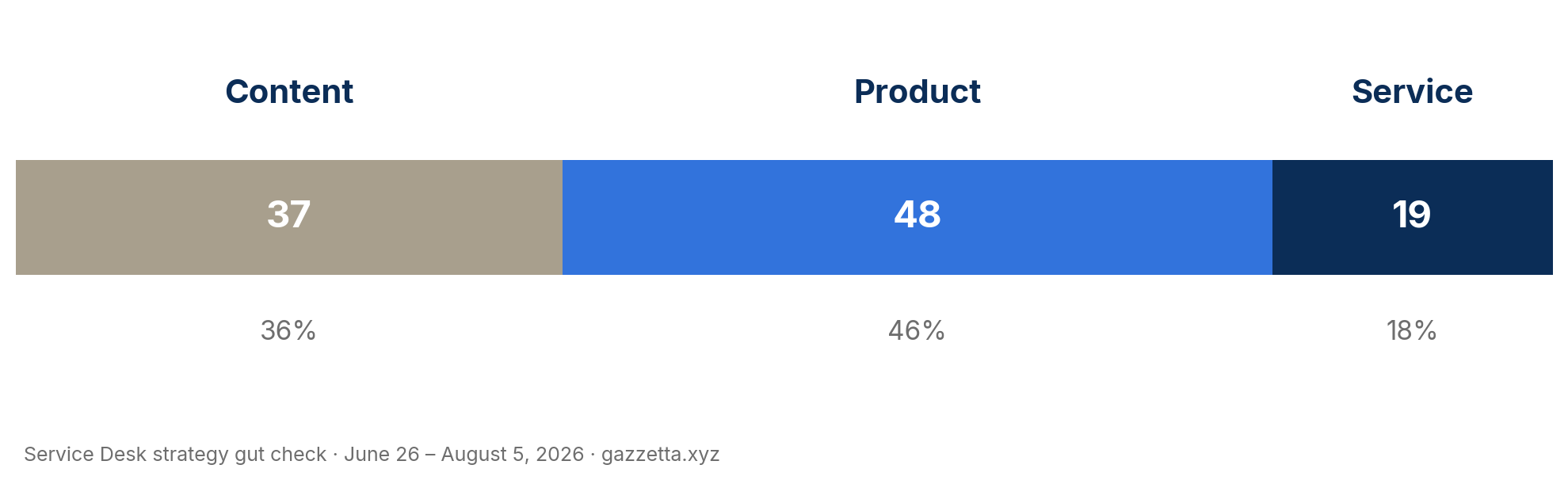
Looking at respondents' total scores, 46 percent default to product thinking, 36 percent to editorial, and 18 percent to service. Almost nobody is a pure type: only a third gave nine or more answers from the same lens. The field is a mix, not camps.
This aligns with what we see in many of our calls and workshops: while more product- and business-focused strategies have begun to enter journalism to move beyond solely editorial focus, they've often come without equal attention to value differentiation.
Strong muscles, weak muscles
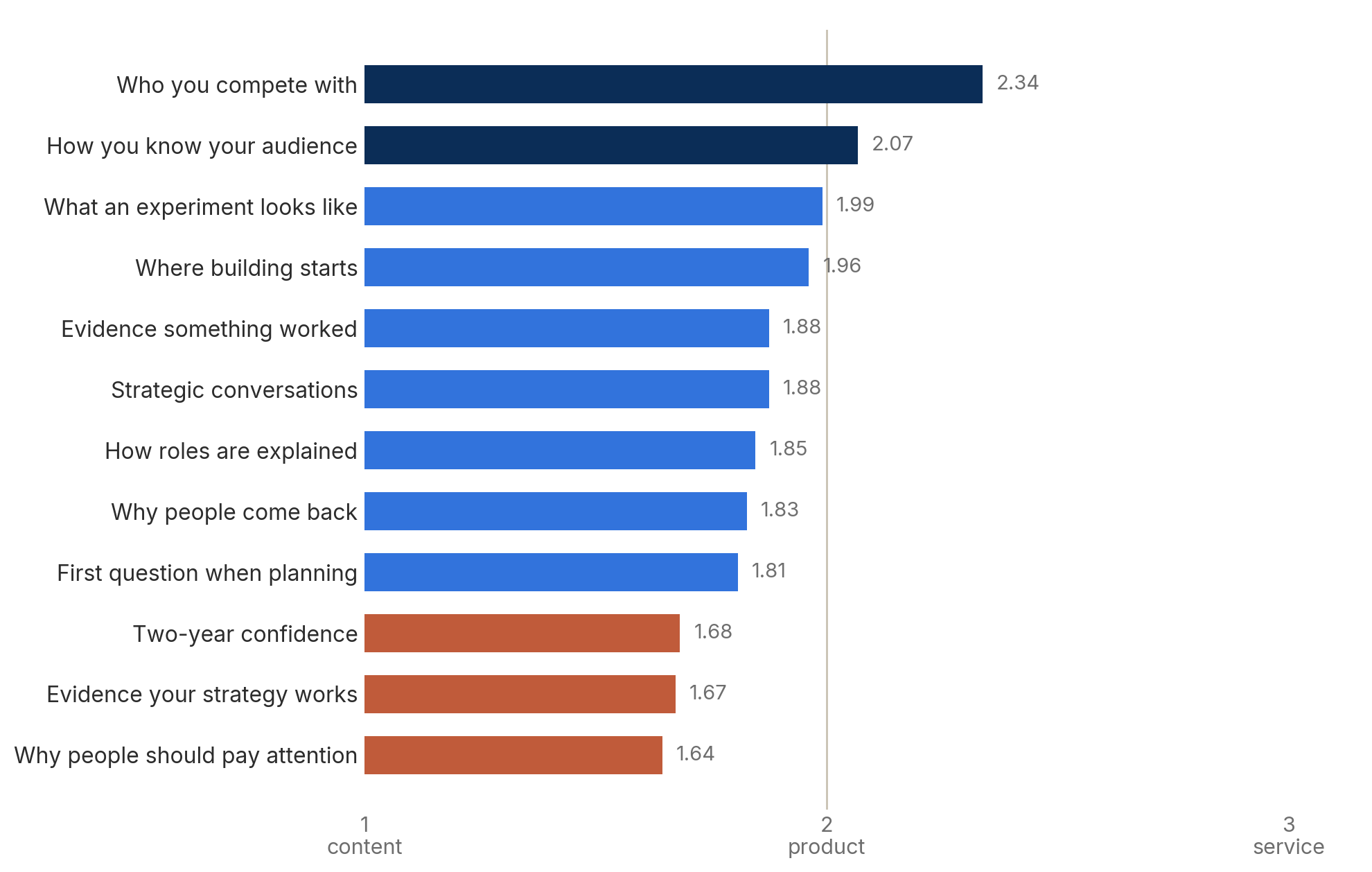
The field is aware of its need for value differentiation, as the strongest muscle across those surveyed was competition framing. Over half say their real competition is whatever does the job for people, a group chat, search, AI, a friend, or nothing at all.
That adds up: every Reuters Digital News Report or Nieman Lab write-up for the last ten years has told us about all the other platforms and people competing for our audience's attention. It's something we're keenly aware of; we've just been stuck on the "so what do we do about it?" question.
To correspond, the weakest muscles all concern value. Six in ten answer "why should I pay attention to you?" with "quality journalism on important topics," which gives us an aspirational ideal of why we hope people pay attention to us, rather than what we actually do for them.
Half judge their strategy by "what performs." And asked what makes them confident they'll exist in two years, most point to the inherent importance of their work, not to anyone finding it useful. That's a fine answer, but it's a hollow one for building an enduring business model.
Talk changes before the practice
One problem is that the effects of not having a clear value differentiation (wobbly strategy, declining readership) sometimes come faster than the internal changes needed to find one.
Of the 55 people with the modern competition framing, almost half still claim their value is "quality journalism" and still steer by "what performs", which indicates a more content-focused strategy.
And of the 47 who say they've listened to people describe their lives (which can lead to finding real service opportunities), 19 still measure success by performance metrics rather than outcomes. The listening (leading insights) happened, but hasn't superseded the dashboard (lagging insights).
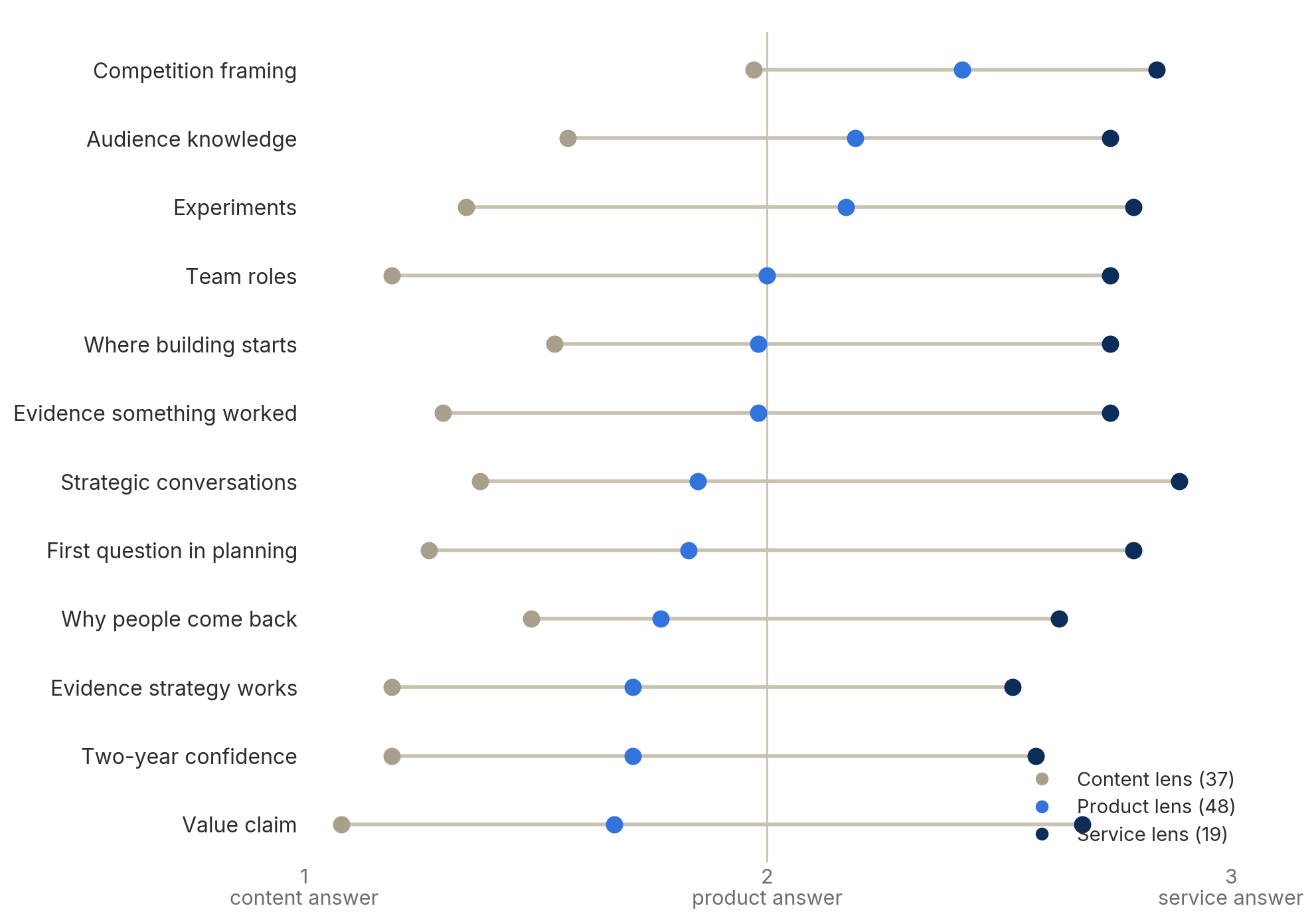
This is a common sticking point we see: glimmers of desires in an organization to shift to a service strategy, but without the throughline needed to connect it from mission to measurement.
The silver lining is that the pattern across the whole dataset shows teams absorb the operational parts of service thinking first: experiments, roles, and evidence.
What's needed is the ability to scale beyond single teams to influence what strategy conversations are about, what you claim as your value, and where your confidence in service comes from.
That can be prompted by devastating market shifts that force those conversations (structural losses of audiences, social leverage and revenue), or by true momentum from journalism practitioners wanting to build more service-oriented businesses.
We're seeing both happen right now, which presents a genuine opportunity to experiment and move us forward.
Last notes
A final note from the early results: when asked why their audience comes back, 36 of 104 said habit and routine. Only 25 said demonstrated usefulness. As we wrote before the summer: habit is not loyalty. It's what you have until something more convenient comes along.
We found that the best predictor of the overall result was the answer to this question: "Why should I pay attention to you?" Try answering it about your own work, without the words quality, important, or journalism.
Journalism is not inherently valuable in itself. Value is determined by the beholder, often because it helps them do something. If you're not sure what yours is, one place to start is by talking to people who currently read your work.
Keep it going
The gut check stays open, and every response makes the next reading more useful. We've fine-tuned it further and added an additional results page that will show you how you compare to others who have taken the quiz.
Same ask as last time: share it with one person who should take it. We were excited to have teams take the test as part of their own workshops and then discuss the results.
Until next time, you can:
- Claim a free brainstorming call to talk about your value add, strategy, or anything else.
- Write to us at servicedesk@gazzetta.xyz with feedback or questions.
- Browse our updated resources.
All best,
Patrick and Madison