Re:noted #5: tbd/con is over. Here's what we learned building it
In case you want to create your own pixel-world convening…
Hello all,
Excuse the off-schedule send. We've been busy, and we’ve got some news and an invite for you very soon.
But first, some reflections! We just wrapped up tbd/con, a free, interdisciplinary virtual conference on AI, information, and journalism that we ran Sept. 23 and 24.
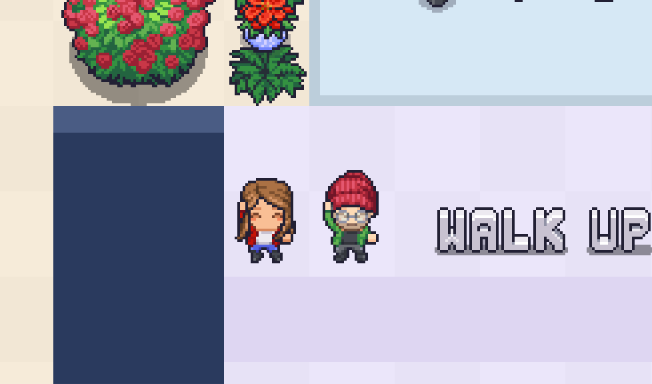
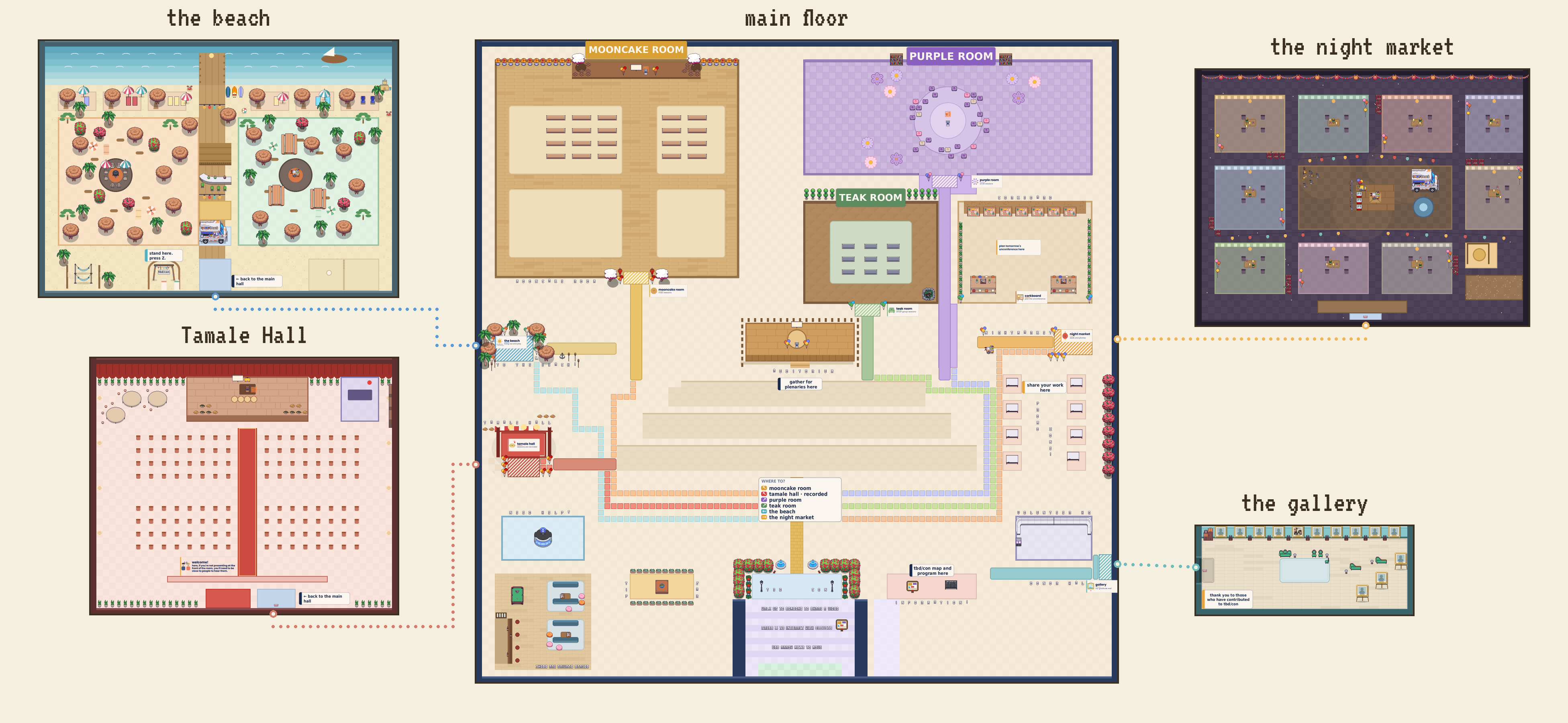
We built it inside a colorful pixel world on gather.town, with a beach, a night market, and conference halls themed around food (tamale hall! mooncake room! each with pixelated pastries and corn husks).
Over two days, it brought together practitioners in journalism, research, education, the arts, and technology, joining from roughly 16 time zones, from California to Tokyo. We had 30 speakers and about 160 participants, with 50-70 concurrent users over sixteen hours of non-stop gathering. Phew!
It was, on our end, an intentionally one-time thing, with no ulterior motive of creating any lasting revenue stream or branded event. Instead, we wanted to bring people together to talk about how AI is changing information and how we think about and build it, in a non-performative way, and to mingle, have fun, and in this way prioritize the moment and learn along the way.
We’ve argued before that when repeated at scale, our gathering formats quietly default to existing power structures, the same faces on the same stages, and that we can proactively design against that. tbd/con was an attempt to do that and see what happens when a new space is created.
(Also, in-person conferences are expensive, and the economics are brutal even for the good ones. Just as we were gathering, LION, an association for local independent online news publishers in the US, announced it’s stepping back from its big annual summit, because you cannot run an unsustainable Sustainability Summit, and a hotel event in a major city is simply costly.)
Add rising travel costs, tightening philanthropy, and the fact that more and more people cannot or will not cross certain borders to attend, and the in-person model gets harder every year.
The good news is there is a wide, mostly open space between a hotel ballroom and a grid of muted rectangles, and we wanted to explore something in it. That became our gather.town world for the two days of tbd/con, and now continues in the Signal group (if you’d like to join!).
We learned a lot from the months of work it took to make it happen. If you were there and want to take anything you saw, or anyone you met, and make it happen again, go for it. We are "dropping the painter's brush," as Madison put it.
For now, here’s the learnings in case you pick up that brush, or a pen, or touchscreen:
Purpose-full design
1. Questions that don't necessarily need answers
In our call for pitches, we invited open questions rather than polished answers, and so many people shared what was actually on their minds, rather than giving post-mortems of ideas months past, and many of them speaking outside their day-job capacity.
This was so much more interesting than “success stories” because it created a shared space for discovery and exploration. One speaker likened it to John Keats's negative capability: staying in uncertainty without reaching for facts and reasons.
It resisted the urge for quick answers and enabled new connections and understanding. Instead of sessions ending with “how to replicate what I did,” attendees left sharing new perspectives on questions they’ll keep thinking about.
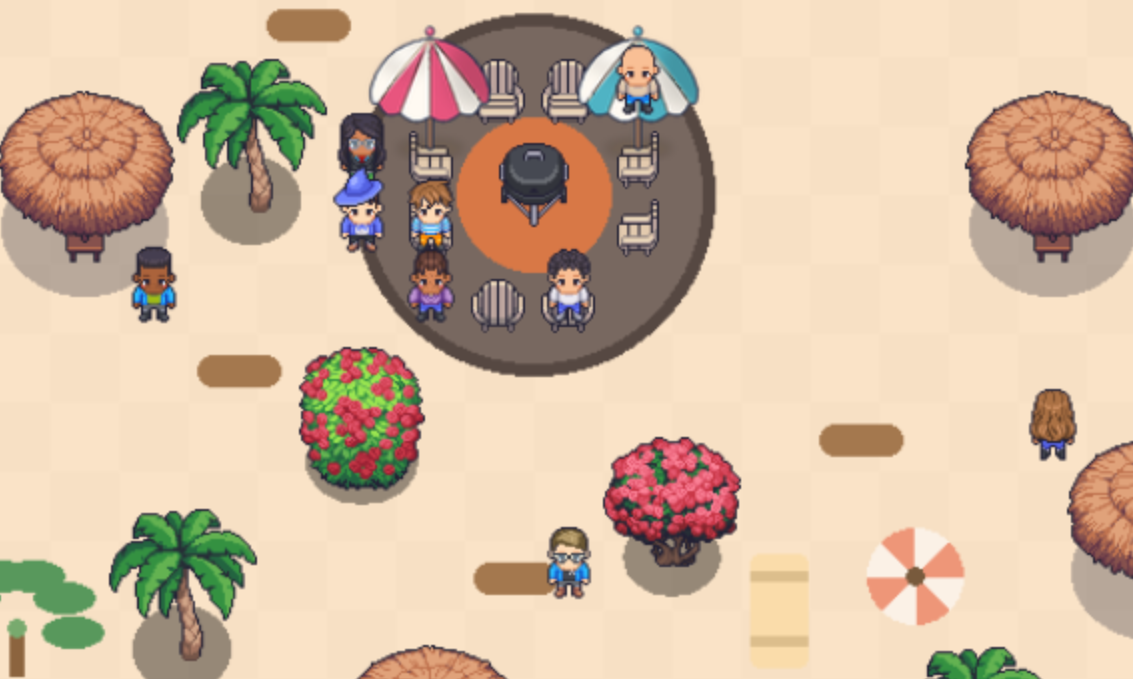
2. Even a pixel room has a shape
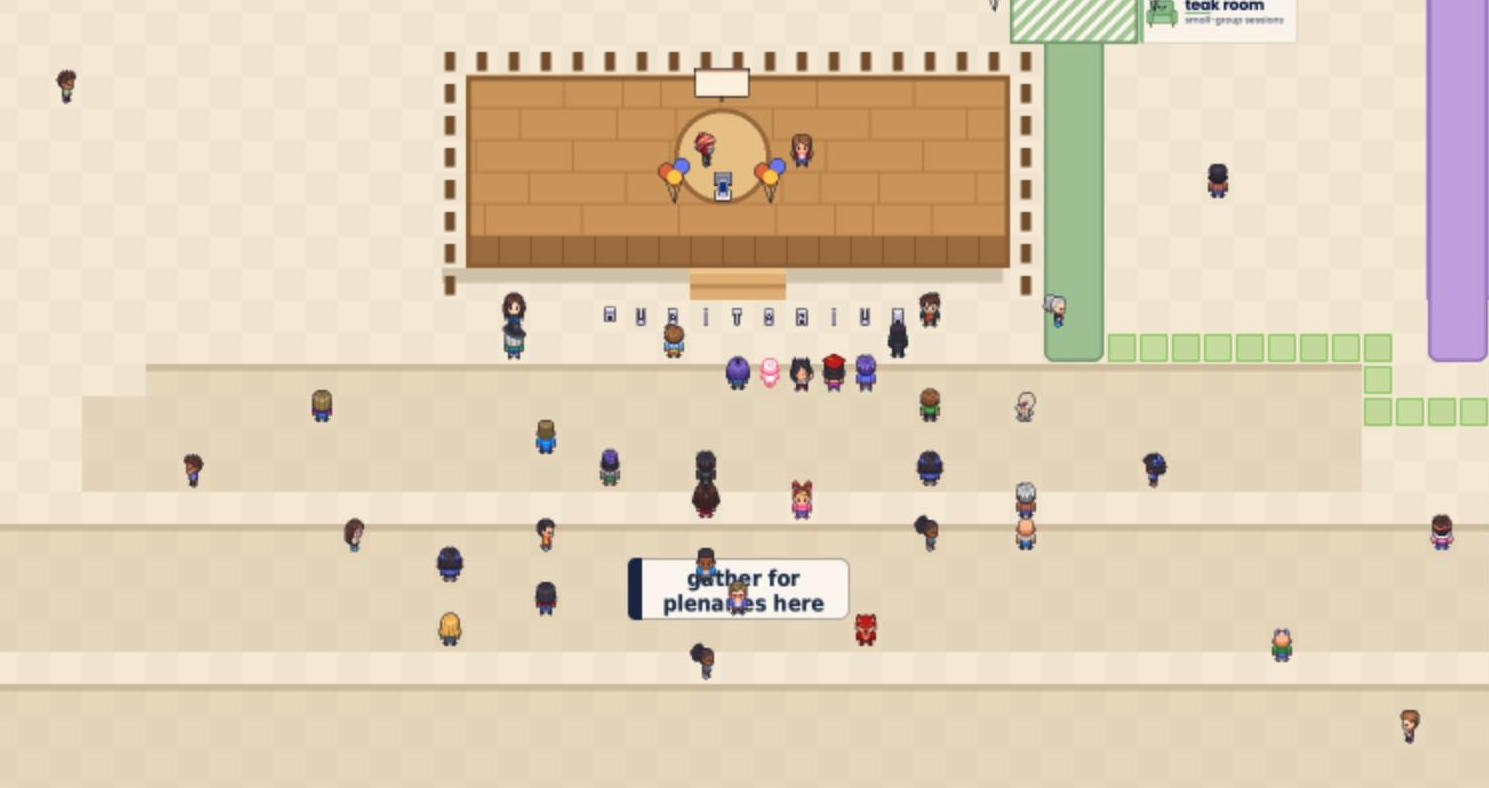
If you’re unfamiliar with gather.town, it’s a pixel space that you can design how you’d like – a virtual office, conference hall, stage, or something else. We spent a couple of months creating ours before the event, trying to guesstimate how we’d use it based on the registration numbers we received.
Mostly, it worked! Yet, as it played out: Some rooms were too large, and speakers were a bit too far away from the participants, sometimes standing right at the door. In others, a circular informal setup naturally invited discussion. Even in a virtual space, it makes a difference if people sit on “wooden” benches or beanbags. Layout signals how people are allowed to participate and can create totally different experiences.
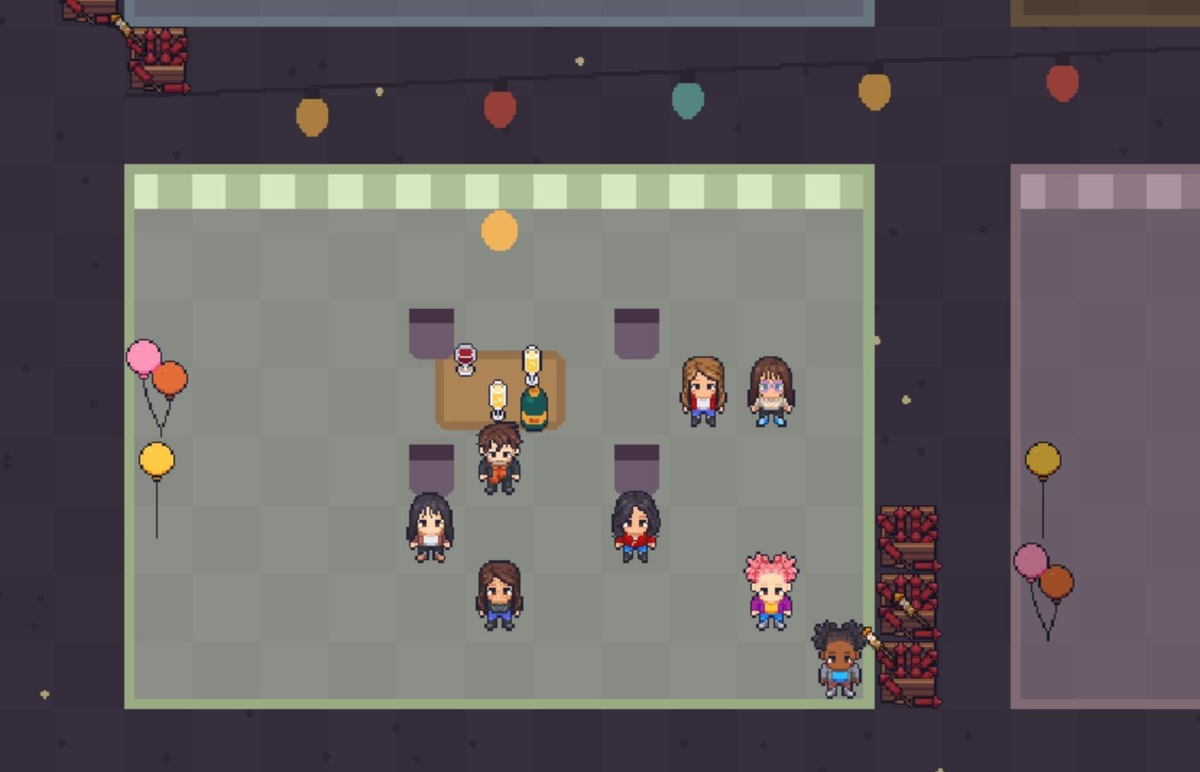
Still, we had a lot of fun seeing people’s pixel avatars use the spaces to follow signs, interact with corkboards and games, hang out at a bar, and throw dance parties. People even “lingered around” as you’d hope for in a physical space – for hours and days after we stopped programming.
Consider this a bit of a nudge to other online organizers: get past the Zoom webinar box and try other configurations. It doesn’t have to be Zuckerberg-style dystopian metaverse cringe. Virtual meeting design can be so joyful. As physical conferences get increasingly inaccessible, virtual settings can also let people juggle tasks, drift in and out, keep working, and still make a real personal connection.
3. Come as anyone, or no one
On gather.town, when “spawning” in the space, attendees create their avatar and external appearance – no verification or registration required. That means attendees could be anyone or anything: using full name, last name only, a completely different name, with appearances as themselves, a zombie or a furry. You might know the person next to you or have no idea who they are.
Some conferences drop institutions and titles from badges in favor of names; this went a step further, with privacy built in by default. It took a lot of the performance and social pressure out of the room — “big names” didn’t play a factor – prompting interactions to start off organically instead of being motivated.
Norms and expectations
4. Tradeoffs in facilitation
As session pitches came in, we ran a volunteer review panel (thank you!) over the summer to gauge interest, but we did not vet every speaker, presentation, or endorse any viewpoint.
That freed up an amazing range, honesty, and real provocation. Making something open is powerful. It is also naive not to prepare for the downside: we did not have instruments to measure in advance, or during the event, how mutually beneficial an exchange would be. When gaps presented, we were left to improvise.
This is a common tension event organizers face when planning and running spaces: what to leave to trust and what to build processes and systems for around curation, relevance, and mutuality in the space. The bottom line always comes to this: when you host, you answer to the people who chose to spend their time with you, and you're responsible for their experience – including what and who else you bring into the space.
5. People can bring their old rooms with them
Even in new territory, people fall back on the behaviors they know. Give someone a pixel beach and an anonymous avatar, and many will still look for the podium, the panel, the familiar order of who speaks and who listens, and what might be advantageous to them post-event.
The opposite of a closed system is not total openness and good faith. We learned from facilitation that openness can be beneficial; it just needs a clearer social contract about how to interact within the space. Otherwise, left alone, new closed systems form on their own.
In retrospect, we would’ve set out clearer norms up front, for organizers and attendees alike, less as a rulebook than as behaviors to model by practice.
Openness needs scaffolding; yet new experimental scaffolding is possible and can be joyful.
A final call to you
6. Just host the gathering!
Hosting cost us some time and money, but it was not complicated: a group chat, calendar invites, emails, and a few posts to friends got it moving.
It was also completely worth it: attendees and presenters shared gratitude for genuine conversations and a new event and space to explore and meet others outside of their circles.
More people should host and try things. It doesn’t need to be heavy, and new people will try things with you if you just go for it. In our case, making it a one-off also took off the pressure to build a grand narrative to justify or fund it again – we could just create what we wanted to.
So consider the brush dropped, and yours to pick up. If you were there and enjoyed it: take tbd/con and run with it, or paint something entirely your own.
Chances are high that far more people than you think want to show up, sit with hard questions together, without a stage or a sales pitch in sight. Go invite them to your table, virtual or otherwise.
Huge thanks to everyone who was part of this: the review crew, the speakers, our fellow organizers and volunteers, and everyone who showed up curious. And if we can help you brainstorm, we are an email away at servicedesk@gazzetta.xyz.
Madison and Patrick