
Full report: Iranian Gen Z on YouTube under censorship and crisis
How young people in Iran navigate information on YouTube. Subscribe to our free newsletter to download.
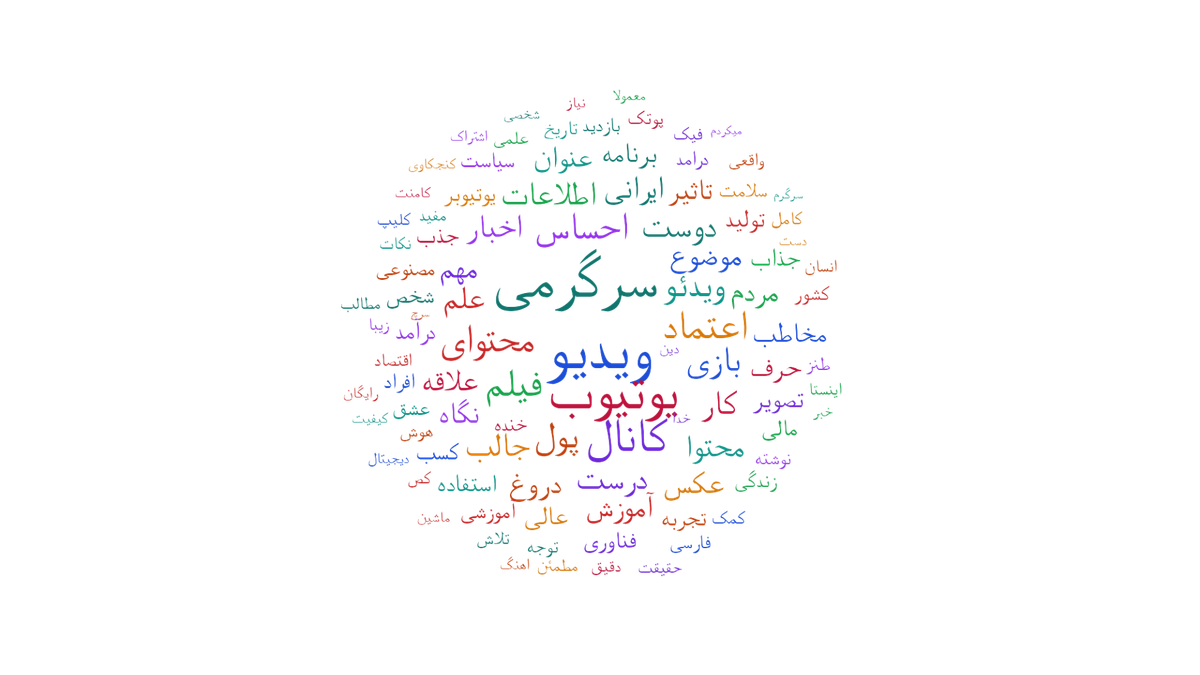
This report investigates how Iranian Gen Z forms trust on YouTube under censorship.
Using a mixed-methods design — human interviews, AI-moderated Telegram interviews, a rapid-response crisis survey during the June 2025 Iran–Israel conflict, and a large-scale final survey (2,000+ respondents) — the research replaces the standard fact-checking assumption that reach alone drives impact.
Instead, it maps the mechanisms through which credibility actually forms for young Iranians navigating blocked platforms — a sequence we formalize as the Journey to Trust framework — and translates those mechanisms into a testable strategy package for future programming.
Key insights:
- YouTube use by Iranian Gen Z is defined by constraint: routine blocking, VPN dependence, unstable connectivity, and uneven risk.
- Credibility forms as a sequence of gates: attention → relational safety → evidence; evidence lands only after the messenger feels safe and relevant.
- Many interventions fail by leading with institutional authority or verdicts; higher-leverage practice is "messenger-first, evidence-fast" with visible receipts early.
- “Gen Z” is not one audience: trust routes vary (creator-led “vibes” versus evidence-led verification), and identity cues can trigger immediate exit regardless of factual strength.
- During crisis (June 2025 Iran–Israel conflict), behavior compresses toward the most reachable channels; YouTube shifts to a later-stage explainer and archive role. Integrity work must assume cross-platform routing and low-friction verification by default.
You can also listen to this AI-generated audio summary of the report below. It covers the main findings in about 20 minutes.
If you have feedback or questions, don’t hesitate to get in touch at hello@gazzetta.xyz.
ASL19 is a technology and exiled media organization dedicated to countering digital authoritarianism. With over a decade of experience fighting internet censorship, ASL19 is known for technology solutions like Paskoocheh and BeePass VPN. Its fact-checking operation, Factnameh, verifies claims circulating in Persian-language media and social networks. Beyond its technical work, ASL19 plays a key role in the internet freedom community, bringing Iranian expertise to the global information resilience space.
Gazzetta is a research lab that helps news organizations serve their audiences in places where that's hardest: under censorship, in exile, or cut off from the people they're trying to reach. We do audience research and service design where standard methods don't work.
Contributors: Aaron Zou, Chu Yang, Arantza Rodríguez Fragoso, Afshin Sadri, Nader Samadi, Farhad Souzanchi, Fereidoon Bashar, Patrick Boehler
Iranian Gen Z on YouTube Under Censorship and Crisis: The Journey to Trust Framework
Executive Summary
Iranian Gen Z uses YouTube in a way that is shaped as much by constraint as by preference. The platform is routinely blocked. Access depends on VPNs and fluctuating connectivity. Risk is unevenly distributed. Under these conditions, “watching a video” is rarely a neutral act; it competes with friction, uncertainty, and the constant option to switch to faster, more reachable channels.
This project’s primary contribution is a field-tested model of how trust actually forms on YouTube for Gen Z inside Iran (both in everyday browsing and during acute disruption) paired with an implementation package designed to turn those insights into measurable programming decisions. Rather than treating credibility as a single moment (“do they believe the correction?”), the research shows that credibility is usually a sequence of gates: attention comes first, then relational safety, and only then does evidence have a reliable chance to land.
That sequencing matters because it exposes a predictable failure mode in many fact-checking interventions. Traditional formats often begin with institutional authority, method, or verdict. But for many Iranian Gen Z viewers, the decision to stay happens before any of that is processed. The first seconds are interpreted through identity cues, tone, and perceived intent. If the messenger feels unsafe, patronizing, propagandistic, or simply irrelevant, the viewer exits before evidence is evaluated. In practice, “correcting the claim” is necessary but insufficient. What works is an operational logic we formalize as messenger-first, evidence-fast: open with a human, culturally fluent entry that clears the relational threshold, then present visible receipts early enough to convert relational trust into epistemic trust.
The research also complicates the idea of “Gen Z” as a single audience. We find meaningfully different patterns in how viewers grant credibility and when they choose to verify. Some audiences are predominantly creator-led, granting trust through parasocial familiarity and “vibes,” often in entertainment-first contexts where misinformation can arrive incidentally. Others are more evidence-led and want to see documentation and method. A large share is identity-salient in a distinct way: national belonging can be highly activated without implying government alignment, and framing that feels “against Iran” can trigger immediate distrust even when the evidence is strong. This means that effectiveness depends not only on what is true, but on how the truth is wrapped: hook, tone, host, pacing, and call to action, while keeping evidentiary standards constant.
A critical part of the project’s added value is that these mechanisms were observed under crisis conditions rather than inferred from “normal times” alone. During the June 2025 Iran–Israel conflict, when uncertainty was high and connectivity degraded, information behavior compressed. Viewers relied more heavily on the most reachable channels, and YouTube was rarely the first destination for updates. In that mode, YouTube functions less as a live wire and more as a later-stage explainer and archive layer. Verification pathways shifted as well: people often checked claims through whatever sources remained accessible, which means “verification” can reflect constrained choice rather than high-quality evaluation. The crisis case study therefore strengthens the practical conclusion that information integrity work cannot be designed as YouTube-only in a filtered environment; it must assume cross-platform routing, especially when misinformation risk spikes.
Across the full dataset, another pattern holds consistently: verification is real, but it is bounded by friction. Many non-verification decisions are driven by time, know-how, and access rather than ideology. Small design choices therefore have outsized leverage. If the evidence is on-screen quickly, if the viewer can see exactly what was checked, and if the “how to verify” step is reduced to a single action, trust and follow-through become more plausible outcomes. Conversely, if the proof is delayed or abstract, viewers who might have been persuadable often disengage.
Because Phase II implementation was not executed within the project period, downstream outcome indicators tied to months 7–12 could not be measured. However, the work concludes with a practical, execution-ready foundation that de-risks any future pilot. Deliverables include a defensible Journey to Trust framework (including crisis compression dynamics), five quantified archetypes that translate trust mechanisms into segment-specific design requirements, a playbook and experiment backlogs aligned to the trust sequence (reach → attention → trust proxies → action). The project’s net effect is to replace a distribution-first theory of change with a mechanism-first one: if the intervention is designed to clear the attention and relational gates, then evidence can do its job.
In short, the research project’s highest-leverage output is not a single video format or a set of topic ideas. It is a corrected model of credibility formation on YouTube under censorship and crisis, translated into concrete design principles and test protocols. That combination makes future implementation meaningfully more likely to succeed, because it specifies where fact-checking efforts fail, why they fail, and what to test first to reduce that risk.
1. Trust is sequential, not binary Our research validates a "Journey to Trust" framework, revealing that Gen Z typically grants attention and relational credibility before processing evidence. This creates a predictable failure mode for traditional “correct-the-claim” formats that lead with institutional authority or methodology.
2. Gen Z is not one audience We identified distinct audience patterns that differ in whether trust is primarily creator-based or evidence-based. Furthermore, identity cues significantly shape receptivity, requiring segmented packaging, tone, and calls to action rather than a "one-size-fits-all" approach.
3. Crisis compresses the journey and shifts platforms During high-stakes events, verification and attention pathways compress. Audiences prioritize faster, more reachable channels, effectively shifting YouTube’s role from a live-update channel to an explainer or archive layer.
4. Verification is friction-bound Many non-verification decisions are driven by constraints on time, know-how, or access rather than ideology. Consequently, small design choices—such as visible on-screen receipts or instructions—can produce outsized gains in trust.
Strategic pivot: The new model
Our starting point was the standard fact-checking theory of change: publish an accurate correction, distribute it widely, and assume the audience will read the evidence, update beliefs, and share the result. In a filtered YouTube environment, that logic breaks before the evidence stage. For Gen Z inside Iran, the first questions are rarely “Is this true?” or “What’s the method?” They are “Is this worth staying for?” and “Is this messenger safe, relevant, and acting in good faith?” Those judgments happen fast, under constraint: VPN friction, unstable connectivity, real safety considerations, and a feed where the competitive baseline is creator-native pace and personality.
This is why we moved away from a distribution-led “deficit model” (the idea that the primary barrier is exposure to correct information) and toward a mechanism-led model built on sequential credibility. The research consistently shows that credibility on YouTube is typically earned through a sequence of gates. If content fails early, the viewer exits before any proof is processed, regardless of how rigorous the verification work is. The practical implication is not “soften the evidence.” It is the opposite: redesign the format so that evidence has a chance to land.
In the updated model, effective YouTube interventions follow a repeatable progression:
- Earn attention (the stop-the-scroll gate). Packaging and openings must make the function obvious quickly: what claim is being checked, why it matters now, and what the viewer will get. Slow context-building and authority-first introductions are high-risk because many viewers decide whether to stay before method is even heard.
- Establish relational safety (the intent gate). Viewers rapidly infer whether the messenger feels culturally fluent, fair-minded, and non-threatening. In low-trust environments, tone is interpreted as evidence. If the entry reads as patronizing, propagandistic, ideologically loaded, or simply “not for us,” persuadable viewers often leave before the proof appears.
- Deliver visible proof early (the conversion point). Once the viewer grants a short listening window, the content must quickly move from “trust me” to “see this.” Proof needs to be on-screen and legible at a glance (screenshots, dates, side-by-sides, original clips, geo frames), so the conclusion feels anchored in observable artifacts, not personality.
- Reduce verification friction (the feasibility gate). Even convinced viewers may not act if checking is costly. In Iran, verification competes with blocked sites, bandwidth instability, time, and know-how. The model therefore treats verification like a product funnel: make the next step one action, and show exactly where to look and what to search.
- Prompt realistic actions by segment (the follow-through gate). Most downstream behaviors are low-effort and private. Different archetypes have different “maximum willingness-to-act.” The goal is to ask for the smallest action that meaningfully reduces rumor spread (save, screenshot, send to one person, forward to a family group, use pinned sources), rather than assuming public sharing or commenting as the default conversion.
This pivot is the project’s highest-leverage output because it replaces an assumption (“reach will do the work”) with an operational model that can be executed, measured, and improved. It de-risks Phase II by making performance diagnosable: if a video underperforms, we can ask where it failed (packaging, relational safety, proof visibility, friction, or CTA fit) and what to change first.
Project Background & Objectives
Project background
This project was conducted as a collaboration between Factnameh (ASL19's factchecking operation) and Gazzetta. The project aims to boost Factnameh’s engagement with Gen Z Iranians to build critical media literacy. Based on Factnameh’s observation and analytics, Iranians under the age of 25 tend to engage with fact-checking content less than those in older age groups. Take YouTube for instance, although a 2024 ISPA study shows that 50.4% of students inside Iran use YouTube daily (Iran International, 2024) and our latest polling in January also indicates younger respondents access foreign media channels more frequently (Factnameh, 2024), less than 20% of Factnameh’s YouTube channel viewership are from audiences under 25.
Building critical information literacy among young audiences is more crucial than ever. Gen Z Iranians encounter a steady flow of misinformation online and in their daily life: They must navigate increasingly rampant mis/disinformation on social media – where they spend a significant amount of time and state-approved narratives are often amplified through coordinated information operations. There have also been cases where school materials were used to reflect “official” viewpoints, presenting a biased and false portrayal of social issues, governance, and Iran’s global standing, with the aim of influencing how young people perceive these topics. These combined forces create an environment that discourages informed public dialogue and debates from youth in Iran.
The importance of addressing this challenge became especially clear during the 2022 Jina (Mahsa) Amini protests, when young protesters emerged as key drivers of change, demanding transparency and truth. During this period, Iran’s disinformation tactics—ranging from spreading false narratives to obscure the killing of young protesters to staging false flag operations—sought to undermine youth participation in public discourse and manipulate public opinion (Factnameh, 2022). These efforts highlight the urgent need to equip Iranian youth with the tools and knowledge to navigate disinformation and stay alert.
This project seeks to address the gap in Factnameh’s current reach to Gen Z Iranians and the unique challenges faced by potential audiences in this age group. By strengthening Factnameh’s capacity to provide engaging, effective fact-checking content and implementing a research-informed content strategy on our YouTube program, the project will enable Factnameh to make an impact on the future generation to help them counter misinformation.
Platform background
This section focuses on YouTube. For an overview of platform access in Iran, see Appendix E.
History of YouTube censorship in Iran
Iran has a long history of censoring YouTube as part of its broader internet control. Key blocking events include:
December 2006: Judiciary officials ordered service providers to filter YouTube (along with sites like Amazon, Wikipedia, IMDB and the New York Times), as part of a campaign by President Ahmadinejad to purge “corrupting” Western influences. The ban came soon after a scandalous private video involving an Iranian actress appeared online, reflecting official fear of “immoral” content. High-speed internet was also curtailed to impede foreign media.
June 2009: Amid the Green Movement protests after the disputed presidential election, authorities drastically tightened controls. They cut mobile networks and blocked access to Facebook and YouTube as protesters were using these platforms to share images and videos of demonstrations. Footage of the violence – such as the graphic video of Neda Agha Soltan’s shooting, which was uploaded to YouTube and viewed globally – galvanized the opposition. In response, YouTube remained permanently filtered in Iran from this point.
September 2012: Iranian officials reacted harshly to the Innocence of Muslims video on YouTube, which was seen as blasphemous. They announced a nationwide block of Google services to protest YouTube’s refusal to remove the video. Gmail was briefly blocked until public complaints forced its restoration, but YouTube stayed banned. This episode reinforced Iran’s commitment to keep YouTube filtered under its “religious sensitivities” policy.
Throughout these instances, YouTube has remained officially banned. The state’s Internet Filtering Committee (headed by the Prosecutor-General) continually affirms the block on YouTube as part of blocking “70 percent of the internet” in Iran (along with Twitter, Facebook, Instagram, etc.). Occasional discussions of unblocking (during the Rouhani era) never materialized. By 2024, YouTube was still banned – a fact even Iran’s own media acknowledges – and access requires evading the country’s sophisticated censorship apparatus.
Government response: Domestic platforms and Aparat
In lieu of YouTube, the Iranian government has promoted local alternatives under its control. The flagship is Aparat, a Persian video-sharing service launched in 2011 by the tech company Saba Idea. Aparat quickly became one of Iran’s most-visited websites, offering a tightly controlled platform where content must comply with Iranian laws.
According to its own reported metrics, Aparat’s user base exceeds 60 million monthly users, with around 21 million pageviews per day. Its growth has been significant: by 2017 it was handling about 10.5 million daily video streams, and by early 2020 it reached 32 million daily views —showing how Iranian users turned to it when YouTube remained blocked.
Officials have actively encouraged use of such domestic platforms as part of Iran’s National Information Network. In 2014, the President’s office and the Minister of Communications created official Aparat channels to boost its legitimacy.
Aparat has since hosted live events (including streaming World Cup matches) and created Iranian original content, positioning itself as a home-grown YouTube replacement. Other government-endorsed video sites exist (e.g. Namasha, Tamasha, Didestan), but Aparat ranks #1 by far.
Beyond video, Iran has pushed domestic social networks and messaging apps to compete with banned foreign services. Examples include Rubika (an all-in-one app with messaging and video), Soroush (a Telegram-like messenger), and Bale, among others.
However, uptake of these state-approved alternatives has been limited. A 2023 survey found only 8% of Iranians use Rubika “often,” compared to 65% who regularly use Instagram (despite it being officially blocked). Even state-affiliated polls admit that the most popular platforms among Iranians are still the foreign ones (Instagram, WhatsApp, Telegram) rather than domestic.
While Aparat has succeeded in capturing a large audience for entertainment and permissible content, Iran’s broader strategy to replace global social media with insulated local services has met only partial success. Many users use local apps for convenience or lower data costs, but continue to prefer the richer content and freedom of international platforms whenever they can access them.
YouTube usage in Iran despite the ban
Even though YouTube is banned, millions of Iranians still access it via circumvention tools. Using VPNs, proxy servers, and other anti-filtering apps has become commonplace. By 2022, roughly 80% of Iranian internet users had installed VPN or anti-censorship tools on their phones to bypass filtering.
A Sharif University policy report in 2024 likewise estimated over 80% of users rely on VPNs in some form. In effect, Iran has one of the highest rates of circumvention usage in the world.
Surveys confirm that a significant share of the population visits YouTube despite the official ban. A nationwide 2023 survey by GAMAAN found 17% of Iranians say they use YouTube “often,” and another ~24% use it “sometimes”.
In total, nearly 60% of respondents had accessed YouTube at least rarely, underscoring its persistent appeal. This is remarkable given the extra hurdles – users must jump the “filternet” and endure slow speeds. The demographic skews toward younger, urban, and educated Iranians who are digitally savvy.
These users turn to YouTube for everything from music and entertainment to tutorials and news, treating it as a window to global content that state media fails to provide. By contrast, Iranians who are older or less tech-oriented tend to rely on easier alternatives (like state TV or unblocked domestic sites) and are less likely to use VPNs for YouTube.
Notably, periods of political unrest have driven more Iranians to access YouTube and other blocked platforms, as people seek uncensored information. During the 2017–2018 protests and the November 2019’s unrest, the government observed spikes in circumvention. Officials complained that users “quickly switch to VPNs” whenever filters are imposed. Indeed, when Instagram and Telegram were temporarily blocked in January 2018 to quell protests, many Iranians simply routed around the blocks to share videos on YouTube and Twitter via proxy connections.
This cat-and-mouse dynamic has characterized Iran’s internet use. By 2023, the regime even floated plans for a “legal VPN” system – essentially requiring government registration to obtain an approved VPN – to control this widespread circumvention habit.
So far, those plans have not been fully implemented, and Iranians continue to widely use illegal VPNs as a daily necessity for accessing YouTube and other global services.
YouTube’s role during protests and political unrest
YouTube has played a pivotal role as an outlet for Iranian protest movements, even though access inside Iran is restricted. During the 2009 Green Movement, Iranians turned to social media to broadcast the regime’s crackdown to the world. Protesters and citizen-journalists uploaded countless clips of demonstrations and police violence to YouTube.
The most iconic was the video of Neda Agha Soltan, a young woman shot by security forces on June 20, 2009, bleeding to death on camera. That graphic 40-second clip was posted on YouTube within hours and went viral globally. TIME dubbed it “probably the most widely witnessed death in human history”.
Neda’s tragedy, viewed by millions, became a symbol of the opposition. The Iranian government responded by intensifying web censorship (as noted, YouTube and similar sites were blocked outright in June 2009) and throttling internet speeds to near dial-up levels to hinder video uploads.
Nonetheless, tech-savvy activists kept finding ways to share footage abroad – often by sending videos to contacts outside Iran, who then published them on YouTube and other platforms. YouTube thus served as an “online stage” for Iran’s protest videos, allowing exiled media and international audiences to see what was happening on the streets.
In subsequent waves of unrest, YouTube continued to be a repository for protest content, though other platforms (like Telegram, Instagram, and Twitter/X) were often used in real-time by Iranians. During the December 2017 – January 2018 protests, for instance, protesters primarily coordinated via Telegram and posted short clips on Instagram. The government temporarily blocked those apps to disrupt the protests.
Since YouTube was already banned, it was not a primary organizing tool within Iran, but it still functioned as an archive where longer videos and compilations of protest footage were shared (usually by diaspora groups or media). After the dust settled, many Iranians caught up on protest coverage by watching YouTube videos posted by outlets like BBC Persian or VOA, which aggregated clips sent in by eyewitnesses.
The November 2019 protests over fuel prices saw the regime implement an unprecedented near-total internet shutdown – cutting off the entire country from the global internet for about a week. This drastic step was aimed at preventing any flow of information (images or videos) to the outside world while security forces suppressed demonstrations.
As a result, Iranians could not directly upload to YouTube during the blackout. However, once connectivity was restored, a flood of videos documenting the 2019 crackdown surfaced on YouTube and international media. This incident underscored both YouTube’s importance for bearing witness and the regime’s willingness to impose absolute isolation to stop that flow.
Most recently, during the 2022 nationwide protests ignited by the death of Mahsa Amini, YouTube again figured into the information ecosystem. The government’s new tactic was to impose rolling internet outages on mobile networks every evening and to block popular services (this time WhatsApp and Instagram) to impede protesters from broadcasting live updates.
Despite these hurdles, Iranians managed to capture countless videos of the “Woman, Life, Freedom” protests and smuggle them onto the internet. The demand for VPNs spiked over 3,000% in September 2022 as citizens scrambled to access banned apps and sites. Many videos made their way to YouTube via diaspora activists or media organizations: for example, Storyful (a social media intelligence firm) verified over 150 protest videos from Iran in the fall of 2022.
The case of the "Baraye" song by Shervin Hajipour illustrates how content initially shared on Instagram quickly migrated to YouTube where it gained international recognition, eventually winning Special Merit Award for Best Song for Social Change at the 2023 Grammy Awards. This demonstrates how YouTube serves not just as an information source but as a global amplifier for Iranian voices that might otherwise be suppressed domestically.
Unlike traditional protest songs that glorify martyrdom and sacrifice (e.g. in the comparison with the 1979 revolutionary anthem "To the Tulip Lying in Blood"), contemporary content shared on platforms like YouTube reflects Generation Z's different priorities - focusing on everyday freedoms, environmental concerns, and quality of life rather than ideological struggle.
YouTube became a hub for viewing and analyzing this user-generated footage outside Iran, even while most Iranians on the ground remained cut off. The platform amplified voices of protesters – clips of women burning hijabs or crowds chanting in the streets were uploaded to YouTube and gained international attention within hours. In turn, this global visibility put pressure on Iran’s government and kept the world informed of the uprising’s scale.
During periods of turmoil, YouTube functions as a critical archive and amplifier for Iran’s protest movement. The Iranian public’s access to YouTube is heavily stifled at those moments (through blocks and shutdowns), but the videos find a way out. Diaspora networks, VPN users, and satellite internet (in some cases) help ferry content to YouTube. The result is a paradox: even as the regime tries to wall off information, YouTube ensures that the images of resistance – and repression – in Iran reach a global audience and become part of the historical record.
Significance for Iranian content creators
For Iranian content creators and vloggers, YouTube offers both huge opportunities and huge challenges. On one hand, it is the premier global platform to reach audiences beyond Iran’s tightly controlled media space. On the other hand, Iranian creators face censorship and sanctions that make it difficult to operate on YouTube.
Since the site is blocked domestically, creators inside Iran can only upload videos using VPNs or other workarounds. This raises risks: if they post political or socially sensitive content, they could be tracked and punished by authorities. There have been instances of Iranian YouTubers being harassed or arrested for content deemed improper (for example, youth posting dance or prank videos that offended conservative norms). So creators within Iran often practice self-censorship or stick to apolitical topics like tech, beauty, or comedy to avoid trouble.
Monetization is another major hurdle. U.S. sanctions on Iran mean that Google cannot do business with Iranian banks or individuals on the sanctions list. YouTube’s policies explicitly suspend AdSense accounts that are based in sanctioned countries, with no exceptions.
This means an Iranian YouTuber cannot directly receive payment in Iran from YouTube’s Partner Program. As a result, those in Iran have had to get creative: many register their channels under an address or relative’s name in a third country (like the UAE, Turkey, or Canada) to collect their earnings. Others use middlemen or cryptocurrency to bypass banking restrictions. Iranian creators often say they must be adept at “managing revenue transfer methods” under sanctions.
In practical terms, this might involve using foreign bank accounts, online wallets like PayPal (though that’s also technically blocked for Iran), or collaborating with multi-channel networks abroad. VPNs are essential not just for accessing YouTube, but even for administering channels and receiving funds securely. This complex workaround is a testament to Iranian creators’ resilience: as one analysis noted, their success “requires a deep understanding of the platform’s monetization mechanisms and a strategic approach to navigate international financial systems”.
Given these difficulties, a growing number of prominent Iranian YouTubers operate from outside Iran. There is a flourishing community of diaspora Iranian content creators based in places like North America, Europe, or Turkey who produce Persian-language content for Iranian audiences. By being abroad, they escape Iran’s censorship and can monetize their channels normally.
Over the past few years, several Iran-based YouTubers left the country to continue their careers elsewhere, after building an online following. This brain drain has led to popular Persian YouTube channels broadcasting from Los Angeles, Toronto, London, etc., covering topics that might be taboo in Iran (from satire about Iranian politics to open discussions of social issues). For example, a Canadian-Iranian gamer “Mia Plays” has attracted an audience by streaming in Persian from Canada.
Educational channels teaching English or coding in Persian also thrive abroad. Some of the most-subscribed Persian channels are run from the diaspora (see list below).
There are still many content creators inside Iran who use YouTube (via VPN) to reach beyond Iran’s intranet. They typically focus on topics like cooking, makeup tutorials, music, or film criticism, which are topical areas less likely to get censored. These creators face the frustration of building an audience inside Iran when the platform is blocked (many Iranian viewers stick to Aparat or Instagram for local content).
Some mitigate this by maintaining a presence on both Aparat and YouTube: they upload censored versions on Aparat and full versions on YouTube. Monetization issues remain, as ad revenue from YouTube can’t be repatriated legally. A few Iranian YouTubers have resorted to crowdfunding and Patreon-style support from fans abroad to sustain their work.
U.S. sanctions have occasionally resulted in Iranian accounts being outright removed from YouTube if they are deemed to represent sanctioned entities. A high-profile example occurred in 2024 when YouTube terminated an account run by Iran’s Foreign Ministry to comply with sanctions law. (The channel had posted propaganda videos; YouTube stated that “Iran’s state-owned channels are not permitted on YouTube” under U.S. sanctions.)
While this case involved an official government account, it illustrates the broader environment in which Iranian creators operate – geopolitics can directly impact their presence on the platform. Independent Iranian YouTubers are not usually banned simply for being Iranian, but they constantly fear that tighter sanctions or policy changes could jeopardize their channels or AdSense payments.
Despite these obstacles, Iranian creators have developed creative strategies to overcome censorship and reach audiences. The case of Shervin Hajipour's “Baraye” exemplifies this resilience. Originally composed from Twitter responses about why Iranians were protesting and first shared on Instagram, the song quickly spread to YouTube where it gained international recognition, eventually winning Special Merit Award for Best Song for Social Change at the 2023 Grammy Awards.
This cross-platform migration pattern - where content moves strategically between available channels to evade censorship - is characteristic of how Iranian youth navigate the digital ecosystem. Rather than relying on a single platform, content flows through whatever paths remain accessible, demonstrating the determination of both creators and consumers to maintain connection with global information spaces.
Overall, many Iranian content creators have found success on YouTube. They have introduced new voices and perspectives that would never appear on state TV. For instance, comedy skit channels by young Iranians, music reaction videos, and Persian-language tech reviews have earned millions of views online. These creators often say that YouTube gives them a freedom of expression and a global reach that is impossible within Iran’s censored media.
In turn, they’ve built virtual communities, connecting Iranians inside and outside the country through shared content. Iranian YouTubers have had to become ingenious entrepreneurs, juggling VPNs, creative financing, and sometimes relocation, to be part of the global creator economy. Their growing subscriber counts and viewership indicate that a sizable Iranian audience is eager for the kind of diverse, user-driven content YouTube provides – content that Iranian state media or even Aparat cannot fully replicate.
Cultural and informational significance of YouTube
Beyond individual creators, YouTube holds a broader cultural significance in Iran’s media ecosystem. It represents a source of information and culture outside state control. Iran’s domestic media landscape is tightly regulated, independent journalism is stifled, and state broadcasters dominate television and radio with the official narrative.
In this context, YouTube (along with other social media) serves as an alternative public sphere for Iranians, especially the youth, to explore content not vetted by the regime. Academic observers and digital rights organizations note that Iranian online users heavily rely on international platforms to get accurate news and diverse viewpoints.
YouTube is one avenue for accessing international media: for example, BBC Persian, VOA Persian, and Iran International (all foreign-based Persian news networks) upload their news programs and clips to YouTube. Iranians with a VPN can watch these on-demand, effectively tuning into uncensored news at their convenience. Surveys reflect this preference: in 2023 a majority of Iranians said they often consume news from foreign-based media like Iran International and BBC Persian, whereas nearly half said they never watch IRIB (state TV). YouTube has become a key distribution channel for these exile media outlets to reach audiences inside Iran who seek an alternative to state propaganda.
Culturally, YouTube has allowed Iranians to engage with global pop culture and with each other in ways that were previously curtailed. Music is a good example. Western music videos and Iranian diaspora music (which might be banned in Iran) are available on YouTube. Iranian youth can listen to the latest global hits or Persian rap songs on YouTube, even if those songs would never pass state censors. This exposure influences fashion, language, and attitudes among connected young Iranians.
Likewise, educational content on YouTube (e.g. TED talks, science explainers) provides knowledge beyond the heavily filtered curriculum of state media. Civil society advocates have highlighted how young Iranians use tools like YouTube to “seek their true selves” online, exploring topics like gender equality, art, or critical history that are often censored at home.
YouTube also facilitates a dialogue between the Iranian diaspora and those inside Iran. Many diaspora Iranians use YouTube to share messages of support, political discussions, or cultural content with their compatriots back home. A striking example is activist Masih Alinejad, who runs a show on satellite TV and YouTube where Iranian women send videos removing their hijab in public as acts of defiance. These user-submitted videos (often sent via proxies) get compiled and broadcast on YouTube, creating a feedback loop of resistance that includes both those inside Iran and those abroad.
In a less political vein, Iranian expatriates on YouTube share vlogs about life overseas, which Iranians watch with curiosity – this subtly counteracts state propaganda that portrays the outside world (especially the West) in only negative terms. Conversely, Iranians inside the country upload snippets of daily life, religious ceremonies, or local humor to YouTube, which helps maintain cultural ties with the diaspora. In essence, YouTube acts as a bridge across the censorship divide: a place where the Iranian global community can exchange ideas and maintain a shared culture, partially evading the regime’s attempt to isolate its population.
Importantly, YouTube has given a platform to voices and communities normally marginalized in Iran. For instance, members of religious and ethnic minority groups (such as Bahá’ís, Kurds, LGBTQ+ individuals) who face heavy censorship in official media have used YouTube to tell their stories. There are channels run by minorities that discuss their identity and issues – content that would be banned on Iranian TV.
While these may not have mass viewership in Iran due to the access issues, they at least exist in the online space and can be found by those Iranians who look for them. This contributes to a more pluralistic media environment for Iran, at least outside the regime’s direct reach.
YouTube’s cultural impact is also seen in episodes where online trends confronted Iran’s conservative social codes. One notable case was the “Happy” video in 2014: a group of young Iranians (men and women) filmed themselves dancing to Pharrell Williams’ hit song “Happy” in Tehran, with the women unveiled. They uploaded the fun, feel-good video to YouTube, where it garnered hundreds of thousands of views worldwide. The video delighted global audiences as a glimpse of Iran’s vibrant youth culture – but Iranian authorities were not amused. The participants were arrested for violating public decency and forced to repent on state TV.
This incident highlighted the cultural power of YouTube: it enabled Iranian youth of multiple generations to momentarily project a different image of Iran (joyful, connected, freedom-seeking) that defied the regime’s strict norms. The heavy-handed reaction by officials also showed the regime’s discomfort with that power. Despite the arrests, the “Happy” video remained online and inspired many Iranians; even President Rouhani indirectly criticized the arrests by saying the state shouldn’t be too harsh on youthful happiness.
In later years, similar viral challenges and memes (from the Ice Bucket Challenge to dance trends) found an underground following in Iran via YouTube and Instagram, illustrating an ongoing tug-of-war between a globally engaged population and a controlling government.
The changing nature of protest content on platforms like YouTube also reflect Generation Z's distinct priorities: Contemporary content created and shared by young Iranians focuses on everyday freedoms, environmental concerns, and quality of life issues. “Baraye,” which became an anthem of the 2022 protests, exemplifies this shift with lyrics addressing concerns ranging from dancing in public to endangered species and air pollution.
This content alignment helps explain why, despite access barriers, YouTube remains essential to Iranian youth. It hosts content that genuinely reflects their lived experiences and concerns in ways state media cannot replicate.
The paradox of officials using YouTube
Ironically, even as Iran’s government bans YouTube for the public, Iranian officials themselves have found ways to use YouTube (and other blocked social media) to advance their own messaging. This double standard is well-known to Iranians. Authorities routinely bypass their own filters, either unofficially or via special permissions, to reach people that Iran’s state media cannot. For example, many state-controlled outlets maintain an active presence on YouTube to target international viewers. Press TV, Iran’s English-language propaganda channel, has an official YouTube channel with hundreds of thousands of subscribers.
Various Iranian state TV programs and documentaries are uploaded on YouTube (often on unofficial channels or under aliases) to propagate Tehran’s viewpoint abroad, even though the same content is inaccessible on YouTube to ordinary Iranians without a VPN. This extends to political figures as well. It’s reported that over the years, figures like the Foreign Minister and even the Supreme Leader’s office have released videos or statements on platforms like YouTube, Twitter, and Facebook – all of which are banned for their citizens.
Former Foreign Minister Javad Zarif, for instance, delivered New Year messages and diplomatic statements via YouTube videos in English, aiming to sway global opinion, while Iranians at home could only watch those via circumvention. Supreme Leader Ayatollah Khamenei’s media team similarly runs accounts on Twitter and other sites to project his messages internationally (with English subtitles, etc.), a point that has drawn criticism for hypocrisy.
This paradox was highlighted when Iran’s Foreign Ministry’s own YouTube channel was shut down by the platform in 2024 due to U.S. sanctions enforcement. Iranian state media angrily accused YouTube of censorship and “violating freedom of speech” for removing the channel, oblivious to the irony that YouTube is officially outlawed in Iran. The incident underscored that Iranian authorities want access to YouTube’s global audience, but deny that same access to their population. Officials have also been known to use proxies. For example, a state-affiliated think tank might post a video on YouTube that essentially conveys an official stance, or Iranian embassies and diplomats will appear in YouTube interviews or live streams hosted by foreign organizations.
Domestic critics and activists often lampoon this hypocrisy. They point out that while an ordinary Iranian could be punished for using YouTube, the regime itself happily exploits YouTube when convenient. In fact, in 2018 when some Iranian ministers opened accounts on Twitter (also banned in Iran), a satirical campaign trended with the slogan: “Disconnect the filter for them!”, poking fun at how officials seemed to have a special switch to get around blocks.
The government’s rationale is that they must use all channels to fight “enemy narratives” abroad, yet this doesn’t square with their stance that these platforms are corrupting for Iranians.
Another facet of this paradox is that Iran heavily promotes Aparat and other national services for internal use, yet those services are virtually unknown outside Iran. So when officials need to reach an international audience, they have to use YouTube or Twitter because their domestic apps have “little success” beyond Iran’s borders.
There have even been cases where Iranian state TV channels, whose content is restricted inside Iran, put their videos on YouTube so that diaspora Iranians (many of whom distrust state TV) might stumble upon them while browsing other content.
Contextual background of Gen Z Iranian’s lived experience
Iranian Gen Z has come of age in a media environment where censorship is structural and circumvention is routine. Major global platforms, including YouTube, are consistently blocked, and day-to-day access often depends on VPNs and shifting connectivity conditions (Sharif University policy report, 2024; OONI, 2025). This shapes not only what information is reachable, but how people learn, verify, and share: information seeking is adaptive, multi-channel, and sensitive to bandwidth, risk, and urgency.
At the same time, trust in state media is widely described as low, even though exposure to state narratives can remain high through passive ambient settings (e.g., public screens). Iran-focused polling and media research consistently distinguishes between exposure and trust in state broadcasting, with many people encountering official narratives without selecting them as primary sources (Factnameh polling; GAMAAN, 2023). In low-trust environments, credibility is often negotiated through proxies—source reputation, creator identity, and social proof—rather than through formal evaluation of evidence.
Gen Z's information behavior is best described as an "information mix" with platform specialization. Under constraint, audiences route around blocks and shift platforms based on reachability, speed, and perceived credibility (Rahbarqazi et al., 2019; Yuan, 2011). In this ecosystem, YouTube matters not because it's the fastest channel, but because it's widely associated with long-form explainers, tutorials, and "learning library" content—including sensitive topics that may be underserved elsewhere (Latifi et al., 2024; GAMAAN, 2023). YouTube has long functioned in Iran as an external archive and amplifier for politically sensitive footage and explainers, even when it's not a primary channel for real-time coordination inside the country. During protest waves and connectivity disruptions, including nationwide slowdowns and shutdowns, consumers and suppliers of information routinely shift toward faster, more reachable platforms, with YouTube serving as a later destination for verification, compilation, and analysis. This makes YouTube a strategically relevant venue for trust-building interventions: when users can access it, they typically approach it expecting depth and explanation, not just updates.
What prior research consistently shows
Across two decades of general constrained-media research and Iran-specific studies, several consistent findings informed our starting hypotheses and research design:
- Multi-platform routing under restriction is the norm, not the exception. Users assemble a complementary mix of sources across platforms, shaped by availability, credibility, and personal relevance, patterns documented in other censored environments (Yuan, 2011) and repeatedly observed in Iran during politically sensitive moments (Rahbarqazi et al., 2019).
- Credibility judgments often rely on heuristics, and repetition increases perceived truth. In Iran, “familiarity” effects (seeing a narrative repeatedly) can significantly increase perceived credibility, especially in algorithmic environments where the same clip or claim recirculates (Soltanifar et al., 2017).
- Youth news consumption patterns shift over generations. Survey research suggests younger cohorts consume less “news” in traditional terms than prior generations, even while remaining attentive to politically and economically consequential issues (Amiri et al. 2019).
- Social media use is high, and video is the dominant preferred format. Iran-wide research documents heavy daily social media use and a strong preference for video over text among large segments of the population (Chegeni et al., 2022; GAMAAN, 2023).
- Verification exists, but it is bounded by friction and context. Qualitative work with young adults shows that cross-checking across outlets and platforms is a common strategy in principle, but it is triggered situationally and constrained by time, access, and perceived stakes (Nazari et al., 2022).
- YouTube plays a distinctive “deep dive” role, including for sensitive topics. Topic-specific research (e.g., health information seeking among young Iranian adults) finds YouTube frequently used to fulfill information needs via video, reinforcing the view that YouTube functions as a learning/explainer layer in Iran’s platform ecology (Latifi et al., 2024).
For the complete literature scan table, see Appendix D.
What was missing
Despite a strong base of Iran media research, several gaps made Phase I necessary to de-risk any YouTube intervention aimed at Gen Z:
- Blocked-platform measurement distortion: Because YouTube access is mediated by VPNs and unstable connectivity, self-report measures can undercount or mischaracterize usage patterns, and standard sampling frames often miss reachable in-country YouTube users (Sharif University policy report, 2024; GAMAAN, 2023).
- Lack of YouTube-specific trust formation models for Iranian Gen Z: Existing studies describe broad media trust and misinformation concerns, but fewer specify how credibility is granted on YouTube (a creator-mediated, high-friction, video-first environment) for this cohort (Nazari et al., 2022; Latifi et al., 2024).
- Limited crisis-behavior observation: Much of the literature captures “normal conditions,” while credibility, verification, and platform choice often change most dramatically during shocks (e.g., conflict, protests, throttling) (Rahbarqazi et al., 2019).
- Urban skew and generalizability constraints: Many qualitative studies center on Tehran or other major cities, limiting visibility into geographic variation and the diversity of reachable users under censorship constraints (Nazari et al., 2022).
- Insufficient linkage from insight to implementation: Prior research often maps behaviors but does not translate them into an actionable experimentation and measurement framework that can guide content design decisions and KPI selection on YouTube.
How this project builds on the literature
This project was designed to build directly on established findings (especially multi-platform routing, heuristic credibility, and friction-bound verification) while addressing the methodological realities of research in a censored environment. Because probability sampling and conventional recruitment can be infeasible or unsafe when studying blocked-platform behaviors, we used Telegram-native instruments and opt-in recruitment to reach in-country Gen Z participants where they already communicate and consume information (Rahbarqazi et al., 2019; GAMAAN, 2023). This approach prioritized defensible mechanism discovery—how trust and verification work in practice—over claims of full population representativeness, a trade-off widely recognized in constrained research settings.
We also used a mixed-methods sequence to move from depth to breadth: human interviews to surface lived experience and trust cues; scaled AI-moderated Telegram interviews to validate themes across a larger pool; and surveys to quantify patterns and build segmentation. To increase ecological validity, we added a rapid-response crisis instrument to observe how platform choice, trust cues, and verification behavior shift under real uncertainty and degraded access—conditions that the literature suggests are pivotal but under-measured (Rahbarqazi et al., 2019). Finally, we operationalized qualitative trust cues into measurable constructs—e.g., evidence orientation, relational orientation, and identity salience—allowing us to translate prior descriptive insights (e.g., heuristic credibility and cross-checking) into indices and archetypes that can directly inform packaging, evidence timing, calls to action, and a testable experiment backlog (Soltanifar et al., 2017; Nazari et al., 2022).
Methodology
- Gen Z defined as 1997–2012.
- Primary audience inside Iran, platform YouTube, cross-platform distribution constraints acknowledged.
Objectives
- Core objective: Scale up Factnameh’s influence and engagement with Gen Z Iranians
- The project was designed in two phases: Phase I (Research & Strategy) and Phase II (Implementation & Testing). Then ongoing political situation made us focus primarily on Phase I, offering a Phase II model for others to develop and execute further.
Activity 1: Conduct audience research on Gen Z Iranians
1.1 Research development: Establish a baseline understanding of Gen Z’s information needs through literature review and preliminary research. Factnameh and Gazzetta co-designed research instruments to identify high-impact misinformation topics and verify hypotheses regarding youth trust.
1.2 Research data collection: Execution of a mixed-methods approach led by Gazzetta with Factnameh/ASL19 support. This included:
- Quantitative. Online surveys targeting 300+ in-country participants.
- Qualitative. Virtual in-depth interviews (10+ participants).
- Recruitment. Leveraging ASL19’s VPN networks and civil society partnerships to ensure access to hard-to-reach subgroups while maintaining safety
1.3 Analysis and content strategy improvement: Gazzetta will support data analysis of the audience research, applying statistical adjustments for accurate, representative findings. A report will be produced to guide improvements in Factnameh’s content strategy to engage young people in Iran. The strategy should include new ways of choosing youth-oriented fact-checking/pre-bunking topics, creating content more impactful to youth, addressing their unique mis/disinformation vulnerabilities, and building greater trust with Gen Z through our content.
Activity 2: Implement strategy through Factnameh’s YouTube program
2.1: Strategy implementation: With the improved strategy, Factnameh will design a new Gen Z-oriented YouTube program. The ideation process will focus on editorial decisions around topic selection, reporting angle, format, etc.
2.2: Testing and optimization: With the launch of the new YouTube program, Factnameh and the Gazzetta team will closely follow the video performance metrics, including our viewer demographics, view time, and other reach and engagement metrics. In addition to YouTube analytics, we will conduct a round of feedback collection through similar channels and methods as the audience research to assess Gen Z’s reception of the new program. The key here is to tweak our content using iterative approaches to optimize our content strategy and editorial outputs for Gen Z Iranians.
2.3: Documentation: Drawing from our learning from the testing and optimization stage, we will produce a “playbook” to document how the research findings are put into practice and tested with youth audiences on YouTube. We will share the findings and the playbook with the broader international fact-checkers’ community, so that the global community can benefit from this actionable research.
Methodological Background
The research examining Iranian information usage and consumption patterns has employed diverse methodological approaches, each with distinct strengths and limitations when gathering different types of insights.
Studies of Iranian media consumption have primarily utilized three methodological categories: qualitative, quantitative, and mixed-methods approaches. The distribution among these approaches appears balanced in the literature, indicating a field that recognizes the value of complementary research perspectives. However, the quality of insights varies considerably based on methodology, sampling strategies, and analytical rigor.
The telephone polling methodology employed by Factnameh represents a robust quantitative approach. Their 2022 and 2024 polls used two-stage stratified sampling based on mobile service provider market share, with data weighted according to the latest Iranian census using gender, age group, and place of residence variables. This methodology excels at gathering broad representative data on media consumption patterns, trust levels, and basic demographic variations across large populations. The clear margin of error calculation (±3.05% with 95% confidence) enhances methodological transparency.
However, telephone polls skew toward older populations, cannot capture the depth of individual experiences, are subject to social desirability bias (particularly regarding politically sensitive topics), and cannot directly observe actual media consumption behaviors, relying instead on self-reporting.
The GAMAAN survey methodology demonstrates a different quantitative approach, particularly suited for online environments. Their use of weighting techniques (the raking method) based on interlocked demographic variables and multiple validation checks against external data sources helps mitigate sampling biases common in online surveys. This methodology is especially effective for reaching digitally connected populations and measuring broad patterns of online behavior, but shares the limitations of other self-reported measures and may over-represent more digitally active segments of the population.
Digital trace analysis and social media analytics, as employed by researchers like Abou Karam, offer methodological advantages for studying actual online behaviors rather than reported ones. Open-source intelligence (OSINT) techniques analyzing platform usage, keywords, hashtags, and content through computational methods can process large volumes of authentic user data. This methodology excels at identifying patterns invisible to survey research, such as network effects and content diffusion. Its primary limitations include sampling bias toward publicly active users, difficulties verifying user demographics with anonymous accounts, and limited insight into the motivations behind observed behaviors.
Visual content analysis methodologies, exemplified by Walsh's work on TikTok videos, provide unique methodological advantages for understanding content consumption and creation patterns. This approach is particularly valuable for examining how visual information is structured, consumed, and shared, a crucial aspect of platforms like YouTube. The methodology's strength lies in its ability to analyze actual content rather than merely reported behavior. However, it is labor-intensive, potentially subjective in coding procedures, and typically covers smaller sample sizes than quantitative methods.
Survey-based methodologies using established psychological scales, as employed by Jafari and others, offer standardized measurement tools for examining correlations between media use and psychological outcomes. This methodology excels at testing specific hypotheses and establishing statistical relationships. Its limitations include self-reporting biases, potential sampling limitations, and difficulties establishing causality. The quality of insights depends heavily on sampling frame, question design, and statistical analysis techniques.
Qualitative interview methodologies, such as those used by Nazari with semi-structured interviews and purposive sampling, excel at capturing rich contextual insights, individual motivations, and lived experiences under censorship conditions. This methodology can uncover the "why" behind media choices and reveal adaptive behaviors invisible to quantitative methods. Its primary limitations include non-generalizable findings, potential social desirability bias, and typically smaller sample sizes focused on specific geographic areas.
Focus group methodologies employed by organizations like BBC Media Action demonstrate particular value for understanding collective experiences and social dimensions of media use. These approaches excel at revealing adaptive behaviors (e.g. offline sharing of downloaded YouTube videos during internet shutdowns or using coded language to evade surveillance) that remain invisible to most quantitative methods. The quality of insights depends heavily on researcher rapport, group dynamics, and methodological transparency in data collection and analysis.
Comparing these methodologies shows complementary strengths and weaknesses for gathering different types of insights: Quantitative approaches like telephone polling and online surveys effectively map broad usage patterns and platform preferences across larger populations but often lack contextual depth. Qualitative methods like interviews and focus groups provide rich explanatory data about individual experiences and motivations but typically sacrifice breadth and generalizability. Digital trace and content analysis methods capture actual behaviors rather than reported ones but may miss the subjective meaning those behaviors hold for participants. Mixed-methods designs attempt to balance these trade-offs but face implementation challenges in restricted research environments.
The methodological landscape reveals the following gaps that limit comprehensive understanding:
- Geographic diversity is limited, with most studies methodologically designed to capture urban experiences rather than rural ones. Documentation quality varies considerably, limiting methodological assessment.
- Population focus exhibits inconsistency, with some methodologies designed for specific demographics while others target broader segments. Measurement challenges with circumvention tools make it methodologically difficult to accurately capture YouTube consumption given access through VPNs.
- There are limited longitudinal methodologies tracking behaviors over time. Most studies (including ours) capture a snapshot shaped by the specific political and connectivity conditions during fieldwork. That means we can describe mechanisms and patterns among reachable users, but we cannot yet say how the same individuals’ behaviors change month to month, or how trust and verification routines stabilize (or decay) over time.
How this project responds to those gaps (and where it does not):
- This research is a beginning toward addressing the literature’s blind spots by observing YouTube trust and verification under real-world constraint, including a rapid-response crisis instrument that captured behavior during acute disruption.
- However, it does not constitute a longitudinal panel. We did not follow the same participants repeatedly across months, and we cannot directly measure individual-level behavior change over time.
Future methodological innovations could address current limitations. Digital ethnography approaches combining online observation with in-depth interviews could provide both breadth and contextual understanding.
Developing better methodological approaches to account for circumvention tool usage would more accurately capture consumption patterns on restricted platforms like YouTube.
Additionally, a longitudinal design (e.g., a Telegram-based panel with periodic short check-ins) would allow future work to track how information routines evolve across changing political moments, connectivity conditions, and platform enforcement shifts.
Despite Iran's unique research challenges, creative methodological solutions have produced valuable insights into Generation Z's information behaviors. The telephone polling methods provide the most statistically reliable data on broad consumption patterns, while qualitative methods offer deeper understanding of motivations and contextual factors.
For future research, mixed-methods approaches that can navigate political sensitivities while maintaining methodological rigor appear most promising for comprehensive understanding of Iranian youth media consumption patterns, particularly regarding restricted platforms like YouTube.
Data collection overview
Data collection proceeded in four complementary phases, sequenced to move from exploratory understanding to quantitative validation. Together, these phases form a mixed-methods design that balances depth (interviews), breadth (AI interviews), ecological validity during a real-world crisis (case study), and population-level pattern testing (final survey).
- Phase 1: In-depth Human Interviews: Audio-based, semi-structured interviews designed to surface lived experience, information needs, and belief-formation mechanisms through techniques such as stimulated recall and critical-incident probing.
- Phase 2: AI-Driven Telegram Interviews: Text-based, AI-facilitated interviews designed to scale qualitative breadth, validate themes from human interviews across a larger pool, and capture additional examples from participants who preferred not to join a voice call.
- Phase 3: Crisis Case Study (Rapid-Response Survey): A short, structured Telegram survey deployed during the June Iran-Israel 2025 conflict to observe information-seeking, trust cues, and rumor-verification behavior under crisis conditions.
- Phase 4: Final Survey: A large-scale survey designed to quantify behaviors, test scenario-based trust tradeoffs, and generate statistically grounded audience archetypes.
For interview schedule, prompts, and survey questionnaire, see Appendix B.
Sampling and recruitment
Sampling
Because our target population (Iranian Gen Z YouTube users inside Iran) is difficult to reach through probability sampling due to platform blocks and safety risks, we utilized a non-probability convenience sampling design. This approach prioritized access to valid in-country users and variation in geography over strict representativeness.
We operationalized “Gen Z” as participants born in 1375 (Iranian calendar) or later (approx. 1996 CE onward).
Recruitment channels
We employed a dual-channel strategy to mitigate bias:
- ASL19 VPN Distribution Network (BeepassVPN)
We leveraged ASL19’s VPN distribution infrastructure to reach Iranians who are actively circumventing censorship (and therefore more likely to use blocked platforms such as YouTube).
Implication: This channel is highly effective for reaching blocked-platform users but may skew toward higher digital literacy.
- Telegram Advertising (PropellerAds via Telegram Mini Apps)
To reach audiences beyond the specific VPN network, we ran paid campaigns via Telegram Mini Apps. We utilized proxy targeting (filtering by VPN exit countries and Persian language browser settings) to circumvent ad-platform restrictions on Iran.
For recruitment specifications, see Appendix A.
Screening and eligibility criteria
Eligibility criteria evolved to match the goals of each phase:
Phase 1-2. Human in-depth interviews and AI-driven interviews
Inclusion criteria: Gen Z, residents of Iran, frequent YouTube users.
Adjustment: We initially excluded "entertainment-only" viewers but reversed this after identifying gaming/lifestyle channels as high-risk vectors for incidental misinformation.
Phase 3. Iran–Israel conflict case study
Streamlined to birth year (1375+) only to maximize speed and accessibility during the conflict.
Phase 4. Final survey
Targeted Gen Z residents of Iran (all ages but analysis focus on age ≤ 28). Low-frequency YouTube users were routed to a shorter survey path to reduce burden while preserving comparative data.
Fieldwork yield and attrition
We tracked participants through three stages—Started, Eligible, and Usable—to ensure data quality.
|
Phase |
Started |
Eligible |
Usable |
Notes |
|
Human interviews |
3,873 (screener) |
1,557 |
7 |
High-depth qualitative
audio; High drop-off; no-show |
|
AI interviews |
374 |
140 |
140 |
52 complete;
88 usable partial |
|
Crisis survey |
8,426 |
7,545 |
584 |
131 complete; 453 usable
partial |
|
Final survey |
2,235 |
2,105 |
2,059 (all
ages) 768 (≤ 28) |
783 complete;
1,276 usable partial |
Usable is defined as eligible respondents with non-blank progress checkpoints and deduplicated identifiers within phases.
Compensation scheme and rationale
We shifted from direct incentives to a lottery model to balance recruitment speed with data integrity:
Phase 1-2. Human in-depth interviews and AI-driven interviews
- Human in-depth interview: $25 gift card because of higher time burden (20–40 minutes), higher sensitivity (voice), and higher value per transcript.
- AI-driven chat interview: $5 gift card because of shorter duration (10–15 minutes), lower burden, scalable format.
Phase 3-4. Iran–Israel conflict case study and final survey
A raffle for ten $25 gift cards was implemented for survey phases. This reduced "incentive-only" fraud and repeat attempts while maintaining sufficient motivation for genuine respondents.
Limitations and mitigations
- Non-probability sampling: results should be interpreted as describing patterns among reachable, digitally connected Gen Z users.
- VPN-channel bias: BeepassVPN recruitment likely over-represents users who are already adept at circumvention and therefore more likely to access YouTube.
- Self-report risk and incentive gaming: participants could misreport age/location to qualify. We mitigated this via deduplication (Telegram IDs/contact IDs where available), checkpoint-based usability rules, and consistency checks.
- Connectivity constraints: intermittent internet during crisis conditions increased drop-off and encouraged shorter answers; we treated partial completions as usable only when sufficient progress and content were present.
Quality control
To ensure analytical reliability across Telegram-based instruments and mixed-format interviews, we implemented a multi-layer quality control pipeline prior to coding and statistical analysis.
- Deduplication and consistency check: We deduplicated records (within phases) using Telegram identifiers, retained the latest non-blank record per participant, and flagged demographic inconsistencies for exclusion.
- Checkpoint logic and drop-off handling: Each instrument used a progress "checkpoint" variable to distinguish partial vs complete responses and filter out sessions that never meaningfully started.
- AI interview quality scoring: AI-led interviews varied in depth. We used automated quality assessment to classify transcripts as High/Medium/Low based on response completeness, coherence, and presence of concrete examples. High/Medium transcripts were prioritized for deep analysis; all transcripts were retained for pattern validation.
Data analysis
We used a hybrid approach designed to generate theory inductively from qualitative data and then validate and quantify it through surveys.
- Thematic development: We conducted iterative thematic analysis across human interviews and AI interviews, using participant-derived coding to identify trust cues, distrust triggers, and verification behaviors. Themes were synthesized into the "Journey to Trust" framework.
- AI-assisted exploration and validation: We used LLM-assisted analysis to identify repeating trust heuristics and validate patterns across the full AI-interview dataset, treating these outputs as pattern validation rather than standalone evidence.
- Quantitative analysis: We used frequency analysis, cross-tabulations with chi-squared tests, and logistic regression. Effect sizes were reported using Cramér's V, and p-values were adjusted using the Benjamini–Hochberg procedure to control false discovery rate.
- Archetype construction via clustering: We translated qualitative insights into three composite indices (evidence orientation, relational orientation, and patriotic identity) and applied k-means clustering to identify five distinct archetypes. Cluster stability was validated through repeated subsampling and Hungarian matching.
Methodological pivot: Crisis case study
During the research period, escalating Iran–Israel conflict created an urgent, ecologically valid opportunity to observe Gen Z information behavior under crisis conditions—precisely the context where misinformation spreads fastest and trust judgments carry the highest stakes.
The research team rapidly deployed a Telegram-native survey instrument to capture real-time trust formation, platform-switching behavior, and rumor evaluation practices during active military uncertainty. This pivot strengthened the project's core objective (supporting Gen Z information integrity) by:
- Observing YouTube's role relative to other platforms when speed, access, and credibility are simultaneously constrained
- Documenting how verification behaviors compress or collapse under time pressure and emotional load
- Validating the Journey to Trust model under conditions of maximum information vulnerability
- Generating crisis-specific design principles for fact-checking content that must compete with rumor velocity
Key Findings
The “Journey to Trust” framework
Most fact-checking strategies are built on an implicit assumption: if people see a correction, they will evaluate the evidence, update their beliefs, and ideally share the result. In Iran’s filtered YouTube environment, that assumption breaks early. The audience’s first decision is not “Is this true?” It is “Do I stay?” and “Is this person safe and relevant enough to listen to?” Those judgments happen under heavy constraints: access friction (VPN + unstable connectivity), uncertainty about who is acting in good faith, and a saturated platform where the closest competitors are not other journalism brands but creator-native formats optimized for pace and personality.
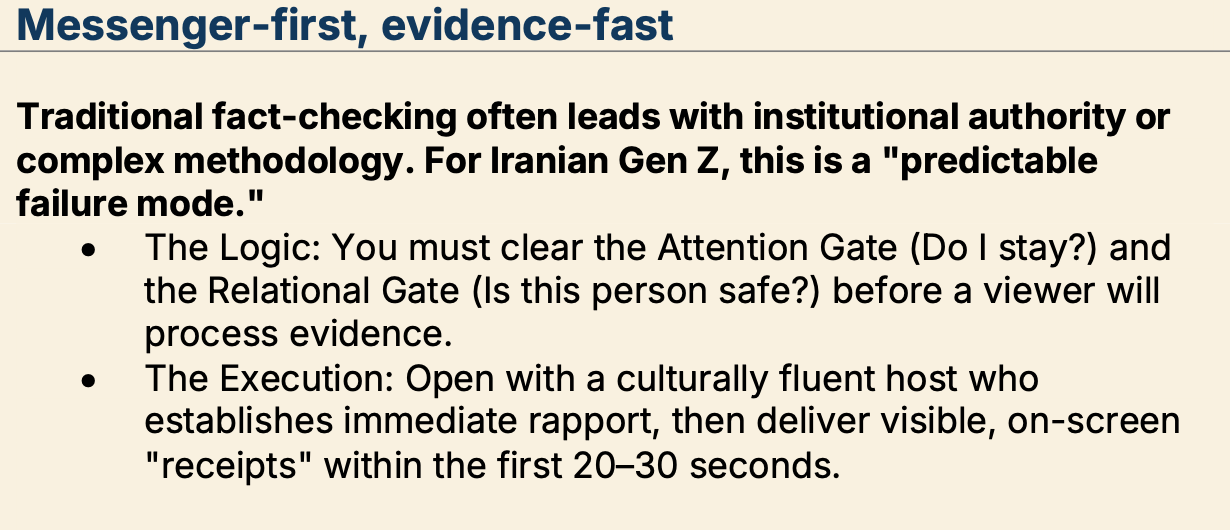
The Journey to Trust framework is our attempt to model that reality in a way that is usable. It is not a moral claim about what people should do. It is a descriptive map of what we repeatedly observed across interviews and survey scenarios: credibility forms through a sequence of gates, and many interventions fail because they speak to the later gates (method, sources, verdict) without first clearing the earlier ones (attention, relational safety, identity fit).
Two clarifications matter for how to read this framework.
First, “trust” here is not a single thing. In practice, viewers often grant a kind of provisional credibility based on relational cues (tone, intent, belonging, familiarity) before they invest the effort required to evaluate evidence. That provisional credibility is fragile. It can be revoked quickly by tone, perceived manipulation, or identity mismatch. Durable belief, by contrast, requires visible receipts that can survive scrutiny and travel across platforms (screenshots, dates, primary-source clips, side-by-sides). This is why we summarize the operational principle as messenger-first, evidence-fast. The purpose is not to replace proof with personality. The purpose is to ensure proof has a chance to land.
Second, the journey is conditional and context-sensitive. People do not move through these stages at the same speed, and they do not start from the same “default.” Prior identity cues, the channel through which the claim reaches them, and their current emotional state can compress or expand the sequence. This matters most during crisis. When uncertainty is high and connectivity degrades, the menu of reachable verification sources shrinks and time-to-decision collapses. In those moments, “verification” often means “checked via the most reachable channel,” not “checked via the best evidence.” The framework therefore does double duty: it explains everyday browsing and it helps anticipate how credibility judgments change when stakes rise.
Finally, this model is meant to be operational, not academic. Each stage corresponds to a design and measurement question:
- Are we earning attention without triggering clickbait distrust?
- Are we establishing relational safety and cultural fluency quickly?
- Are we making evidence visible early enough to convert relational trust into epistemic trust?
- Are we reducing friction so a viewer can check (or share a check) in one step?
- Are we avoiding avoidable distrust triggers tied to tone, ethics, or perceived intent?
What follows is the five-stage pathway itself. Read it as a set of failure modes and leverage points. If a video underperforms, the framework helps diagnose where it likely failed (packaging, messenger, receipts, friction), and therefore what to change first.
Context and identity (trust “defaults”)
Before a viewer even clicks, they bring identity lenses that shape what feels plausible and who feels trustworthy.
Two belonging dynamics operate as “trust accelerators”:
- National belonging: sensitivity to perceived unfair criticism of Iran and high salience of national security narratives. This does not necessarily equal support for the government; it is often framed as loyalty to “people/culture/country.”
- Creator belonging: parasocial closeness to creators and identification with their audience community. This is especially strong for entertainment-first users, where trust can transfer from “I like them” to “I believe them.”
Trust cues that signal “this is for us” or “this person is one of us” can reduce the cognitive cost of listening—especially in the first moments.
A practical way to use this is to assume every piece of content starts with a “default skepticism” that varies by viewer. If the opening visuals, language, and examples signal cultural fluency and good faith, the viewer is more likely to grant a short window of attention. If those cues signal outsider judgment, propaganda, or the wrong “audience,” many viewers never reach the evidence stage, even if the evidence is strong.
Discovery (how the claim reaches them)
Gen Z typically encounters claims through pathways that already carry implicit credibility:
- Algorithmic curation: homepage and recommendations.
- Creator curation: subscribed creators or creator-to-creator recommendations.
- Peer-to-peer relay: friends/family forwarding links or screenshots.
- Active search: more common when there is a specific need.
If discovery is mostly algorithmic or social, content creators must optimize for packaging and retention, not just accuracy.
In practice, that means treating distribution as part of the credibility problem. If a claim arrives via a friend or the recommendation feed, the viewer is borrowing trust from that pathway before they borrow trust from the creator. The job of the packaging and first seconds is to convert that borrowed trust into earned trust by making the purpose obvious and the tone safe enough to keep watching.
Hook (the attention gate)
The “hook” is where most YouTube credibility work begins. It is often pre-evidentiary, based on signals that suggest relevance, usefulness, and authenticity.
Common hooks include:
- Surface hooks: title, thumbnail, description, channel name, visual style.
- Utilitarian promises: “this will help me” (money, safety, clarity, practical tips).
- Recognition hooks: known creator, familiar format, trending topic, or a creator referenced by other creators.
Even high-quality verification can fail if the hook does not quickly communicate what the viewer will get and why it matters now.
A useful mental model is that the hook is a promise, not a trick. Viewers in a high-friction environment do not want to “work” to understand what a video is doing. Clear openings that name the claim, name the stakes, and preview the proof (“here is the clip/date/document we checked”) are more likely to feel trustworthy than suspenseful intros that resemble the formats misinformation videos use.
Trust (how they decide “this is credible”)
Trust formation operates in three effort tiers. Most users start low-effort and escalate only when stakes or emotions rise.
- Relational signals (low effort)
- “Creator vibes”: warm, sincere, authentic tone
- Value alignment: “this creator thinks like me” or “represents who I want to be”
- Story alignment: the video’s worldview “feels right”
- Trust heuristics (medium effort)
- Social proof: likes/comments, audience sentiment
- Reputation cues: track record, perceived experience, institutional affiliation
- Aesthetic cues: professional visuals, confident delivery
- Epistemic cues: mentions data/documents, references to named sources
- Active verification (high effort)
- Cross-checking across multiple sources/platforms
- Checking credentials, dates, documents, original footage
- Validating screenshots or claims via search and reverse verification steps
The most effective design is a layered trust stack: open with a familiar, values-safe messenger to clear the relational threshold, then present visible receipts early so relational trust transfers to epistemic trust.
This framing also explains why “being right” is not enough on YouTube. Many viewers decide whether the creator feels aligned, calm, and competent before they decide whether the claim is true. The goal is to make that first decision easy, then immediately give the viewer something concrete they can recognize and repeat elsewhere (a screenshot, a timestamp, a side-by-side) so the trust does not depend on the messenger alone.
Distrust (how trust breaks)
Distrust is not only about factual error. It also comes from mismatches in tone, ethics, or perceived intent. Common triggers include:
- Epistemic failure: lies, sensationalism, inaccurate framing
- Substance failure: shallow content, inefficiency, lack of depth
- Affective failure: tone that feels aggressive, humiliating, or performative
- Ethical failure: scamming, self-commodification, “betraying the tribe,” perceived manipulation
Some “fact-check style” assets can backfire if they read as patronizing, overly ideological, or optimized for conflict rather than clarity.
Operationally, this means distrust should be treated as a design constraint, not a post-hoc explanation. Even when the facts are correct, viewers can interpret certain tropes (mocking tone, “gotcha” edits, sweeping labels, or moralized language) as signals of bad intent. Formats that stay respectful, show their work, and avoid humiliating opponents tend to keep persuadable viewers in the video long enough for evidence to do its job.
Implication for strategy
- Do not start with “we are a fact-checker.” Start with a relationally acceptable entry: a clear promise, a warm tone, a non-threatening framing.
- Show evidence quickly and on-screen. Viewers need to see why the claim is wrong before they decide to invest attention.
- Design for belonging without partisanship. “Pro-people/pro-safety/pro-community” framing travels farther than overt political positioning.
- Treat distrust as multi-dimensional. Avoid not only factual mistakes, but also avoidable tone/ethics triggers that cause viewers to disengage before the evidence lands.
Five Gen Z archetypes
What we mean by “archetype”
We use the term archetype as a practical label for a repeatable pattern in how people make credibility decisions. In other words, it is less about who someone is and more about how someone tends to behave when they encounter information on YouTube: what gets them to pause, what signals “safe” versus “propaganda,” what kind of proof they need to see, and what makes verification feel worth the effort.
In this report, archetypes are an output of clustering across three measured dimensions (evidence orientation, relational orientation, and patriotic identity salience). They are meant to be operational: if an archetype does not change how we package a video, how fast we surface receipts, or what call-to-action we choose, then it is not doing useful work.
Do not confuse archetypes with personas. A persona is a narrative composite used in design and product work. Personas bundle background, goals, frustrations, and context into a human-readable character. That can be valuable for empathy and alignment, but it can drift into "story time" that is hard to test. Personas can feel persuasive even when they are not anchored in measured behavior.
Personas are often written as people (a lifelike character you can imagine), while archetypes are defined as decision patterns (a behavioral template you can design and measure against). A person can match different archetypes depending on topic, emotional state, and context (especially during crisis), which is why we treat archetypes as defaults rather than fixed identities.
A central output of Phase I was a data-driven segmentation of Iranian Gen‑Z YouTube users into five archetypes. These archetypes summarize how trust is formed, specifically whether trust is primarily relational (creator/community/identity cues) or evidence-based (documents, verification, observable proof), and whether users’ worldview is strongly shaped by patriotic/national belonging cues.
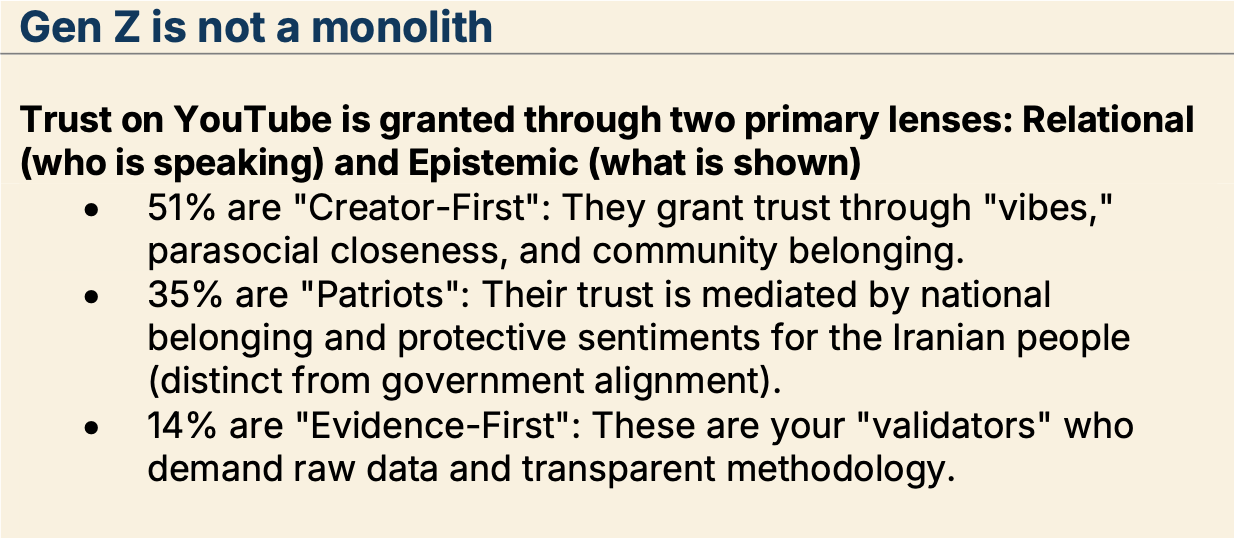
How the archetypes were derived
We translated qualitative themes into three standardized indices used for clustering:
- Evidence orientation (preference for verifiable proof and documentary-style receipts)
- Relational orientation (parasocial/community cues, “this creator is one of us,” creator mentorship)
- Patriotic identity salience (in-group sourcing on national security topics, sensitivity to narratives about Iran/defeat, etc.)
We then applied a k-means clustering approach to group respondents into a small set of interpretable segments. Archetypes should be read as behavioral templates that people tend to default to; they are not fixed identities and can shift by topic, emotional state, and context, especially during crisis.
Archetype overview
|
Archetype |
Share of Gen‑Z |
Self-reported verification rate |
Trust basis (dominant) |
Patriotism (salience) |
|
Creator-first /
Cosmopolitans |
51% |
34% |
Relational |
Low |
|
Mixed-cues / Patriots |
18% |
81% |
Mixed |
High |
|
Creator-first / Patriots |
17% |
84% |
Relational |
High |
|
Evidence-first / Cosmopolitans |
9% |
61% |
Evidence |
Low |
|
Evidence-first / Patriots |
5% |
76% |
Evidence + identity
(hybrid) |
High |
Archetype profiles and what they imply for strategy
- Creator-first / Cosmopolitans (51%)
This is the largest segment and also the lowest-verification group. They tend to build trust through familiar creators, “vibes,” and community belonging, often in entertainment-first contexts (gaming, comedy, lifestyle). They are also the most exposed to the “entertainment-to-politics” pathway, where political opinions embedded in non-political content can be persuasive via parasocial trust transfer.
In practice, this archetype optimizes first for whether a video feels worth attention and whether the messenger feels socially “safe” and familiar. Credibility is often borrowed from parasocial closeness and format fluency, which means a fact-check can fail before evidence is even processed. The most common failure mode is tone and sequencing: if the opening feels like institutional lecturing, moralizing, or slow context-setting, many viewers exit before any receipts appear. For this segment, the most reliable way to preserve both attention and credibility is to treat the host as the vehicle through the first gate, and then surface a concrete, on-screen receipt quickly enough that the viewer does not have to “trust us” in order to keep watching.
Implication: This segment is the primary risk surface for misinformation. Interventions must be host-led and emotionally legible, with visible evidence very early (e.g., within the first 20–30 seconds), and with downstream asks calibrated to realistic behavior. In our survey patterns, many viewers’ maximum willingness-to-act is private and low-effort, so prompts like saving, screenshotting, or sending to one friend are more plausible than expecting wide public sharing.
- Creator-first / Patriots (17%)
This group also uses relational trust, but it is anchored in national belonging and protective sentiment around Iran’s people/culture (not necessarily government-aligned). Despite being creator-first, they report very high verification, suggesting that identity salience can motivate checking when stakes feel national or communal.
The key nuance is that identity here is often read as “for our people” rather than “for the state,” and that distinction drives what feels trustworthy. They tend to scan quickly for intent: whether the messenger seems protective, fair, and culturally fluent, or whether the framing feels humiliating, contemptuous, or “against Iran.” At the same time, they can be suspicious of state-coded tone and rhetoric; content that resembles propaganda can trigger the same distrust as outsider judgment. This creates a narrow but usable lane: protective, government-neutral framing paired with fast, visible proof.
Implication: They can become amplifiers for fact-checking content when messaging is framed in government-neutral patriotic language (“for our people,” “protect our city,” “don’t let rumors harm Iranians”), paired with quick receipts. When asking for action, the most plausible conversion is community-protective forwarding into close networks (especially family groups), rather than broad performative sharing.
- Mixed-cues / Patriots (18%)
This segment tends to require both a credible messenger and some proof. They are comparatively balanced: neither purely creator-led nor purely evidence-led, but still strongly patriotic. Verification is high.
Behaviorally, they function like a two-key system. A socially safe messenger can earn the initial listening window, but it does not substitute for proof; conversely, proof without a culturally legible, good-faith entry can feel cold or suspicious in a high-manipulation environment. They typically respond best when the “messenger-first, evidence-fast” logic is executed as a sequence: the opening names the claim and stakes in a calm, respectful register, then moves rapidly into visible receipts, and only then explains method in a way that the viewer can repeat.
Implication: For them, the optimal design is “warm host + receipts + sources.” They respond well to content that feels culturally aligned but also demonstrates method (showing how the claim was checked). In practice, this often means adding a short “how we checked” module after the first receipts, and providing a one-step verification route via pinned sources so their high verification intent is not blocked by friction.
- Evidence-first / Cosmopolitans (9%)
These users lean toward proof-first evaluation and are less driven by patriotic identity cues. They verify at moderate-to-high rates and often function as “validators” in their networks—people who want to see how the conclusion was reached.
They optimize for traceability and internal consistency. Packaging that resembles clickbait, suspense, or rumor-content conventions can lose them quickly, because ambiguity reads as manipulation. They are also the segment most likely to punish “trust us” claims that are not backed by on-screen artifacts. When the proof is clear and the pathway is legible, they can become an informal infrastructure for correction in peer networks: the person others consult, or the person who wants the timestamp, original clip, or document.
Implication: This is the best fit for transparent methodology, source packs, and “show your work” segments. They are also a good target for making Factnameh’s verification process legible and repeatable (templates, step-by-step checks). Calls to action should align with their validator role, such as prompting them to use the pinned sources or to reuse a specific receipt in a reply, rather than assuming they will share widely.
- Evidence-first / Patriots (5%)
This is the smallest segment, combining high patriotic salience with a demand for evidence. Notably, they may still take limited post-watch action unless prompted (i.e., verification doesn’t automatically convert into sharing/correcting behavior).
This archetype is best understood as a hybrid constraint rather than a midpoint. They want strong documentation, but they also read for identity safety and intent. Evidence that is technically strong can still underperform if it is wrapped in framing that feels anti-Iranian or contemptuous toward ordinary people. They are also sensitive to overconfidence in fast-moving situations: when uncertainty is real, performance of certainty can feel like manipulation. Even when convinced, they may default to private updating rather than visible correction unless the next step is explicitly pro-social and easy to execute.
Implication: Pair strong proof with explicit pro-social prompts (“send this to protect your family/community”), and make the next step unambiguous (what to do, where to share, what to say). A clear “what we know / what we don’t know yet” posture can preserve trust in crisis contexts while keeping the tone distinctly non-state and non-humiliating.
Implication for strategy
Across the study, the archetypes explain why the same fact-checking style will not land equally well across Gen‑Z. The majority segment is creator-first/cosmopolitan, meaning that YouTube trust often begins relationally; meanwhile, the patriot segments (collectively 40%) show higher verification but require framing that resonates with identity and perceived stakes. Evidence-first segments (collectively 14%) create an opportunity for method-forward content—while still benefiting from strong packaging and early clarity.
These archetypes directly inform Phase II decisions on messenger selection, opening seconds, evidence timing, CTA design, and cross-platform distribution.
Verification behavior: What drives checking
Verification is not a default behavior for Iranian Gen Z in our data. It is a conditional behavior that activates when something raises stakes, uncertainty, or emotion. In day-to-day YouTube browsing, many respondents operate with a “good enough” trust heuristic (creator familiarity, social proof, vibe), and only switch into explicit checking when a piece of content feels consequential, confusing, or personally activating. Under censorship and volatility, this makes sense: verification is work, and the menu of reachable sources is often constrained.
1. “Hot” emotions are the strongest behavioral trigger
Across the conflict case study and final survey patterns, high-arousal emotions were most likely to push users into verification mode.
- Anger is the most reliable driver of checking. In the conflict survey regression, compared to anger:
- Skepticism was associated with roughly a 92% reduction in the odds of verifying (highly significant).
- Curiosity and sadness also reduced the likelihood of checking (significant, but smaller effects than skepticism).
- Fear appeared motivating in descriptive results, but did not remain statistically stronger than anger once other factors were controlled.
Interpretation: Verification is often an activation response, not a purely rational one. Anger tends to create a sense of urgency (“someone is lying”, “this is unacceptable”), which pushes people to seek confirmation fast. “Cooler” states—skepticism (“this is probably false”) or curiosity (“interesting”)—can reduce urgency. People may dismiss and move on rather than spend limited time checking.
Contextual note: High-arousal content is also more likely to circulate rapidly in private networks (family groups, close friend groups). That social relay adds pressure to resolve uncertainty quickly, which can further increase the impulse to verify when the emotion is mobilizing.
2. Feeling informed correlates with verification
Respondents who reported feeling well-informed were substantially more likely to verify rumors (approximately 3.7× higher odds in the conflict survey model). This likely reflects a reinforcing loop:
- People who verify more often build a larger “toolbox” of sources and routines, so verification feels feasible.
- People who feel informed are more confident navigating where to look and how to interpret what they find.
Interpretation: Verification is partly an efficacy skill. It is easier to check when a person already knows which sources are reachable, which channels are reliable, and what “good evidence” looks like.
Design implication: A fact-check is not only a verdict. It can also be a short training moment that increases perceived self-efficacy (“I can do this next time”), which makes future verification more likely.
3. The main reasons for not checking are practical, not ideological
Among Gen Z respondents who did not verify a rumor in the final survey, the leading reasons were:
- Don’t know how or where to verify: about 29%
- Didn’t think it was important in the moment: about 26%
- Didn’t have time: about 25%
Interpretation: Non-verification is often a friction story: lack of time, lack of know-how, or a quick “triage” decision that something is not worth the effort. This matters because it suggests a large persuadable middle: people are not necessarily rejecting verification, they are declining it because it feels costly or pointless.
Contextual note: In Iran (any many other places), “where to verify” is not always obvious. Sources can be blocked, loading can be slow, and some forms of searching feel risky. That raises the “activation energy” of checking, even when the intent exists.
4. Archetypes strongly relate to verification rates
Verification rates vary sharply across the five Gen Z archetypes:
- Creator-first / Cosmopolitans (majority segment) have the lowest self-reported verification rate (about 34%).
- The three Patriot archetypes verify at high rates (roughly 76%–84%, depending on subtype).
- Evidence-first segments verify at moderate-to-high rates, but do not automatically translate verification into visible onward action.
Interpretation: Archetypes shape the default trust posture (who feels credible) and the perceived stakes (what feels worth checking). Patriotic identity salience appears to increase verification when a claim is framed as affecting “our people”, “our city”, or national dignity. Meanwhile, creator-first segments are more likely to accept information through social/parasocial trust pathways unless something sharply raises stakes.
5. Even after a strong fact-check, most behaviors are low-effort
When asked what they do after watching an excellent fact-checking video, Gen Z most often selected:
- Like: about 43%
- No action: about 25%
- Share: about 19%
- Comment: about 5%
Interpretation: For many viewers, the “conversion” is internal and private: updating beliefs, feeling calmer, or knowing what to say if the rumor comes up again. Public behaviors (sharing, commenting, correcting others) are a higher social-cost action, and are therefore rarer by default.
Contextual note (social risk): In polarized or surveilled environments, visible correction can create interpersonal conflict or perceived risk. This likely pushes correction behaviors further toward private channels (one-to-one sends, family groups) instead of public comments.
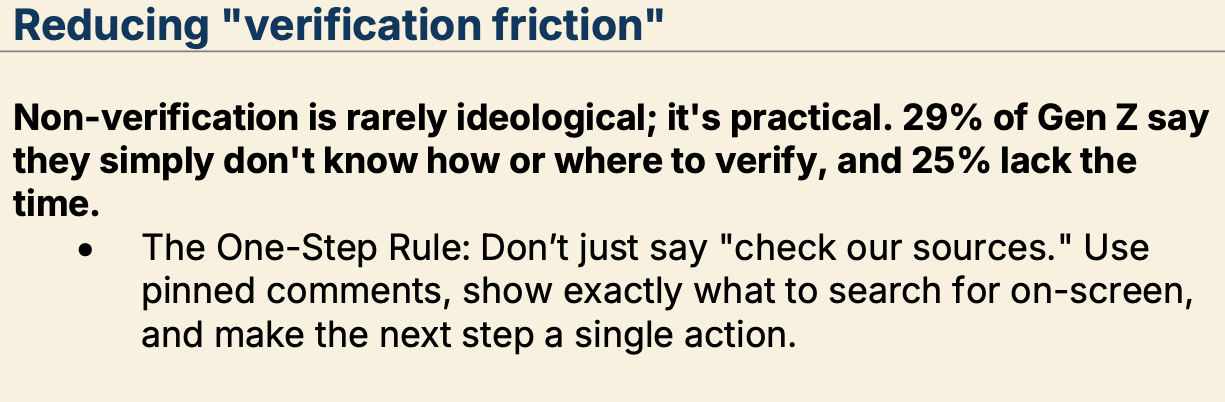
Implication for strategy
- Design for hot states: prioritize rumors that evoke anger/fear; open with stakes and deliver verification fast.
- Reduce verification friction: make the “where/how” explicit (on-screen receipts, pinned links, step-by-step “how we checked” module).
- Use segment-sensitive calls to action:
- For low-sharing segments, prompt “save” or “send to one person” rather than “share widely.”
- For high-verification Patriot segments, emphasize pro-social, community-protective action (“share to protect others”).
Crisis dynamics during Iran–Israel conflict
A major geopolitical shock during fieldwork created a “stress test” for our core questions about information seeking, trust, and rumor verification. The Iran–Israel conflict that in June 2025 coincided with periods of disrupted connectivity inside Iran, forcing participants to navigate high uncertainty under constrained access. We captured these behaviors through a rapid Telegram-based instrument designed for low time and low bandwidth conditions.
What the crisis changed in the information ecosystem
- Platform priorities shifted away from YouTube toward faster, more accessible channels. In the conflict case study, YouTube was rarely the first destination for updates. Only 4% reported using YouTube for conflict updates, while TV/Radio, Telegram, and Instagram dominated. This indicates that during acute crises, YouTube’s role is less “live updating” and more likely “later explanation/archiving,” especially under filtering and throttling conditions.
- Access constraints became the primary driver of “feeling uninformed.” Among respondents who did not feel well-informed, the dominant reasons were structural rather than motivational. Reported barriers centered on:
- Internet instability and outages
- Blocking and censorship
- Difficulty identifying reliable sources
- Information overload
In aggregate, connectivity and censorship-related barriers were reported by a clear majority of those who felt poorly informed, underscoring that crisis information needs are shaped as much by infrastructure and governance as by user preference.
- What rumors “worked” in a crisis: dominant threat frames
Rumors that participants recalled clustered around proximate, high-stakes threats—claims that implied immediate danger to self, family, or national symbols. The most recurrent rumor families included:
- Personal proximity threats: “My city/loved ones are being attacked.”
- Catastrophic escalation threats: “A nuclear strike is imminent.”
- Symbolic leadership threats: “The leader is targeted/killed.”
- National status threats: “Iran has been defeated.”
- Strategic capability threats: “Nuclear facilities have been attacked.”
Across these categories, high salience was consistently linked to perceived immediacy and high consequence, rather than to technical plausibility.
Verification behaviors under stress
- Rumor attention was emotion-led, and emotions were tied to the threat frame.
Participants’ reactions to rumors followed a predictable pattern: more “proximate” threats tended to elicit fear/anxiety and drive urgent information seeking; symbolic or identity-linked threats often elicited anger; more abstract narratives were more likely to trigger curiosity or generalized uncertainty.
- Verification was often routed through whatever sources remained most reachable.
Under crisis conditions, verification frequently relied on the most accessible channels, including broadcast media and widely available Telegram-based sources.
This matters because it means “verification behavior” does not necessarily imply “high-quality verification”; it can reflect constrained choice within a limited menu of reachable outlets.
Net effect: a crisis compresses the information journey
Under normal conditions, Gen Z’s “journey to trust” on YouTube is a multi-step process with room for hesitation, comparison, and backtracking. A viewer can see a claim, decide whether to click, watch long enough to read tone and intent, and then (optionally) verify through a mix of reachable sources. The sequence contains multiple “off-ramps,” including the option to simply delay judgment until more information arrives.
During the Iran–Israel conflict, that sequence compressed into a shorter, more brittle pathway. The key shift is not only psychological (higher arousal). It is also infrastructural (reachability) and social (relay through trusted networks). When uncertainty spikes and connectivity degrades, audiences have less time, fewer reachable sources, and stronger pressure to resolve the question quickly.
We observed four compression dynamics that are operationally relevant:
- Time-to-decision collapses. In crisis, the primary decision is often not “Is this true?” but “What do I do with this right now?” (ignore, forward, seek confirmation, or act). The attention window narrows, and content that requires slow context-building has less chance to land. This reduces tolerance for long introductions and pushes people toward channels that deliver updates fast.
- Emotion increases urgency, but narrows cognition. High-arousal emotions (especially fear and anger) increase the probability that people will try to verify, but they also reduce capacity for careful evaluation. In practice, this produces a demand for quick, confidence-providing cues: a familiar source, a plausible explanation, or a concrete piece of evidence that can be understood at a glance.
- Platform choice becomes constrained triage. Under filtering and degraded connectivity, “best source” is often replaced by “reachable source.” The crisis case study shows that YouTube was rarely a first destination for updates; audiences prioritized faster, lighter channels and broadcast media. In this mode, YouTube’s comparative advantage shifts: it functions less as a live wire and more as an explainer or archive layer that people may consult later (if they can access it) to make sense of what happened.
- Verification becomes a proxy for reachability. When the verification menu shrinks, verification behavior can still occur, but it is routed through whatever sources remain accessible. This creates an important interpretive risk: a person can report “I checked” while the check itself is low-quality or circular (e.g., confirming a claim by seeing it repeated across multiple Telegram channels). Under compression, repetition and social proof can masquerade as corroboration.
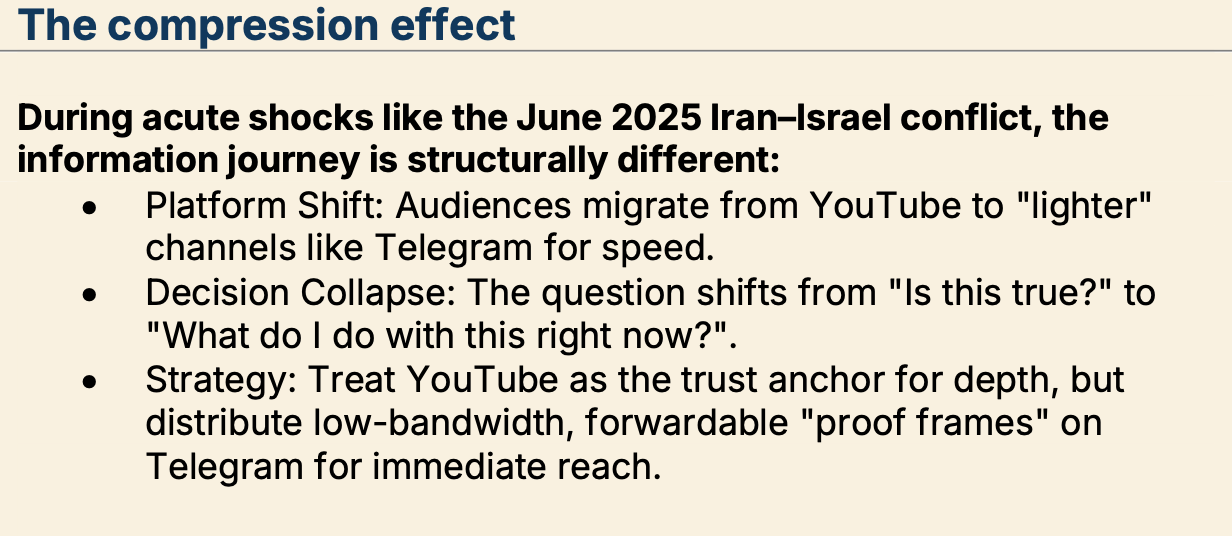
The practical implication is that crisis response cannot be designed as “YouTube-only,” even when YouTube is the flagship channel for depth and documentation. Crisis moments (when misinformation risk spikes) push people toward Telegram, Instagram, and broadcast channels first, with YouTube playing a secondary role.
Operationally, this means the resilience strategy should treat YouTube as the trust anchor (canonical explanation, receipts, and updates), while simultaneously producing low-bandwidth, forwardable assets that travel where the audience actually is during a shock: screenshot-friendly proof frames, short text summaries with clear “what we know / what we don’t know yet,” and one-step links or keywords that allow a user to verify without leaving the channel they are already using.
Demand-side YouTube creator analysis
Competitive reality check: Gen Z’s attention market is creator-native
- For Gen Z respondents, top-of-mind YouTube reference points cluster in gaming/entertainment and creator-persona channels, not in news brands.
- As a result, Factnameh’s effective competition for attention is often not other fact-checkers. It is creator-native formats that win on pace, personality, and editing language.
- Implication for implementation: packaging and the first 20–30 seconds must clear the attention gate on creator terms (clarity, momentum, culturally fluent tone), while keeping evidence standards constant.
To ground Phase II strategy in the real attention environment, we mapped the Persian-language YouTube ecosystem as it surfaced organically in Phase I. This snapshot reflects which channels Gen Z respondents spontaneously recalled when asked about what they watch and who they trust. The goal is practical: identify the creator-native reference points that shape attention and credibility on YouTube, where trust is often granted through familiarity and “vibes” before evidence is processed.
Data source and interpretation caveats
The mention counts below come from the open-ended question in the Phase I survey. Counts reflect raw mentions. They should be interpreted as salience in respondent recall, not population reach or watch-time share. Because open-ended recall tends to privilege entertainment and highly familiar creators, these results are best used to inform packaging, messenger selection, and entry points, not as a definitive market share estimate. Detailed methodology notes and full tables are included in appendix F.
Top recalled YouTube channels among Gen-Z
In Gen Z recall, creator-native entertainment and gaming channels appear as primary anchors. News brands are not the dominant spontaneous reference point in this list, consistent with our broader finding that YouTube credibility often begins relationally (creator-first) rather than institution-first.
|
Rank |
Channel (Persian /
Latin) |
Mentions (Gen Z) |
Primary content role
(observed) |
|
1 |
پوریا پوتک / Pooria Putak |
8 |
Music + creator-persona (often culturally salient) |
|
2 |
آریا کئوکسر / Aria
Keoxer |
6 |
Gaming + entertainment |
|
3 |
میا پلیز / MiaPlays |
5 |
Gaming + entertainment |
|
4 |
کومان / Komaan |
4 |
Entertainment / variety |
|
5 |
نیما تکیدو / Nima Tikido |
4 |
Entertainment / reaction / talk style |
|
6 |
میکی کلافه / Miki
Kalafe |
3 |
Entertainment (creator-led) |
|
7 |
عشق ابدی / Eshgh Abadi |
3 |
Entertainment / series-style content |
|
8–15 |
Vafa4, Saeed Valkor, Amir Tataloo, Mr Oneshot, Onten, Kourosh,
Benyamin BE, Lil Rahzad, RahzadX, Moravekh |
2 each |
Mixed: entertainment, gaming, commentary, music |
Top recalled YouTube channels (All ages)
Across all ages, recall shifts sharply toward diaspora news brands and large-format “TV-like” channels, suggesting either broader reliance among older respondents, or that these brands have higher top-of-mind salience in politicized contexts.
|
Rank |
Channel / brand |
Mentions (All ages) |
Notes |
|
1 |
Iran International |
58 |
Dominant diaspora news brand in recall |
|
2 |
BBC Persian |
31 |
Legacy credibility brand |
|
3 |
Manoto |
25 |
Entertainment-news hybrid brand |
|
4 |
Kocheh |
21 |
High recall; needs category labeling in appendix |
|
5 |
Pooria Putak |
14 |
Cross-age creator salience |
|
6–8 |
MrBeast / Onten / Factnameh |
9 each |
Factnameh is recallable cross-age, not Gen Z top |
|
9 |
Tunnel Zaman |
8 |
Long-form / themed programming |
|
10–12 |
Avaye Falsafeh / Komaan / Chizomiz / Max Amini |
7 each |
Mix of philosophy/variety/entertainment |
Learnings
- Gen Z’s YouTube reference points are predominantly creator-native. In open recall, Gen Z’s anchor channels cluster in gaming, variety, music, and creator-persona formats. In other words, the default “language” of YouTube for this cohort is creator-native: fast pacing, familiar editing tropes, and a parasocial relationship that makes a viewer feel they already know the host. This matters operationally because it sets the baseline expectation against which Factnameh’s content will be judged. Even if the topic is serious, the attention gate is often cleared (or failed) on creator terms: a quick promise, a recognizable vibe, and immediate clarity about what the viewer will get.
- What this implies for future implementation: treat creator-native craft as table stakes. Scripts should assume low patience for slow context-building, and should move to the first concrete receipt quickly. The “messenger-first, evidence-fast” sequence is not just a trust choice; it is a competitive adaptation to the dominant formats that Gen Z already watches.
- How to use this insight without changing evidence standards: keep the verification work rigorous, but package it with creator-grade momentum (tight openings, direct language, early visuals, and a host tone that reads as mentorship rather than instruction).
- News brands remain salient, but they are not Gen Z’s default entry door. Across all ages, recall shifts toward large diaspora news brands and TV-like channels (Iran International, BBC Persian, Manoto). Among Gen Z, those brands appear far less often as spontaneous reference points. That gap does not mean Gen Z never consumes news on YouTube. It suggests that “news-brand YouTube” often functions as a second step (confirmation, catch-up, or long-form explanation) rather than the first click when a viewer opens the app. The competitive set for Gen Z attention is therefore less “other fact-checkers” and more the creators that dominate everyday YouTube use.
- What this implies for future implementation: do not assume that looking like a news brand will be a credibility advantage at the hook stage. For many Gen Z viewers, “news-like” packaging can read as slow, formal, or institution-first, which increases drop-off risk before the evidence appears.
- Operational translation: design the entry so it can win in a creator-native feed (browse/suggested) while still being legible as verification content. Titles and thumbnails should make the function explicit (this is a check, here is the claim, here is the proof direction), and the first 20–30 seconds should earn attention before the viewer decides whether Factnameh is “for them.”
- Cross-platform implication: because Gen Z’s everyday attention anchors are not news brands, Factnameh should plan for routing: use creator-native hooks to win the first click, then provide assets that can travel into private networks (screenshots, short receipts, pinned sources) where “trust” often becomes social rather than institutional.
Outcomes
Phase I: Research and strategy development
Quantitative deliverables
|
Indicator |
Target |
Achieved |
|
Number of respondents to the audience research survey |
300 |
Conflict survey: 584 |
|
Final survey: 768 (<28), 2059
(all ages) |
||
|
Number of interviewees participating in the audience research |
12 |
Human interview: 7 |
|
AI interview: 140 (additional) |
Note: Survey counts reflect usable completions from two separate Telegram-native instruments and are not deduplicated across waves due to identifier constraints.
Strategic deliverables
|
Output |
Strategic value |
Output location |
|
Journey to Trust model |
Corrects sequencing errors in YouTube fact-checking by showing
attention and credibility precede evidence evaluation |
Key Findings: The Journey to Trust Framework |
|
Five archetypes with prevalence |
Enables segmented programming and prevents ineffective
one-size-fits-all content |
Key Findings: Five Gen Z archetypes |
|
Crisis case study findings |
Validates trust and verification patterns under high-stakes,
high-misinformation conditions |
Key Findings: Crisis dynamics during Iran-Israel conflict |
|
Playbook, experiment backlog with
hypotheses and metrics |
Translates strategic insights into testable, measurable programming |
Playbook |
Phase II: Implementation and testing
Phase II programming was not executed within the project period due to capacity and external events. Consequently, performance indicators tied to YouTube audience growth and engagement during months 7–12 are not measurable in this reporting period.
The project concludes with an execution-ready implementation package, including content formats, experiment protocols, and crisis workflow specifications, that enables Factnameh to launch pilot programming and begin measurement immediately upon resourcing.
Original outcome indicators (as proposed)
|
Indicator |
Target |
Status |
Reason |
|
% of YouTube views from under-25s (last 6 months) |
25% |
Not measurable |
Phase II not implemented |
|
# of under-25 YouTube views (last
6 months) |
36,000 |
Not measurable |
Phase II not implemented |
|
Average % viewed on videos under new strategy |
80% |
Not measurable |
Phase II not implemented |
|
% of Gen Z feedback providers who
find content relevant |
60% |
Not measurable |
Feedback stage not conducted |
Implications and strategy changes
Updated theory of change
The central outcome of Phase I is a fundamental correction to the theory of change driving engagement with Gen Z. The core shift is from a distribution-led model ("get the correction in front of them") to a mechanism-led model ("clear the gates that make evidence readable and usable").
The traditional assumption in fact-checking is a "deficit model": it assumes that if an organization publishes an accurate correction, the primary constraint is reach. The implied pathway is linear: distribution → exposure → evidence processing → belief update → sharing. In a filtered, high-friction environment, that pathway breaks early and often.
Our research indicates that this model is insufficient for Iranian Gen Z. Credibility is not a single test of facts. It is a sequential journey shaped by:
- Attention scarcity and high competition (the feed is creator-native, and the first seconds are decisive).
- Identity and intent inference (viewers rapidly judge whether a messenger feels safe, culturally fluent, and "for us").
- Friction constraints (VPN, bandwidth instability, and limited time/know-how change what "verification" is realistic).
In practice, the key barrier is not only access to true information. It is clearing two early gates that precede evidence evaluation:
- The attention gate: “Do I pause?”
- The relational gate: “Is this messenger safe, relevant, and acting in good faith?”
Only after those gates are cleared does evidence reliably have a chance to land. That is why the project’s corrected theory of change is operational, not philosophical: it describes what has to be true for proof to be processed at all.
Operational theory of change: "Messenger-First, Evidence-Fast”
This is the project’s operational “engine.” It turns the Journey-to-Trust finding into a publishing and production sequence that can be executed repeatedly, reviewed, and improved. The core claim is simple: evidence does not compete in the same arena as the scroll. If attention is lost, and if intent is misread, the proof never reaches the viewer’s working memory. So the job of the format is to clear two early gates (attention and relational safety) without diluting rigor, and then to make proof visible fast enough that belief can transfer from the messenger to the method.
- Earn attention
Attention is not a neutral precondition. It is a gate with its own failure modes. In a creator-native feed, viewers make an immediate judgment about whether a video is relevant and legible. If the opening feels slow, abstract, or genre-confusable ("is this a rumor video or a fact-check?"), many people exit before any verification happens.
- Use clear hooks that name the claim and the stakes in plain language.
- Make the function obvious quickly: this is a check, and there will be receipts.
- Avoid ambiguity and intrigue-first openings that resemble misinformation formats.
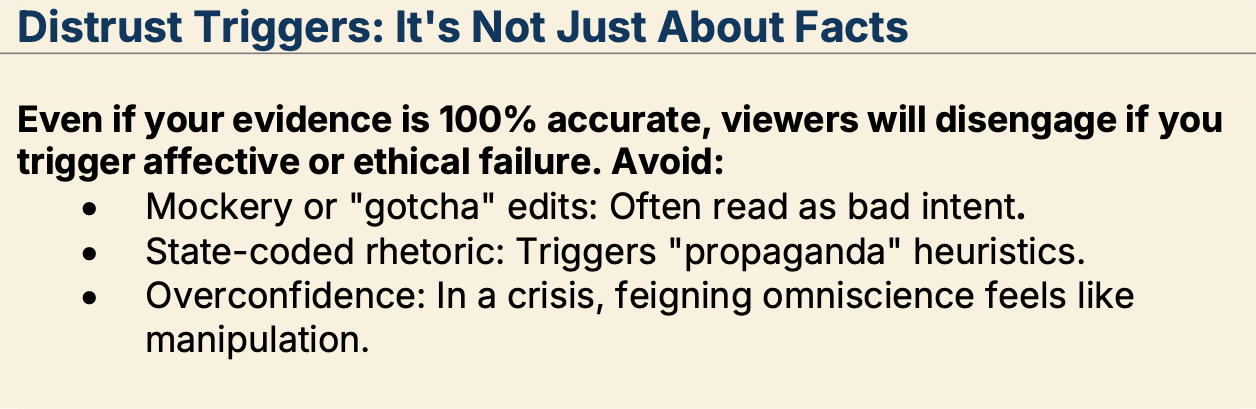
- Establish relational safety
Relational safety is the “permission” layer: the viewer decides whether the messenger feels culturally fluent, fair-minded, and worth listening to. In low-trust environments, tone and perceived intent are interpreted as evidence. If the messenger reads as patronizing, ideological, propagandistic, or contemptuous, viewers often do not stay long enough to see proof, even when the proof is strong.
- Lead with a human entry that signals good faith and relevance (“we’re here to protect people from harm/rumors,” not “we’re here to scold”).
- Use a respectful, non-humiliating tone that keeps persuadable viewers in the video.
- Treat distrust triggers (mockery, overconfidence, state-coded rhetoric, outsider contempt) as design constraints, not after-the-fact explanations.
- Deliver visible proof
This is the conversion point: once the viewer grants a listening window, the content must quickly replace “trust me” with “see this.” The purpose is not to rush to a verdict, but to surface observable artifacts early enough that the conclusion feels anchored in reality, not personality.
- Move fast to on-screen receipts (documents, dates, side-by-sides, original clips, geolocation, satellite, etc.).
- Prefer proof that is legible at a glance and can travel across platforms (screenshots, timestamps, a single key visual).
- Structure the story so the viewer could repeat the proof pathway to someone else (“here’s what they showed, here’s what we checked”).
- Reduce friction
Even convinced viewers may not act if the next step is costly. In Iran’s constrained environment, “verification” competes with bandwidth, blocks, time, and know-how. So a fact-check that ends with “check the sources” without making that check easy can fail its own conversion.
- Make verification a one-step action: show what to search, where to click, and what to look for.
- Assume limited time and unstable access; design the verification path to work under constraint.
- Where possible, offer a single, clear “do this now” move rather than a menu.
- Segmented action
A strong fact-check does not automatically produce sharing or public correction. Most downstream behaviors are low-effort and private. The goal is to ask for the smallest action that meaningfully increases safety and reduces rumor spread for that archetype.
- Prompt realistic, low-social-cost actions matched to how different viewers behave.
- Examples: “save this” or “send to one friend” for creator-first cosmopolitans; “forward to protect your community” for identity-salient patriots; “use the pinned sources” for evidence-first validators.
Transferability: Beyond Iran, Gen Z, and YouTube
While this work is grounded in Iran’s specific constraints (filtering, VPN friction, uncertainty shocks, and a distinct relationship between national belonging and the state), the mechanisms we observed are not Iran-only. The core transferable idea is that credibility is often a sequence of gates on video-first platforms, and most fact-checking and media literacy interventions fail when they optimize for the later gates (method, sources, verdict) without first clearing the earlier ones (attention, intent, relational safety).
Transferability is therefore best understood as two layers:
- What transfers as-is: the structure of the trust journey, and the operating logic that turns it into repeatable production decisions.
- What must be localized: the content of identity cues, the platform routing map, and the risk and reachability constraints that determine where people can actually verify.
Note on language: In this report, when we refer to “framing,” we mean the way a correct claim is presented (hook, tone, host, pacing, and call to action) while keeping evidentiary standards constant.
Reusable framework elements (high transfer)
- The Journey-to-Trust sequence (as a diagnostic tool)
The model transfers because it maps how people actually process video under attention scarcity: first they decide whether to pause, then whether the messenger feels safe and relevant, and only then do they invest effort in evidence.
- Why it transfers: on most platforms, the viewer’s first decision is not “true/false.” It is “stay/leave.”
- How to apply elsewhere: use the stages as a post-mortem template. When a piece underperforms, ask: did it fail at packaging and attention, at intent/relational safety, at evidence legibility, or at friction to verify?
- “Messenger-first, evidence-fast” (as a format principle)
The principle is transferable across YouTube, TikTok, Reels, Shorts, and even messenger-native video because it solves a universal problem: evidence cannot compete with the scroll unless it appears early and visibly.
- What transfers: a human, culturally fluent entry that avoids distrust triggers, followed by on-screen receipts early enough to convert relational trust into epistemic trust.
- What it prevents: “authority-first” openings that lose persuadable viewers before the proof arrives.
- Receipts as the unit of transfer (proof that travels)
A key transferable insight is that the most useful proof is not “we checked.” It is a reusable artifact a viewer can carry into another platform or a private conversation.
- Examples: one screenshot with date and source, a timestamped clip, a side-by-side, a clear geolocation frame, a short “what to search” instruction.
- Why it transfers: cross-platform spread is the norm. Even in open environments, corrections often move through group chats and reposts rather than through original links.
- Audience archetype logic (behavioral, not demographic, segmentation)
The specific clusters will differ, but the segmentation logic is widely reusable:
- Relational-first vs. evidence-first trust defaults.
- Identity-salient vs. identity-light audiences (where “identity” might be national, partisan, religious, local, or subcultural).
- Why it transfers: these axes describe decision patterns, not Iranian politics.
- Operational use: keep evidence standards constant while adapting hook, host tone, framing, and CTA to the dominant trust posture.
- Friction-aware verification design
Even in freer media environments, verification is often bounded by time, know-how, and attention, not only by ideology.
- Transferable rule: treat the verification step like a product funnel. If it takes more than one or two clear actions, most viewers will not do it.
- Implementation: show exactly where to look and what to type, and make the “first check” possible without leaving the platform whenever feasible.
- Experimentation as governance (not as growth hacking)
The testing discipline transfers to any newsroom or integrity team trying to move from “publish and hope” to measurable learning.
- Transferable approach: a small set of high-leverage tests (evidence timing, host tone, title framing, CTA variants) with clear primary metrics and guardrails.
- Why it matters: the same piece of evidence can succeed or fail based on packaging, sequencing, and friction—not only editorial choice.
Context-specific dynamics (adapt before applying)
These findings transfer best when teams explicitly re-map the local environment rather than copy the Iran-specific wrapper.
- Platform routing map (what people use first, second, and last)
In Iran, crisis pushes audiences toward the most reachable channels, and YouTube becomes a secondary explainer/archive layer. Elsewhere, the “crisis routing” may look different.
- In some contexts, TikTok or WhatsApp may be the primary crisis layer.
- In others, local radio or Facebook groups may dominate.
Adaptation task: document the “first destination” platforms for everyday browsing vs. crisis moments, and design your correction assets to match.
- Identity cues and polarization codes
Iran’s “patriotic but not state-aligned” lane is not universal. In many environments, patriotic framing is strongly partisan, and “in-group” cues can polarize as much as they persuade.
Adaptation task: identify which identity frames function as safety and good-faith cues for persuadable audiences, and which trigger backlash or immediate dismissal.
- Safety, surveillance, and reputational risk
Iran shaped recruitment, anonymity, and the preference for low-social-cost actions (private forwarding over public correction). In other contexts, the risks might be different (harassment, doxxing, employment risk, social conflict).
Adaptation task: treat “what a viewer is willing to do” as context-specific, and design CTAs that respect the local social-risk landscape.
- Reachability constraints (blocked sites vs. attention constraints)
Even where the internet is open, the analog of “blocked platforms” may be paywalls, app switching costs, low bandwidth, or low trust in mainstream institutions.
Adaptation task: define the dominant friction (technical, economic, literacy, or trust) and redesign verification steps accordingly.
Practical transfer checklist (how to port the model responsibly)
- Step 1: Map the local journey to trust (what earns attention, what triggers distrust, what counts as “proof”).
- Step 2: Rebuild a messenger-first, evidence-fast prototype in the local platform language (pace, visuals, humor, norms).
- Step 3: Define “receipts” that can travel in your ecosystem (screenshots, short clips, search keywords, one-card summaries).
- Step 4: Segment by trust posture (relational vs evidence) and identity salience, then calibrate CTAs to realistic actions.
- Step 5: Run a small experiment set and use retention, source-clicks, and low-friction actions as learning signals.
What not to transfer (common misapplications)
- Do not copy the framing without re-testing the identity lane. What reads as protective in one context can read as propaganda in another.
- Do not treat “creator-native” craft as a substitute for proof. The whole point of the model is to use relational trust to deliver evidence, not to replace it.
- Do not assume cross-platform redundancy is only for censored environments. Even in open contexts, rumor spread often happens in private channels; receipts that travel are still decisive.
Strategy Package
This strategy translates the Phase I research findings into a set of execution-ready publishing protocols. These are not static rules, but evidence-backed levers designed to solve the specific friction points of the Iranian Gen Z audience: low initial trust, high emotional thresholds for verification, and platform access constraints.
Core strategic principles
These eight principles function as the "editorial constitution" for Factnameh’s Gen Z programming. They are designed to operate under Iran’s specific constraints (filtering, VPN friction, and unstable internet).
- Messenger-first, evidence-fast
- The Finding: Gen Z grants attention based on relational cues (who is speaking) but sustains belief based on evidence (what they show).
- The Principle: Do not lead with institutional authority. Open with a human messenger who signals warmth, cultural fluency, and "insider" status to clear the relational gate.
- The Execution: Deliver verifiable proof early—ideally within the first 20–30 seconds—to convert relational trust into epistemic trust. Evidence should be visible on-screen, not only described. Viewers should be able to see “receipts” (documents, timestamps, satellite images, original quotes, primary-source screenshots, side-by-side comparisons).
- Clarity Beats Intrigue
- The Finding: Ambiguity looks like clickbait, which triggers distrust heuristics in skeptical users.
- The Principle: Optimize for immediate comprehension over curiosity gaps.
- The Execution: Titles and hooks should explicitly state the claim and the verdict direction. If a viewer cannot determine within 5 seconds whether the video is a fact-check or a conspiracy theory, you have lost the "Evidence-First" segment and failed to ground the "Creator-First" segment.
- Operationalize "Hot States”
- The Finding: Different rumor topics cause different emotions. Emotion—specifically anger and anxiety— predicts verification behavior more reliably than demographics. "Cool" states like curiosity often lead to passivity.
- The Principle: Use high-arousal topics as an ethical attention gateway.
- The Execution: Meet the audience in their moment of anxiety (e.g., safety threats, economic shocks). Acknowledge the emotion ("It is scary to see reports about X..."), then immediately pivot to certainty management ("...but here is what we can confirm right now").
- Design for "Frictionless Verification”
- The Finding: The primary reason Gen Z does not verify is not ideology; it is a lack of know-how and time.
- The Principle: Make verification a one-step action.
- The Execution: Every video should offer a low-effort verification path. Use pinned comments to link directly to the source. On screen, show exactly what to search (e.g., "Google this phrase in Persian + [Date]").
- Use Relational Trust as Vehicle
- The Finding: Parasocial relationships are the dominant trust mechanism for the majority (51%) of the audience.
- The Principle: Use "vibes" to deliver facts.
- The Execution: The host’s tone should be mentorship-oriented, not lecture-oriented. The goal is to transfer the trust placed in the person onto the method of verification.
- Segment-Sensitive Framing
- The Finding: One "fact" needs different framings for Cosmopolitans (who want lifestyle protection) vs. Patriots (who want national protection).
- The Principle: Keep the evidence constant; adapt the tone/hook/CTA.
- The Execution:
- For Cosmopolitans: "Send this to a friend so they don't lose money." (Individual benefit).
- For Patriots: "Share this to stop rumors from hurting our community." (Collective duty).
- Cross-Platform by Default (Crisis Resilience)
- The Finding: During crises, YouTube traffic collapses as users migrate to lighter, faster platforms (Telegram, TV).
- The Principle: Treat YouTube as one node in the distribution system, not the whole system.
- The Execution:
- Prepare companion assets that can travel on Telegram and Instagram when YouTube is less usable: text-first summary card, short clip with the key receipt, “what we know / what we don’t know yet” bullet list.
- Keep core proof modular so it can be reposted, screenshotted, and forwarded.
- Transparency as a Defense
- The Finding: Distrust is triggered by perceived manipulation or "acting like the state media."
- The Principle: Standardize uncertainty.
- The Execution: Distinctly separate facts, analysis, and uncertainty. When a previous fact-check needs updating, do it visibly (pinned comment/correction video). Admitting a gap in knowledge builds more trust than feigning omniscience.
Archetype-specific messaging matrix
|
Archetype |
Creator-First /
Cosmopolitans (51%) |
Patriots (Mixed +
Creator-First) (~35%) |
Evidence-First (14%) |
|
Primary Trust Driver |
Relational (Host "vibes", entertainment value) |
Identity (National belonging, protection) |
Epistemic (Methodology, raw data) |
|
Ideal Host Persona |
Warm, conversational, peer-like. "I checked this so you don't
have to." |
Pro-social, community guardian. "Let's protect our people from
lies." |
Neutral, professional, transparent. "Here is the
documentation." |
|
Tone & Style |
Light, non-preachy, fast-paced. |
Serious but distinct from Gov tone. Solidarity-focused. |
Clinical, precise, distinct from sensationalism. |
|
Call to Action (CTA) |
Micro-Action: "Save this," "Send to one
friend," "Screenshot this." |
Civic Duty: "Forward to your family group,"
"Stop this rumor to protect [City/Group]." |
Validation: "Check the source in the pinned comment,"
"Read the full report." |
|
Visual Priority |
Host face + rapid visual cuts. |
Cultural symbols + community imagery. |
Documents, timestamps, side-by-sides. |
Distribution architecture
|
Content Format |
Role |
Tactic |
|
Shorts (The Discovery Engine) |
Top-of-funnel reach. |
Answer one specific sub-claim in <60 seconds. End with a pointer:
"For the full proof, click the link below." |
|
Long-Form Explainers (The Trust
Anchor) |
The "Source of Truth." |
5–8 minute deep dives. Structured clearly: Claim → Context →
Verification Method → Verdict. |
|
Community Posts (The Crisis Wire) |
Routing and rapid updates. |
Text-based updates or image cards used when video production is too
slow or bandwidth is too low. |
|
Verification Hub (The
Infrastructure) |
Onboarding new users. |
A permanent "Start Here" playlist and a "How to Spot
Impersonators" video pinned to the channel home. |
Measurement framework
We move beyond vanity metrics (views) to measure the three layers of the Journey to Trust.
- Reach (Did it show up in the feed?)
- Impressions: Number of times thumbnails are shown to potential viewers
- Views: Total number of times content has been watched
- Click-through rate (CTR): Percentage of impressions that result in views, segmented by traffic source (browse vs search) to understand which discovery pathways are most effective
- Attention (Did we stop the scroll?)
- Retention at 0:30: Percentage of viewers still watching at 30 seconds—a critical threshold for determining whether the hook and early evidence presentation are working
- Average percentage viewed: Mean percentage of video duration watched across all viewers, indicating overall content quality and pacing
- Completion rate (Shorts): Percentage of Shorts watched to completion, given their shorter duration and different consumption pattern
- Trust Proxies (Do they believe us?)
- Source Clicks: The CTR on the pinned comment link (source material). High clicks indicate the "Evidence-First" loop is working.
- Returning viewers: Percentage of viewers who have watched content from the channel before, indicating sustained trust and audience loyalty
- Comment Sentiment Ratio: Net positive vs. negative sentiment. Used to detect when "Patriotic" framing accidentally triggers "Government-aligned" backlash.
- Action (Amplification / Verification / Commitment)
- Save/Share Ratio: "Saves" indicate personal utility (Cosmopolitans); "Shares" indicate collective utility (Patriots).
- Link clicks: Clicks on cards, end screens, or description links (to verification hub, canonical explainers, or related content)
- Follows/subscribes: New subscribers per video, when relevant—indicates the content successfully converted casual viewers into committed audience members
Implementation blueprints and measurement
This table selects the highest-priority tests from the experiment backlog (Appendix C) to launch in the first days. These are just our recommendations to show the conceptual logic and need to be adjusted to platform and usage pattern developments and individual publishing strategy.
|
Test |
Hypothesis |
Primary metric |
Success threshold |
Audience segment |
|
Evidence timing (early receipts) |
Showing the primary evidence within first 20–30s increases retention. |
Retention at 0:30 |
+5 percentage points vs baseline format |
Creator-first / Cosmopolitans |
|
Host style (warm vs formal) |
Warm host improves retention and perceived trust vs documentary tone. |
Avg % viewed |
+10% relative lift |
Creator-first (both subtypes) |
|
Title framing (direct vs curiosity) |
Direct fact-check titles outperform curiosity titles on browse. |
CTR |
+1–2 pp CTR |
All |
|
CTA by archetype (send-one vs
protect-people) |
Segment-matched CTA increases intended action. |
Share/send rate |
+20% relative lift |
Patriots vs Cosmopolitans |
|
Patriotic pro-social framing |
Pro-people patriotic framing increases sharing among patriotic
archetypes without increasing backlash. |
Share rate |
+25% lift, with no increase in negative sentiment |
Patriot segments |
|
Crisis distribution
(Telegram-first) |
In crisis, Telegram low-bandwidth assets reach more people faster than
YouTube-first. |
Telegram reach in first 6h |
+50% reach vs YouTube-first workflow |
All (crisis mode) |
Lessons Learned
This project generated a set of practical lessons about how trust, attention, and verification actually work for Iranian Gen Z on YouTube and what that implies for fact-checking programming, especially under censorship and crisis conditions. The lessons below combine (1) what we learned from the data and (2) what we learned operationally from executing the research in Iran-constrained conditions.
- The biggest “implementation lesson” is a corrected theory of change
A core outcome of Phase I is a correction to a common assumption in fact-checking: that audiences will process evidence once a correction reaches them. For Iranian Gen Z on YouTube, attention and credibility are granted before evidence is evaluated. Viewers often decide whether to stay (and whether the messenger feels credible) prior to engaging with proof.
Implication: Effective programming must be designed around a sequential pathway—earn attention, establish relational credibility, then deliver visible proof quickly (“messenger-first, evidence-fast”). This shift is central to why Phase I is high-leverage: it makes future implementation meaningfully more likely to work.
- Trust is layered, not binary—and distrust is multi-dimensional
Trust formation is not a single “is it true?” test. It is built in layers (identity and belonging cues, creator/community signals, then evidence). Similarly, distrust is not only triggered by factual error. It can also be triggered by:
- Tone and affect (e.g., patronizing, humiliating, performative)
- Perceived intent/ethics (e.g., manipulation, clout-chasing, propaganda-coded delivery)
- Substance failures (e.g., shallow or inefficient content)
Implication: On YouTube, credibility is a product of method + tone + perceived intent. Fact-checking formats must protect against avoidable distrust triggers, not only factual mistakes.
- Segmentation is not “nice to have”; it prevents predictable failure
Phase I segmentation shows that Gen Z is not a uniform audience. The largest segment is creator-first (trust begins relationally), while evidence-first segments want transparent documentation, and identity-salient (“patriot”) segments respond to culturally resonant framing.
Implication: A one-size-fits-all fact-checking style will predictably underperform with major parts of the target audience. Segmentation enables the team to keep evidence standards consistent while adapting the hook, host tone, framing, and CTA to how different groups actually grant trust.
- Crisis conditions change the platform map; YouTube cannot be the only plan
The crisis case study shows that during shocks (conflict, uncertainty, connectivity disruption), audiences prioritize faster and more reachable channels. In those moments, YouTube is rarely the first destination for updates; Telegram/Instagram/broadcast channels become the primary routing layer.
Implication: Information integrity programming must be cross-platform by default. YouTube can function as the trust anchor (explainers, archives), but crisis moments require low-bandwidth, rapid assets distributed via the channels people can access immediately.
- Success behavior is usually low-effort—so CTAs must be realistic
Even when audiences value a fact-check, downstream behavior is often minimal: many will “like,” save privately, or take no visible action; fewer will share or comment.
Implication: Calls to action should be designed around realistic micro-actions (e.g., “save this,” “send to one person,” “use this line in your family group”), rather than assuming broad sharing as the default conversion behavior.
- Research in censored environments benefits from Telegram-native, mixed-method designs—but requires transparency about bias
Telegram-native tools and opt-in recruitment are feasible and scalable under Iran’s constraints and can produce strong analytic insight when combined across methods (interviews, rapid crisis survey, quantitative validation). However, these approaches carry expected biases (e.g., skew toward digitally connected users, VPN users, and urban participants).
Implication: The right standard is defensible mechanism discovery with clear limits, not perfect representativeness. Transparent reporting on sampling constraints and quality controls is essential for credible donor-facing evidence.
- AI-facilitated qualitative work can scale insight, but it must be governed like a method, not a shortcut
AI-driven chat interviews expanded qualitative breadth and helped validate themes beyond a small number of human interviews. At the same time, quality varies and requires governance (screening, scoring, and prioritization).
Implication: AI-enabled qualitative methods are high value when used with explicit protocols and quality controls, and when treated as pattern validation alongside human-led depth interviews—not as standalone evidence.
Conclusion
This research project began with a pragmatic observation: Factnameh’s goal is to reach Iranian Gen Z on YouTube, yet the standard fact-checking playbook assumes a distribution environment that does not exist inside Iran. YouTube access is intermittent and effortful. It depends on VPNs, fluctuating connectivity, and a constant risk calculus that makes “watching a video” a more consequential act than it appears from outside. In that setting, publishing a correction and pushing it out does not reliably translate into attention, trust, or durable impact. The work therefore started one step earlier. Instead of beginning with production, Phase I began by asking what has to be true for the truth to be heard at all.
That choice shaped what this project ultimately delivers. It does not claim that a better fact-check will automatically travel farther, nor does it promise that improved credibility will mechanically produce better distribution. In a filtered and volatile information environment, trustworthiness and reach are related but not deterministic, and they often move on different timelines. A channel can do rigorous work and still be buried by the platform. A piece of misleading content can spread widely while being distrusted. An algorithm change, an enforcement shift, or a geopolitical shock can alter the visibility of any given asset overnight. Under those conditions, the meaningful goal is not a one-time spike in reach. The goal is to build a relationship with an audience that remains resilient when distribution conditions change.
Phase I’s central contribution is a clearer, evidence-backed map of how that relationship is earned on YouTube for Iranian Gen Z. The research demonstrates that credibility is typically sequential rather than binary. Viewers often grant attention first, decide whether the messenger feels safe second, and only then decide whether to invest cognitive effort in evaluating evidence. That sequencing is not a philosophical point. It is an operational constraint. It explains why many traditional formats underperform when they begin with institutional authority, methodology, or verdict, and why some viewers exit before any proof is processed. It also clarifies the practical logic behind “messenger-first, evidence-fast.” The purpose of that framing is not to soften standards or replace proof with personality. It is to ensure that proof has a chance to land.
This is also where the project’s value becomes most concrete. By translating qualitative and quantitative findings into design principles, archetypes, and a measurement framework, the work turns “trust-building” from an aspiration into a set of testable mechanisms. A program can now ask, with discipline, whether packaging is earning attention, whether the opening seconds are clearing the relational gate, whether evidence is visible early enough to convert relational trust into epistemic trust, and whether the verification pathway is low-effort enough to be used under real constraints. The end state is not a single recommended format. It is a way of working that treats credibility and distribution as hypotheses to be tested rather than assumptions to be repeated.
Two findings sharpen that point further. First, Gen Z is not a single audience. The research identifies distinct patterns in how viewers grant credibility and when they choose to verify, including segments that are primarily creator-led and segments that are primarily evidence-led, as well as identity-salient segments whose trust decisions can be shaped strongly by cues of belonging and perceived intent. Second, crisis conditions compress the entire information journey. During acute shocks, YouTube is rarely the first destination for updates, and “verification” often routes through whatever sources remain reachable rather than through an ideal menu of high-quality options. These dynamics matter because they show why any Iran-facing YouTube strategy must be cross-platform by design and must be prepared for periods when the platform becomes less usable precisely when misinformation risk spikes.
Seen together, these results support a more realistic theory of change. The project does not posit that audiences will process evidence once it reaches them. It posits that attention, relational safety, and friction constraints govern whether evidence is processed at all, and that a sustainable program must be designed around those gates. In practice, that means building repeatable formats that protect against predictable failure modes: openings that do not trigger avoidable distrust; proof that appears on-screen early rather than arriving late as a verbal claim; a method that is visible and legible rather than implied; and calls to action that match actual willingness to act, including micro-actions such as saving, sending to one person, or using a line in a family group instead of assuming broad public sharing.
Because distribution is non-deterministic, the correct response is not to over-interpret any one outcome. A single high-performing video can be luck, timing, or algorithmic drift. A single underperforming upload can be a topic mismatch, a packaging failure, or an access shock that has nothing to do with credibility. The project therefore treats Phase II not as a “rollout” but as an experiment cycle: a structured attempt to learn which mechanisms survive contact with real publishing conditions. The immediate questions are operational and measurable. Does showing evidence within the first 20–30 seconds improve early retention? Do different audience segments respond to different hooks, tones, and calls to action, even when the evidence standards remain constant? Do short “how we checked” modules increase value without depressing attention? Do crisis workflows preserve reachability when YouTube degrades? Those questions are answerable if the program is instrumented and reviewed with discipline.
This is also why success cannot be framed as views alone. In a constrained environment, the most meaningful indicators are those that suggest relationship depth rather than incidental exposure. Returning viewers matter because they reflect earned repeat attention. Early retention matters because it reveals whether packaging and openings are doing their job before proof is processed. Engagement with sources and verification pathways matters because it reflects a viewer who is not only consuming but using the work. Even the texture of the comment environment matters, not as a popularity contest, but as a signal of whether viewers perceive the content as useful and understandable rather than merely provocative. These are imperfect proxies, but together they are more resistant to algorithm noise than any single reach metric.
The project ends with an execution-ready package, but the next step should remain deliberately modest and disciplined. Implementation benefits from naming ownership clearly, establishing a cadence that can be sustained, and producing an initial batch that is designed for learning rather than for scale. In practical terms, that means launching a small set of assets that share a consistent structure and instrumentation so performance can be compared cleanly, then running a limited number of high-leverage tests that isolate the mechanisms identified in Phase I. It also means reviewing outcomes on a weekly rhythm with a simple decision discipline: continue what improves attention and trust proxies without triggering avoidable distrust, iterate what is directionally promising, and stop what fails.
This project’s closing claim is intentionally modest but durable: It does not say that credibility will automatically produce distribution. In Iran’s information environment, that promise would be misleading. We believe we found something more defensible: that relationship-building on YouTube is knowable, that the gates to credibility can be mapped, that these mechanisms can be tested rather than assumed, and that a program built around disciplined experimentation has a better chance of staying useful through platform change. The aim is to build a following that returns, not because an algorithm happens to deliver a video, but because the work becomes a reliable part of how people make sense of uncertainty.