Re:filtered #34: Who to listen to now
Journalism’s strategy layer rested on unearned reach. A reporter’s test for who is worth learning from.
Welcome to the 34th edition of my monthly newsletter on journalism in a moment of systemic disruption.
As a reporter, I used to sit in my cubicle at the South China Morning Post in Hong Kong, looking for stories and worried about finding few. The office windows were no help. They were covered with ads, which kept the lights on in the rooms they darkened.
My screens were full of signals: the feeds of what was then a lively Chinese domestic press, then Weibo and WeChat and their hot lists. I read the trending topics lists knowing they were manipulated and hoping for glimpses of the public debate anyway. Then there were the Post’s own Chartbeat analytics, which showed what people had clicked. On slow afternoons I opened my own under-read stories in a few extra tabs, because clicks were what the executives asked about.
In those years I watched the Communist Party respond to the Arab Spring and to domestic social media at the same time, with complete clarity: contain it, take it over, run it, and use its data, its amplification and its silencing to manage the population and spare the elite any accountability.
It was a master class, years early, in what the platforms and now the AI companies can do to media everywhere: hold the reach, set the terms, decide what people see.
Once you have worked with data from a system you know is rigged, you read dashboards differently. Sadly, most people who advise journalism on strategy never had to learn to. The artificially precise and always growing data Google, Meta and TikTok offered looked enough like demand.
I do not remember many stories from that content mill. I remember every one of the handful of stories that began with someone telling me something in person, or that I had lived through myself. The screens were the wrong place to look then.
Now that the internet is intermediated far more deliberately and cynically, they are the wrong place for anyone working in journalism, most of all strategy.
Just another broadcast age
We have lived through a digital broadcast age, the social one, in which reach came from platforms and for a while came free. That age is turning into something tighter: more controlled, more intermediated, and with less room for people who practice acts of journalism than the one before it.
While the reach was free, reporters like the old me, the editors who employed me, the executives who paid my salary and the consultants they listened to could ride the platforms’ growth without having to be right about much.
Proximity to the platforms did the work that thinking should have done. “Post more video” was good advice in the year YouTube wanted video. Earlier this month I saw a much-celebrated conference run a slide that read “the year you actually make money with video.” Come on.
By consultants I mean the strategy layer: the leaders of support organizations, the advisers to funders, the conveners between the money and the work. It is a small group. If you work in this space you can probably name the handful from memory. Many have held the same seats for a decade.
Most of them are decent and smart, and many are good at something real: some were entrepreneurial reporters, some incisive editors, others were good at running a team, or inspiring a room full of people, or good at raising money to fund their work. Those skills hold up.
What did not hold up is the strategy consensus built on top of those skills, because it rested on assumptions the platform years made unnecessary to check: that reach was demand, that growth on someone else’s system was your growth, that the people clicking were the people served.
And whenever the reach stopped, the same assumptions turned into a story of victimhood. The platform had changed the rules, so the work could not be at fault.
The consulting layer never had to prove that its advice made journalism more useful to anyone. While the platforms grew, growth stood in for proof: the numbers went up, so the advice must have worked.
When the growth stopped, nothing replaced it as evidence, so the field fell back on signals that were still available, which was who was already visible within: the right stage, panel, mention from someone nearer the money became the measure of good ideas.
Those are the signals the journalism thinking space still runs on. That’s bad news for anyone caring about its ability to adapt. The old broadcast age ran on the same, which is why it has been so resistant to reform and why it has been so brutally disrupted.
Around those signals networks of patronage have formed. Funders backed the people who were visible, visibility came from proximity to funders, and the people in between followed the power, from the social platforms then to the AI companies now.
A generation of good people came into journalism support in those years and learned the field from whoever was held up by that system, and often emulated its mannerisms.
You cannot see shallowness when shallow is the only depth you have been shown.
That is the real damage the status signals do. A conference badge tells a newcomer who to learn from, and too often it points at the wrong people.
The platforms still carry reach, but no longer as a free and predictable resource that any news venture could count on. Most advice of the past decade depended implicitly on exactly that, and without it most journalism strategy is hollow.
The same people are now selling versions of strategy for creators and for AI. A few tokenized success stories, with the failures left out, keep them going: enough hope upwards to funders and downwards to newsrooms to hold their place, and not enough to move anything.
I say this without bitterness. I was and perhaps am still part of it, most of it was done with good intentions, and the individuals are not the problem. The system that rewarded them is, and systems can be changed.
The heroes of the platform decade were made by it. They were good at a game somebody else was running, and they took as much credit as they could get away with. Many of them can adapt. They are mostly decent and, like me and probably you, need to pay rent. It is hard to be told that the thing you were best at no longer counts, and even harder when the invitations keep arriving as if it did.
For myself, I have started to separate the two: I keep the friendships and partnerships, and I still learn from these people whenever they talk about specifics, because the craft needs them doing what they are good at.
What I have stopped taking from them is direction. The big visions for journalism that still come from that layer are mostly rooted in the platform years, in what people wished the field would become, and I have grown more alert to how much of what sounded like insight was coasting on that wish.
The system has been running on circular affirmation: the people who set the direction were the people who judged it.
The networks that grew around the free reach still run on the same logic, where an introduction counts for more than anything anyone has learned.
Status signaling is what people fall back on when they have nothing else to show. If you can, skip that space. It has not earned its keep.
Treat them like sources, not role models
The work itself is in better shape than the conversations about it.
Much of what works in journalism now is small and habitual, and perhaps we lack the vocabulary to see it as success. The prism we inherited from the broadcast ages, the old one and the social one, largely picks up what promises scale.
Anything that does not is uninteresting to it, however well it may serve the people it reaches. So most of what is working goes unnamed, and what goes unnamed does not get funded or copied.
Yet, reporting and storytelling are full of new possibilities. News product work has also professionalized a great deal.
Where things are stuck is strategy, where the field still listens to the people it listened to ten years ago, with that era’s broadcast assumptions largely intact, validated by circular affirmations, however often they say AI or creator while conjuring the same old system.
So the question is who to listen to, but good reporters already have a test for that.
You would not trust a source that tells you a simple story about who they know and how important and widely known they are. Bad sources would tell you claims you cannot check, simple black-and-white truths, inspiring but improbable tales of heroism and sacrifice.
A good reporter would never risk their reputation by quoting them. They know there is little to learn. More likely they are being used.
The person you want is the one who has charted their own path, who has little to gain from talking to you, who was there, whose interests you understand, who knows specifics deeply. They are probably flawed in many ways, but they are genuine in what they do well.
Apply the same test to anyone offering journalism its strategy. Question them for insights, as you would a source, rather than copying them.
Then put two questions to whatever they offer. Does it bring you closer to the people you serve? How?
I tend to ask this on three levels: content, product and service. They keep expertise meaningfully apart for what the most frequent challenges are.
The older ways of structuring, editorial and business, or newsroom and audience, often lumped together skills that have little to do with each other, and divided people who should work together closely.
The split is not perfect, but ask which of the three someone can actually help you with, and much of the fluff in strategy advice falls away.
If the answer is none of them and they still promise reach or impact, it’s very likely that you are looking at a survivor of the world that lived off the platforms.
Those old signals rested on reach that was not really earned.
This matters because it sets up good people to fail. I will miss Rest of World if it goes away. But as far as I can tell it was built to the old layer’s assumptions, a global audience and an impact story, and that is the shape that funders reward and that the free reach made look viable.
It also means reading failure differently. Real work cannot compete with the carefully curated stories a small group tells about itself, so next to those stories almost everything looks like failure. Most of it is just what the work actually looks like up close.
Those simple stories also do quiet damage at the top. An executive who sees only the curated version concludes that success is easy and that their own newsroom is simply not doing it right, and the lesson they draw is to hire someone who tells the story well rather than to change how the work is done. A picture that looks too easy leaves little reason to do the hard part.
The signals that hold are slower. A coach or strategist worth listening to gets you away from your desk and in front of the people the work is meant to be for.
They help you make sense of what you heard, including what did not fit. And they can tell you what failed and why, without a tidy lesson at the end that turns it back into a success story for their next panel.
Decide what your work is for and who it is for, and look for help by that measure.
Guardians, old and new
Kant opened his essay on enlightenment by defining it as our "emergence from self-incurred immaturity": the inability to use your own understanding without someone else’s guidance, self-incurred when the cause is a lack of courage rather than a lack of intelligence.
Most people stay immature, he argued, because it is comfortable. If a book does my understanding for me, I need not trouble myself.
Guardians like high priests help this along. They put their charges in leading strings, make sure they never take a step alone, then warn them how dangerous walking alone would be. The danger is small; a few falls and they would learn.
But the warning makes them timid, they grow fond of their condition, and the formulas they are handed become, in his words, the fetters of a permanent immaturity.
The platforms have been journalism’s guardians, and the strategists too often their helpers. The platforms handed out reach until newsrooms could not picture an audience without them.
The strategists did the warning: without the platforms, there would be no audience.
Dashboards have been a leading string. They stand between the journalist and the reader the way a guardian stands between the child and the world, and report what people probably did, with the confidence of a number. The strategist reads them to you and tells you what they mean.
That is why it is so hard to get a room of journalists to go out and talk to people. The first conversations are the falls Kant describes: you learn that people do not read what you thought they read, or for the reasons you thought. It hurts, and then you can walk.
It is also why doing it unsettles the people whose job is to stand in between. I know, because in Causeway Bay in Hong Kong I was the journalist so often taking the dashboard’s word for what people wanted instead of going out there. It is so much easier.
The AI companies are the new guardians, and the fit is closer than it ever was with the social platforms and Google search.
A platform stood between your work and the people it was meant for. It offered to carry the work to them, and the terms were its own (like Google's EEAT). Models go much further and offer to do your understanding for you, in Kant’s sense.
They will tell you what your readers want, from a synthetic audience or a summarized survey, so that you get away with not having to actually ask them.
I worry that the support layer is lining up for the same arrangement and calling it AI readiness. The leading strings go on first, again, and the warning comes later: without them, no future.
It only remains true if we choose to rest in self-incurred immaturity.
Go out
The support layer spent the platform decade professionalizing in abstraction: frameworks, ecosystem maps, readiness checklists. The AI disruption is so profound, it may be a chance to do the opposite.
A model can now do most of what a desk-bound strategist does. It reads the briefs, summarizes the surveys and draws the map, faster and cheaper. What it cannot do is touch grass.
It cannot sit in a café with a person who was a stranger earlier that day and notice their hesitation before an answer, the surprise when a question lands somewhere unexpected, the thing they mention on the way out that turns out to really matter.
I hope we are moving into a phase in which an hour like that counts as executive strategy rather than a chore to outsource: finding out from people what your organization does for them and whether they would miss it.
A platform may still bring you that person in the first place. It is much harder to take them away if you have built your own bond with them.
In a revenue program I co-run, I've defined my own success as making sure that participants leave with a greater sense of independent agency: more of their own say over what they make and for whom, in the service of other people’s information needs.
That's also where growth is, in not yet defined or romanticized ways. The old system runs on scarcity and on an imaginary nostalgia for a journalism that never quite existed.
It drives you toward abstraction and away from anyone you could ever serve. Success in it may feel like rising, but the fall, when it comes, will hurt more.
We tried this shift in Taiwan this month. Madison Karas and I ran Service Desk workshops in Taipei and Kaohsiung with China Media Project’s Tianjian 田間 team. We asked media executives and working journalists to talk to strangers on the streets of those two wonderful cities and to treat what they heard as the start of strategy.
The resistance beforehand was palpable, as it always is. Underneath it is the fear of finding out that your work does not matter to the person in front of you. In most people it turns into relief, once they find out what does matter to that person and that they could actually do something about it.
To evaluate this effort, we asked everyone the same questions before and after. Their familiarity with service design methods went up, but their confidence that they already understood their readers did not, and for a couple of people it dropped. That is the best outcome.
It is hard to stay certain after an hour with strangers, much harder than after a dashboard, a survey or a news desert map. Participants left more humble and more curious, which is what the start of a strategy can look like.
You build from there and keep going back to other people.
Who to look for
I hope that a new generation of journalism thinkers is forming.
The free reach is gone, proximity has largely stopped paying (give or take a few more years of AI lobbying money), and the people who are coming into the field now have far fewer chances to coast on narratives.
The new thinkers are harder to spot, because visibility is still paid in the old currency.
To find them, this is what I look for: they talk about specific people, they are far less sure of themselves because they have been out and found no simple truths, and they care about what the information does for the person who gets it, with less hubris and more joy in finding things out. They care about what the work does more than what it looks like.
So for now treat the journalism-support layer like a stage. Watch if you like, and do not take direction from it. For anything it offers you (and anything I offer) put the question from above to it, and add a second: does it make you more independent, or does it lead you to a new dependency?
A new guardian is a new guardian, whether it is a platform, a funder or a model company. Independence is your own understanding of who you serve, and your own list, tools, relationships and revenue, however small.
If something gets you more of that, take as much of it as you can. You will not find much of it in the old rooms or on a dashboard.
Step away from all that. Go out, walk and talk in the real world. Often, what you will find there is still waiting to be defined, and it might as well be you who defines it.
Looking back
The NPA summit in Chicago was great.
A few years ago these jobs were still called “hybrid”, a polite word for a mix of everything, and now distinct roles have formed and professionalized. The old cliques are still there, but maybe that is also just how fields age. The new ones are learning to hold rooms and building their own spaces. I'm so grateful to get to be a tiny part of their story.
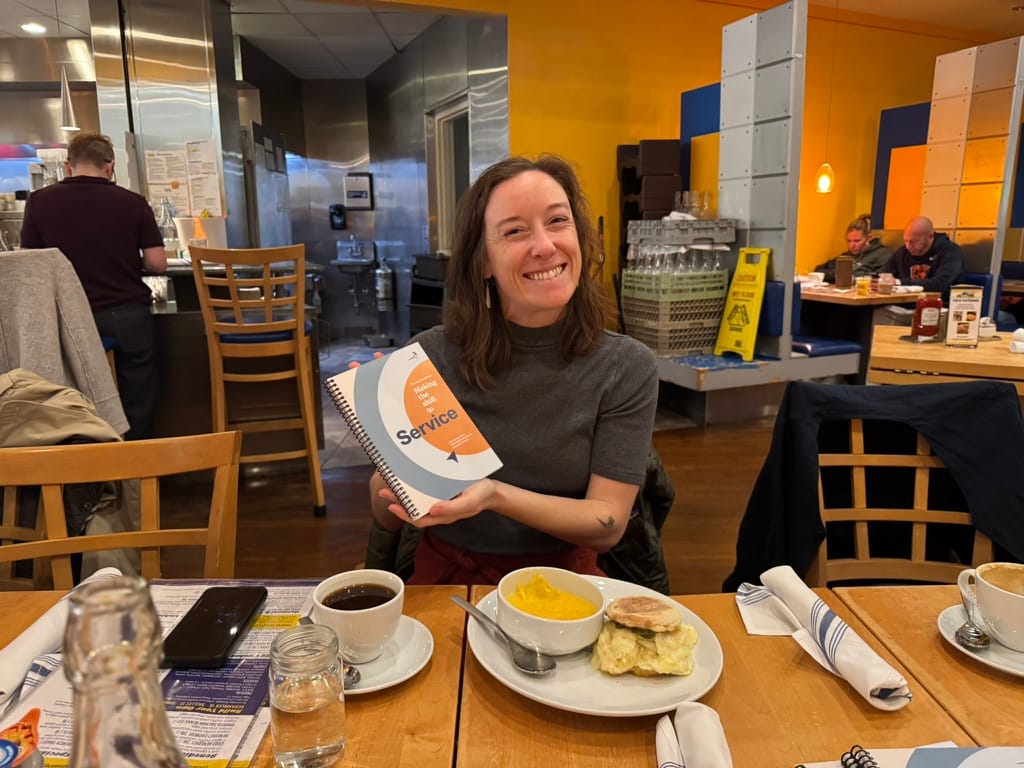
Over breakfast we launched our Service Desk workbook, Making the shift to service, and met plenty of people building things that get them closer to the people they serve.
One of them was Cara Kuhlman, who runs Future Tides, a small Seattle news venture about the people who use the region’s waterways. She gives walking tours, and she told me she runs them on stories she has not yet written. She hears what people ask and writes a better story.
It is the opposite of how most newsrooms are trained to work. I used to keep stories fiendishly secret until they were published, then wonder why nobody read them. Cara finds out first.
It is easy to slide back, because the old status signaling is in the same rooms and it is comfortable. If you work in journalism support, use occasions like these to practice your own compass: who is building, and who is working the room.
Cara is building. I was so glad I got to meet her and pick her brain.
Looking ahead
Since this issue has told you how to judge people like me, here is how I am trying to be useful, so you can judge it.
A virtual book club on the workbook starts Nov. 10 and runs on five Tuesdays through Dec. 15.
The first week teaches you to see the exchange behind any service. The next two turn that eye on your own work and then on one real person. The last asks you to try something small with that person and learn from what happens.
Almost all seats, provided with the Lenfest Institute’s support, are taken. Do claim yours soon if you still want to join us.
It would be easy to mistake it for the kind of program the old layer runs to survive, so hold it to the same questions: whether you can check what it tells you, whether you end up closer to a specific person than you started, and whether you leave with more of your own say.
I hope the participants will be measuring it the same way. We asked them what they want from it:
- “I want to move away from short results and chasing views to build services that people truly trust and use for a long time.” (small newsroom, Bangladesh)
- “We’re doing a vision reset soon and I want to center service.” (medium newsroom, US Southwest)
- “To do better for our readers and the people we cover.” (small newsroom, Canada)
- “Less panic in reaction to unexpected events requiring my attention or response.” (journalism support, Ireland)
Publishing strategy and personal reflection turn out to be very similar work. Details and registration here. I’d love for you to join us.
Thank you for reading. Talk soon.