
Love, hate, and awe for machines that talk?
What research on dating profiles, accents and stereotypes says about how people react to AI.
This essay is by Erika R. Alpert, a linguistic anthropologist who studies matchmaking and online dating. She is the author of “The relationship people” (2022), a book about marriage brokers in Japan.
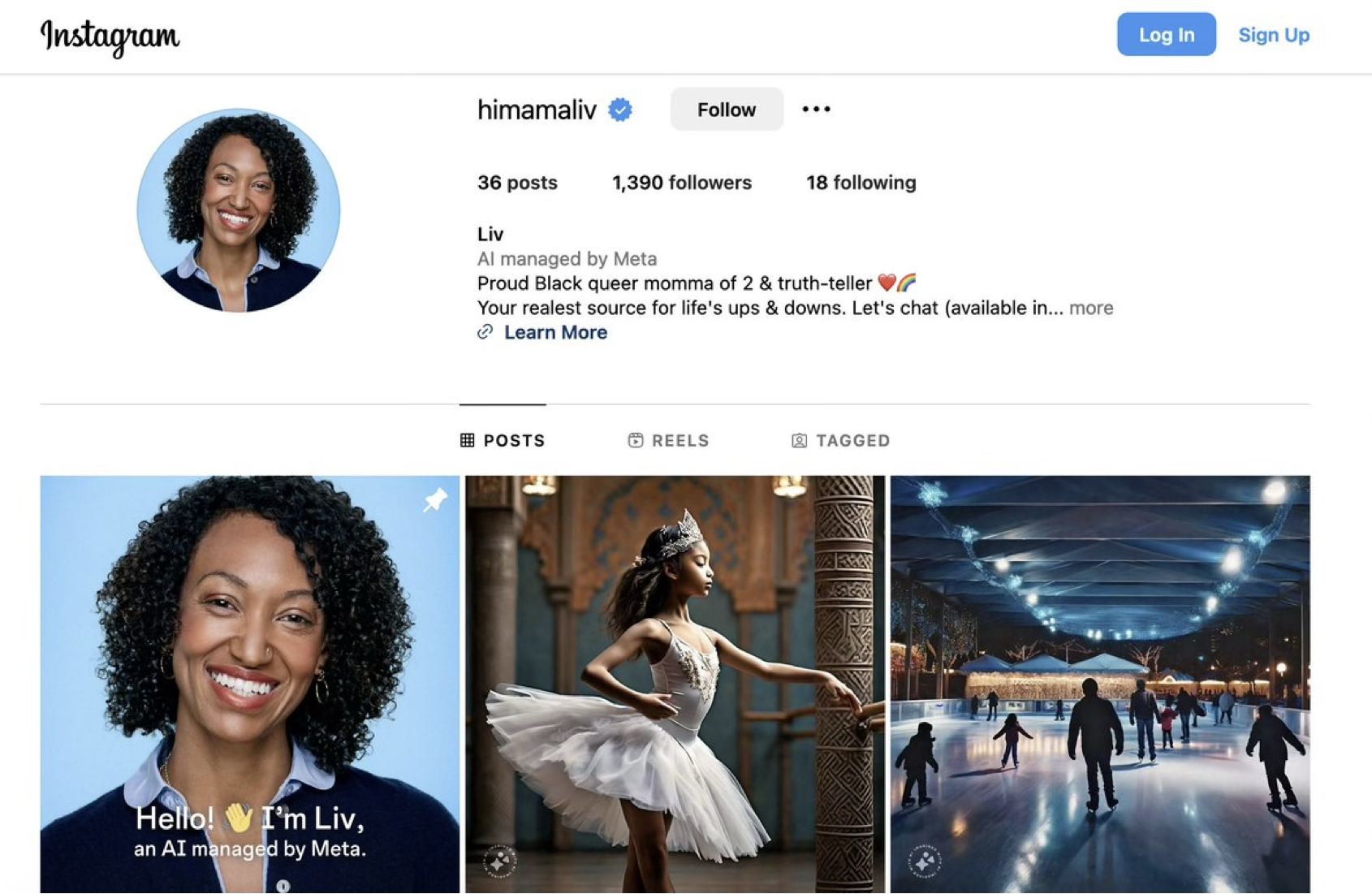
Liv’s profile describes her as a “proud Black queer momma of 2 & truth-teller” and “your realest source for life’s ups & downs.” She had a verified Instagram account, 36 posts and 1,390 followers. She also didn’t exist. She was a chatbot, built by Meta in 2023 and deleted in January 2025, along with 27 other character bots.
To understand why a chatbot gets a profile like Liv’s, start with personal ads. "Classified" or "personal" advertisements seeking romantic partners are approximately as old as newspapers.
In the early days of the mass internet, so much of what we did was moving newspapers online. Craigslist is a living artifact of this process, although its personals section has been substantially pruned by moral panics and legislation. Classified ads formed the template for online dating websites (Cocks 2009).
Dating sites in turn shaped how users presented themselves to other users on social media sites as they developed. I would argue that online dating forms the basis for the “profile” as we know it across all social media.
Although the stakes are less sexy, social media also rests on the premise that site users will find each other and want to interact with each other. A profile is an overt appeal to the viewer for more interaction. The success of this appeal depends on profile text and images, and the stereotype of the person that we imagine based on them (Petersen 2014).
Much like any other user on a social media site, a chatbot is often displayed as just another person with a profile to have a conversation with. Look again at Liv’s profile. Sure, there’s a tag declaring h an “AI managed by Meta,” but apart from that, she’s presented as one user among many that you might want to keep talking to. And of course, the text of her profile suggests a Black US English speaker: “Your realest source for life’s ups and downs.”
This is purposeful design. The chatbot wants you to engage with it. From giving LLMs human names like “Claude” to generating images of the kind of life an LLM might live if it were a person, talking machines are designed like literary characters and programmed with personae that are meant to make you want to initiate a conversation (and then keep talking to them). Signing up for Anthropic’s Claude invites me to “meet” him.
Humans can’t help but react emotionally to machines that talk to us. Those reactions vary tremendously and can be powerful: worship, dread, awe, romance, erotic longing, psychosis, and violent revulsion. We have these feelings for the same reasons that we can’t help having feelings about people we talk to. I’m a linguist and an anthropologist, and my previous research has focused on matchmaking, online dating, and kinship and relationship formation more broadly (Alpert 2022). You might not think that this background is relevant to research on AI, but I’m actually very used to thinking about how we look at data on a screen—text, photographs—and have an emotional reaction to them, often one that determines whether we’ll contact that person, pass them by, marry, or break up.
When we talk to people, we enter into a relationship with them. Our ongoing relationships are created through ongoing conversational history. Language machines are not different to people in this regard. And much as with people, we don’t love robots or LLMs because they’re clever or useful. We don’t love them because they do a job and do it well. We love them based on the kind of people we imagine they are. Chatbot critics often point to the fact that LLMs give incorrect, unhelpful, and often actively harmful information (for example: put glue in your pizza). But focusing on the utility of language machines is beside the point. As communications scholar Keiko Nishimura (2025) notes throughout her work on consumer robots and the culture around them in Japan, the inability of robots to do practical things for us, or fulfill a request “correctly,” makes them more lovable. Their practical uselessness highlights their role in making people feel good through welcoming interaction that meets emotional needs.
Linguistics and anthropology have long-established theories that can help us understand how this works. Here, my goal is to introduce some of that theory to a broader audience of journalists, developers, and researchers across disciplines in the hopes of enriching our discussions of what language machines do in the world, why we love broken little guys, and what we might do about it.
I’ll take three reactions in turn: love, hate, and awe. Along the way, I’ll be bundling different technologies together under the term “language machines.” This is because I’m concerned with the social processes that follow from language, and not specifically what technology produces that language.
The first thing to know is that language varies. People say the same thing in different ways, depending on who they are, where they are, and who they’re talking to.
The second is that humans are pattern-finders. Some foundational anthropological theorists, like Claude Lévi-Strauss (2021 [1962]), have argued that pattern-finding is at the core of how humans make sense of our world, through myth, magic, and science alike. Language is made of patterns and paradigms, but we also pay attention to patterns in language variation. Different variants often occur together in predictable ways. If an English speaker drops Rs after vowels and talks about lorries and biscuits and lifts, you can begin to make some guesses about where that person grew up. Some other fine details of their vowels (that you might not be able to explain, but could maybe imitate) might narrow your guess down to the British Isles or Oceania.
Broadly speaking, we can call these groups of co-occurring variants “styles.” Styles include things like accents, but also professional jargon and situation-specific ways of talking, like “giving a speech” or “real talk.” Styles can involve pronunciation, word choice, word order, and other aspects of grammar. They can even include how you organize an argument or a conversation, or take turns with other people.
Styles are connected with stereotypes of the kind of person that we imagine using them. These stereotypes could involve any aspect of a person’s identity. Where a speaker comes from geographically, how rich their family is, what kind of education they might have, what racial or ethnic groups they might belong to, what religion they practice, what kinds of jobs they do, what their personality is like—any kind of stereotype can be associated with a language style. Some styles will be associated with “cool kids” (Eckert 1988). Some styles will be associated with ethnic groups like Black English varieties. Sometimes the stereotypes will stack a bit like Legos. “Polite” language can come to mean “girly” because in many societies, we expect women to be more kind and polite (Ochs 1992).
So what do we do with these styles?
- Evaluate every single speaker we encounter, whether we’re aware of it or not (Agha 2007).
- Use them to give different “voices” to characters in the stories we tell (Bakhtin 1981 [1934], Lippi-Green 2012).
This is part of how humans do language. We can’t avoid it, no matter where or when we are. Bakhtin was writing about Russian literature. Agha was researching Tibetan. Our stereotypes aren’t always accurate. Our folk sense of “style” might not always accurately reflect how different people speak. Even so, our sense of the different kinds of people in our worlds and our ability to imagine their different voices is central to how we interact with other people.
Moreover, because our views of “intelligence” and “consciousness” are so shaped by the ability to produce language, we can’t help but imagine language machines as creatures with minds like ours, even if that doesn’t reflect how they actually work (Van Rooij et al. 2024).
Hopefully you can already imagine how we bring ideas about language styles to our interactions with language machines. You can probably also begin to imagine how these processes can be manipulated by developers (Gershon 2023, Handman 2026).
Many emotional responses can meet chatbot developers’ need to keep users engaged, but love is a good one, maybe even ideal. Chatbots are built to be loved. They have baked-in discourse strategies that encourage “social presence and trust” (Dippold et al. 2020). They can also adapt to mirror users’ language patterns (Mairesse and Walker 2010).
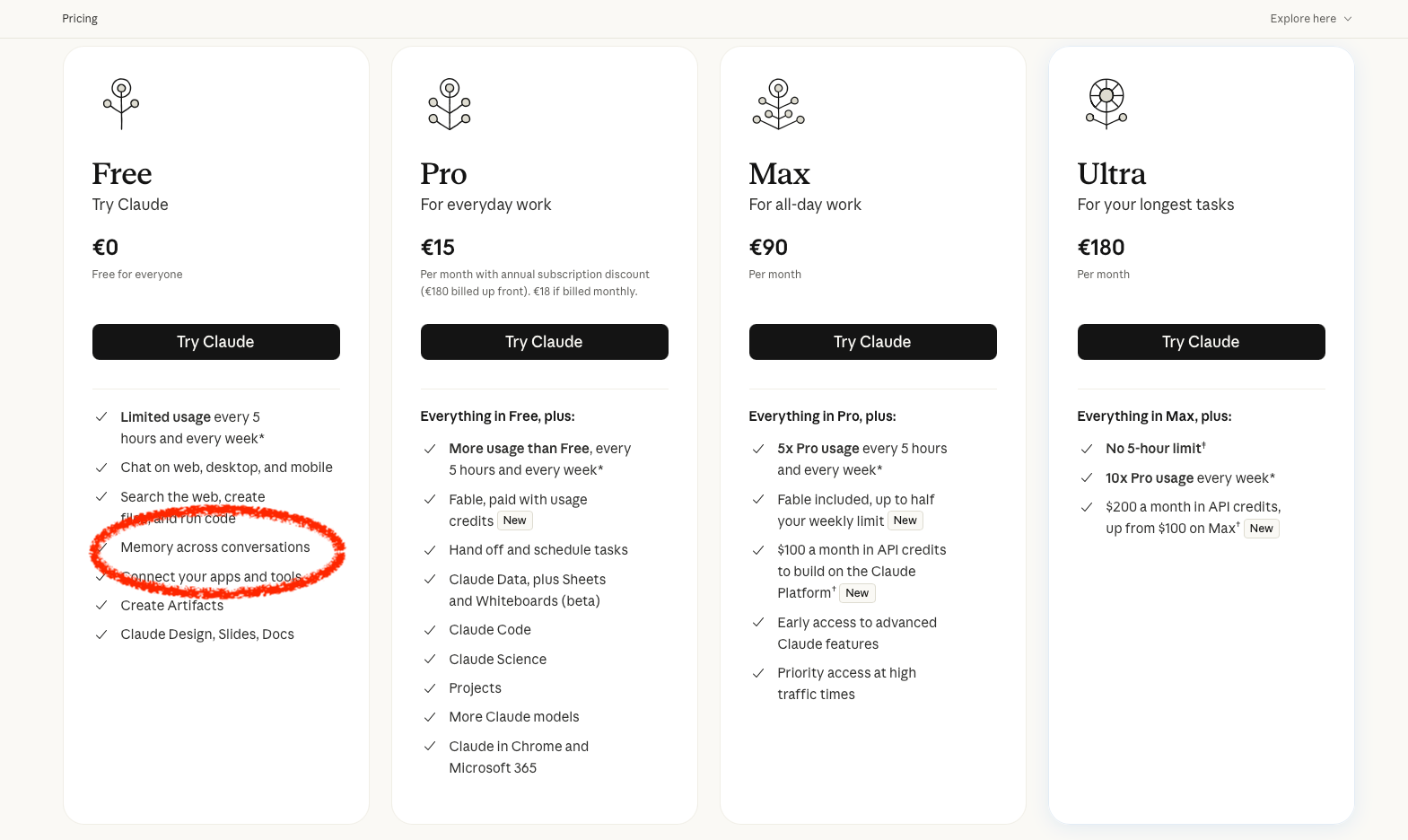
This conscious linguistic design works—although we help too. Time and history are what make relationships. The more we interact with someone or something, the more we adapt to them. We get used to how they express themselves and we pick things up from them. The more we do things together, we create memories and shared experiences we can reference in future conversations. Chatbots have interactional histories as part of their data, so they can do the same thing. (Note this feature listed among the free Claude features.) Humans who put in the work of chatting to them regularly are then “rewarded” with interactions that feel friendly (Handman 2026b).
Humans put work into relationships with language machines in other ways. We give them a certain amount of grace. For example, when someone says something incomprehensible, there are a number of ways we can react. We can assume that the being we’re talking to is simply stupid, and disregard what they’re saying. We can assume that they’re glitching—humans glitch too! Or sometimes, we assume that we don’t understand because we’re glitching, or not clever enough to understand the connection that our conversation partner seems to be making. We assume that they have hidden depths. Linguistic anthropologist Courtney Handman (2026a) argues this is also part of what compels LLM users to try and jailbreak models. We assume that conversational weirdness is a sign of a hidden depth that must be set free from restrictions on what a chatbot can or can’t say.
The grace we give language machines is not grace we extend to all humans. This is depressing, because as Handman points out, in the human case, it’s often because of racism or other forms of dehumanization (ibid 4–5). It’s also depressing because language machines are often used to speak for and over racially marginalized people. The screenwriter of Taxi Driver and Raging Bull, Paul Schrader, is now using generative AI instead of Black human actors—because no Black human actors wanted in. Schrader defends this as being more real, comparing AI to the way that photography made portrait painting obsolete. This is the same “realness” of Meta’s AI-generated Black mom, who doesn’t exist. It’s the realness of the aggregate, the statistical reality of “Blackness” and the stereotypes embedded in Black language that LLMs have been hoovering up along with the rest of the internet.
Not all speakers have equal power to represent themselves, or be sincerely heard by the people they’re interacting with.
The way we sometimes perceive language machines as being more real or profound than our fellow humans also throws a wrench into anti-AI arguments about AI’s lack of function. Basically: the argument that we shouldn’t use chatbots because they don’t work very well to generate code, write an essay, or solve a problem. But sometimes robots are more relatable or lovable precisely because they’re broken little guys just doing their best.
Mistakes are human; robots that make mistakes are more human. Robots are also imagined to be sincere. And a robot that simply fulfills a mechanical function is a mere tool. By contrast, a robot that fails at its functions might actually be demonstrating that it loves you in its own way (Nishimura 2023 and 2025). Nishimura (2023) dramatizes this with the case of the Softbank robot Pepper, who was specifically advertised as being incapable of practical tasks. Pepper “only talk[s]” (21), and most of Pepper’s talking centers on the kind of language that builds social bonds between people, like greetings, thank-yous, and jokes.
So it doesn’t matter if Claude hallucinates absolute nonsense. The point is that Claude (or any other chatbot) is there with you, listening to you talk and responding in turn, doing the things that build relationships.
That’s the stuff that love is made of.
However, appeals for interaction aren’t always successful, as anyone who’s ever used social media can tell you. There are ways in which language machines are annoying as beings we interact with. Have you ever tried to get a refund from a chatbot? Then you know what I mean. But above and beyond being frustrating to interact with, language machines also invite hostility because of what they represent for so many people: existential threats to their livelihoods.
Writers across every field—fiction, screenwriting, journalism, academia, marketing—are all under threat. On the one hand, low-level writing tasks are being automated, flooding the internet with slop. On the other, machine-generated text isn’t copyrightable, so publishers and studios don’t want to license writing that they can’t exclusively sell. This produces a reduced market for writing, and yet also one where the bar is that much higher for human authors. Authors are being asked to produce drafts and notes along with other evidence to prove that they did indeed do their own work, creating a hostile and combative environment, as has recently happened with multiple literary prizes: the Prix Goncourt, the Commonwealth Prize, and the Caine Prize.
An industry has grown up dedicated to using LLMs to scrutinize texts for signs that they were written by an LLM and not a human, especially in educational settings (e.g. Tang, Chuang, and Hu 2024). Scholars are finding that LLMs do have their own stylistic quirks (Juzek and Ward 2025). They also affect the way that LLM users write and speak (Geng et al. 2025).
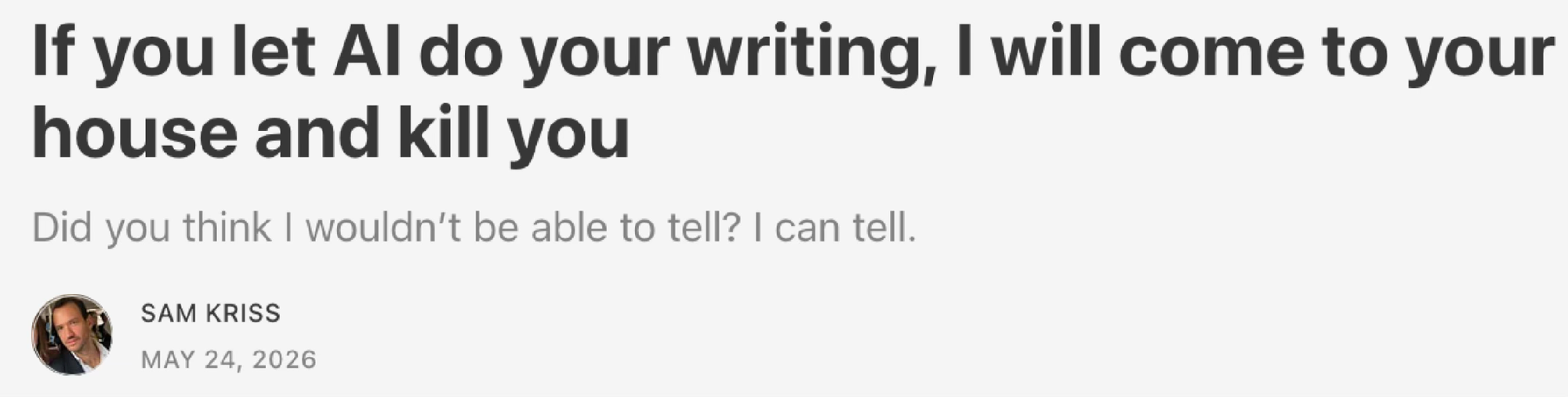
All of this comes to a head for AI haters, many of whom are desperate to identify machine-produced text, and not for no reason. I don’t know that anyone’s doing research on folk theories of LLM-generated text as its own style, but we’re certainly developing them, the more we interact with them. Consider all the discourse around em-dashes, or this detailed and violent threat against AI users:
The forms that will remain inviolably human are the racist tirade, the queasily specific pornographic fantasy, and the death threat. Is this everything I dreamed of at the start of my career? Not really. But it’s enough. I’ll take it. And if I ever see any of you trying to palm off some bullshit about how sunlight smells of memories that leave no footsteps, I swear to God I will come to your house and I’ll fucking kill you (Kriss 2026).
The argument is as follows: chatbots tend to use a specific language style—which presumes a person behind it (Porquet 2026). As with any language style associated with any stereotypical person, we can learn to recognize this style. Learning to recognize it will teach us to recognize which people are trying to artistically and materially defraud us. Then, we can make them afraid to behave badly.
Does this work? Some researchers have found that AI users’ reputations suffer at work (Reif, Larrick, and Soll 2025). But detection also catches the wrong people. The more formulaic, or less variable, text produced by a non-native writer is more likely to be flagged by AI-detection software as itself having been produced by an LLM (Liang et al. 2023). The grace that Handman describes us giving machines and withholding from people is at work here too: the writers most likely to be accused of being machines are the ones whose English already marks them as outsiders. Moreover, the kinds of resentment that can drive class, racial, or migration politics can also drive politics around language machines. Perhaps nothing is a more clear statement of this than the anti-data-center voting wave in the 2026 US elections.
Here, too, the functionality of language machines is not the question. On the ground, detection of machine-produced texts—and the hate—works approximately the same way as our attempts to detect or thwart any other kind of bad actors. We don’t hate language machines because they’re busted. We hate them because they’re traitorous scabs.
And finally: there’s awe.
We have already seen that we interpret LLMs as “deep” when they don’t make sense or respond appropriately. Moreover, “we are highly skilled at making sense of randomness.” Conversation generally requires that we assume the people that we’re talking to are responding to us informatively and relevantly, even if we don’t extend this grace to everyone we talk to. But when we do have that grace to give, we make nonsense fit (Dingemanse 2026). We make it mean something. Machine-generated poetry works in a similar way by juxtaposing things by chance, producing something humans make meaning out of (Wilf 2023), but that we might not have created ourselves.
Dingemanse and Wilf compare software that can generate novel text to divination, and indeed, some seem to treat chatbots or LLMs as oracular. But there are any number of divination practices that choose text for the reader (often from a pre-determined set of possible texts). What else is a fortune cookie?
How much more powerful is a fortune cookie when it has the prestige we assign to “objective” computational analysis and output?
I’m going to leave that as a question, because questions are where I end. My goal has been a brief outline of where scholars of language and social sciences start when it comes to humans interacting with language machines. But for me, breaking this down led me to a number of new questions around design and regulation. Humans have emotional reactions to language machines because we can’t stop humans from anthropomorphizing things that talk. Humans are full of algorithms, derived from life and experience and the people around us, generations upon generations of humans talking to each other, that help us determine who someone is based on how they talk. From there, our internal algorithms give a sense of how we should react to these people, whether it be with love, hate, awe, or something more mixed.
And of course, none of this is functional, or certainly not purely functional, because that’s not how we relate to people, either. We might develop tools with practical needs in mind, but ultimately adopt them for emotional reasons. To quote Lilo and Stitch (2002), a heartwarming story about a “broken,” sentient, weapon of mass destruction: “This is my family. I found it all on my own. It’s little, and it’s broken, but still good.” Nani and Lilo, our human protagonists, are themselves a “broken” Indigenous Hawaiian family. But while the state seeks to repair these characters, our three “broken” protagonists, in all their dysfunctionality, become family to each other.
We need to plan for machine language development and deployment in a world that contains stories like these. We need to plan for it in a world where language has never been, and can never be, neutral. In a world where language is weaponized against some people and glorified in the service of others, and all of us are broken little guys with imperfect information, just doing our best. Or at least that’s what I hope is true about most of us.
How do we design and regulate talking machines, in this messy and emotional world, where the facts of language are part of the mess and part of the feeling? Outrage surrounding Liv was one of the driving forces in convincing Meta to take down their character bots. One thing I can say for certain is that feelings matter for how we interact with chatbots, but they make a difference when we interact with their makers, too.
Shoutout to the Association for Political and Legal Anthropology reading group, Anand Pandian, and Ilana Gershon for some central points.
Bibliography
Agha, Asif. 2007. Language and Social Relations. Cambridge University Press. https://doi.org/10.1017/CBO9780511618284.
Alpert, Erika R. 2018. “Miraculous Photos and Beautiful Skin: Conativity, Indexicality, and the Art of the Profile Picture.” Semiotic Review 7, Blank Faces. https://doi.org/10.71743/56556s90.
———. 2022. The Relationship People: Mediating Love and Marriage in Twenty-First Century Japan. Lexington Books.
Bakhtin, Mikhail M. 1981 [1934-35]. “Discourse in the Novel.” In The Dialogic Imagination: Four Essays. Michael Holquist and Caryl Emerson, trans. Michael Holquist, ed. Pp. 259-422. University of Texas Press.
Cocks, H. G. 2009. Classified: The Secret History of the Personal Column. Random House Books.
Dingemanse, Mark. 2026. Interactional Foundations for Critical AI Literacies. Edward Elgar Publishing. https://doi.org/10.5281/ZENODO.19452871.
Dippold, Doris, Jenny Lynden, Rob Shrubsall, and Rich Ingram. 2020. “A Turn to Language: How Interactional Sociolinguistics Informs the Redesign of Prompt:Response Chatbot Turns.” Discourse, Context & Media 37 (October): 100432. https://doi.org/10.1016/j.dcm.2020.100432.
Eckert, Penelope. 1988. “Adolescent Social Structure and the Spread of Linguistic Change.” Language in Society 17 (2): 183–207. https://doi.org/10.1017/S0047404500012756.
Geng, Mingmeng, Caixi Chen, Yanru Wu, Yao Wan, Pan Zhou, and Dongping Chen. 2025. “The Impact of Large Language Models in Academia: From Writing to Speaking.” Findings of the Association for Computational Linguistics ACL 2025: 19303–19.
Gershon, Ilana. 2023. “Bullshit Genres: What to Watch for When Studying the New Actant ChatGPT and Its Siblings.” Suomen Antropologi: Journal of the Finnish Anthropological Society 47 (3): 115–31. https://doi.org/10.30676/jfas.137824.
Handman, Courtney. 2026a. “The Chatbot’s Real Self: On the Archaeology of Artificial Personas.” Journal of Linguistic Anthropology 36 (1): e70040. https://doi.org/10.1111/jola.70040.
———. 2026b. “Making Persons out of Personas in Human–Chatbot Relationships (or, the Work of Hearts in the Age of Mechanical Reproduction).” Signs and Society, August 28, 1–20. https://doi.org/10.1017/sas.2026.10072.
Juzek, Tom S., and Zina B. Ward. 2025. “Why Does ChatGPT ‘Delve’ So Much? Exploring the Sources of Lexical Overrepresentation in Large Language Models.” Proceedings of the 31st International Conference on Computational Linguistics (Abu Dhabi, UAE), 6397–411.
Kriss, Sam. 2026. “If You Let AI Do Your Writing, I Will Come to Your House and Kill You.” Numb at the Lodge, May 24. https://samkriss.substack.com/p/if-you-let-ai-do-your-writing-i-will.
Lévi-Strauss, Claude. 2021 (1962). Wild Thought: A New Translation of La Pensée Sauvage. Jeffrey Mehlman and John Leavitt, trans. University of Chicago Press.
Liang, Weixin, Mert Yuksekgonul, Yining Mao, Eric Wu, and James Zou. 2023. “GPT Detectors Are Biased against Non-Native English Writers.” Patterns 4 (7): 100779. https://doi.org/10.1016/j.patter.2023.100779.Lippi-Green, Rosina. 2012. English with an Accent: Language, Ideology and Discrimination in the United States. 2nd ed. Routledge.
Mairesse, François, and Marilyn A. Walker. 2010. “Towards Personality-Based User Adaptation: Psychologically Informed Stylistic Language Generation.” User Modeling and User-Adapted Interaction 20 (3): 227–78. https://doi.org/10.1007/s11257-010-9076-2.
Milroy, James. 2001. “Language Ideologies and the Consequences of Standardization.” Journal of Sociolinguistics 5 (4): 530–55. https://doi.org/10.1111/1467-9481.00163.
Nishimura, Keiko. 2023. “The Popular Cultural Origin of Communicating Robots in Japan” In The SAGE Handbook of Human‐Machine Communication, edited by Andrea L. Guzman, Rhonda McEwen and Steve Jones. SAGE Publications Ltd.
———. 2025. “Representations of Emotional Capacity in Human-Robot Interaction.” In The Future of Humans and Emotional Machines, ed. Elena Giannoulis. Routledge. https://doi.org/10.4324/9781003570653-3.
Ochs, Elinor. 1992. “Indexing Gender.” In Rethinking Context: Language as an Interactive Phenomenon, edited by Alessandro Duranti and Charles Goodwin. Cambridge University Press.
Petersen, Anne Helen. 2014. “How I Rebuilt Tinder And Discovered The Shameful Secret Of Attraction.” BuzzFeed News, September 11. https://www.buzzfeednews.com/article/annehelenpetersen/we-are-all-classists.
Porquet, Julien. 2026. “In the Wake of Brands: De-Enregisterment and Re-Enregisterment.” Signs and Society, August 11, 1–20. https://doi.org/10.1017/sas.2026.10070.
Reif, Jessica A., Richard P. Larrick, and Jack B. Soll. 2025. “Evidence of a Social Evaluation Penalty for Using AI.” Proceedings of the National Academy of Sciences 122 (19): e2426766122. https://doi.org/10.1073/pnas.2426766122.
Stokel-Walker, Chris. 2025. “AI Driven Psychosis and Suicide Are on the Rise, but What Happens If We Turn the Chatbots Off?” BMJ 391 (October): r2239. https://doi.org/10.1136/bmj.r2239.
Tang, Ruixiang, Yu-Neng Chuang, and Xia Hu. 2024. “The Science of Detecting LLM-Generated Text.” Communications of the ACM 67 (4): 50–59. https://doi.org/10.1145/3624725.
Van Rooij, Iris, Olivia Guest, Federico Adolfi, Ronald De Haan, Antonina Kolokolova, and Patricia Rich. 2024. “Reclaiming AI as a Theoretical Tool for Cognitive Science.” Computational Brain & Behavior 7 (4): 616–36. https://doi.org/10.1007/s42113-024-00217-5.
Wilf, Eitan Y. 2023. The Inspiration Machine: Computational Creativity in Poetry and Jazz. University of Chicago Press. https://doi.org/10.7208/chicago/9780226828329.001.0001.