
The original Gazzetta Veneta: full text in Italian and English
We found a copy of the Gazzetta Veneta from a seller in Ariccia, outside Rome. It's one of Italy's earliest newspapers, and the source of our name.
This issue from Wednesday 6 February 1760 contains two things worth reading today, centuries later. The first is a value proposition: a plain list of what the paper offers and why anyone would pay for it. The second is a letter, likely from an invented character, to the printer, reminding him that serving the public well and punctually is what brings profit and reputation.
An editor making the case for usefulness as a business model, 260 years before we started saying the same thing. Below is the full text in the original Italian and in English translation.
Wednesday, 6 February 1760. No. 1.
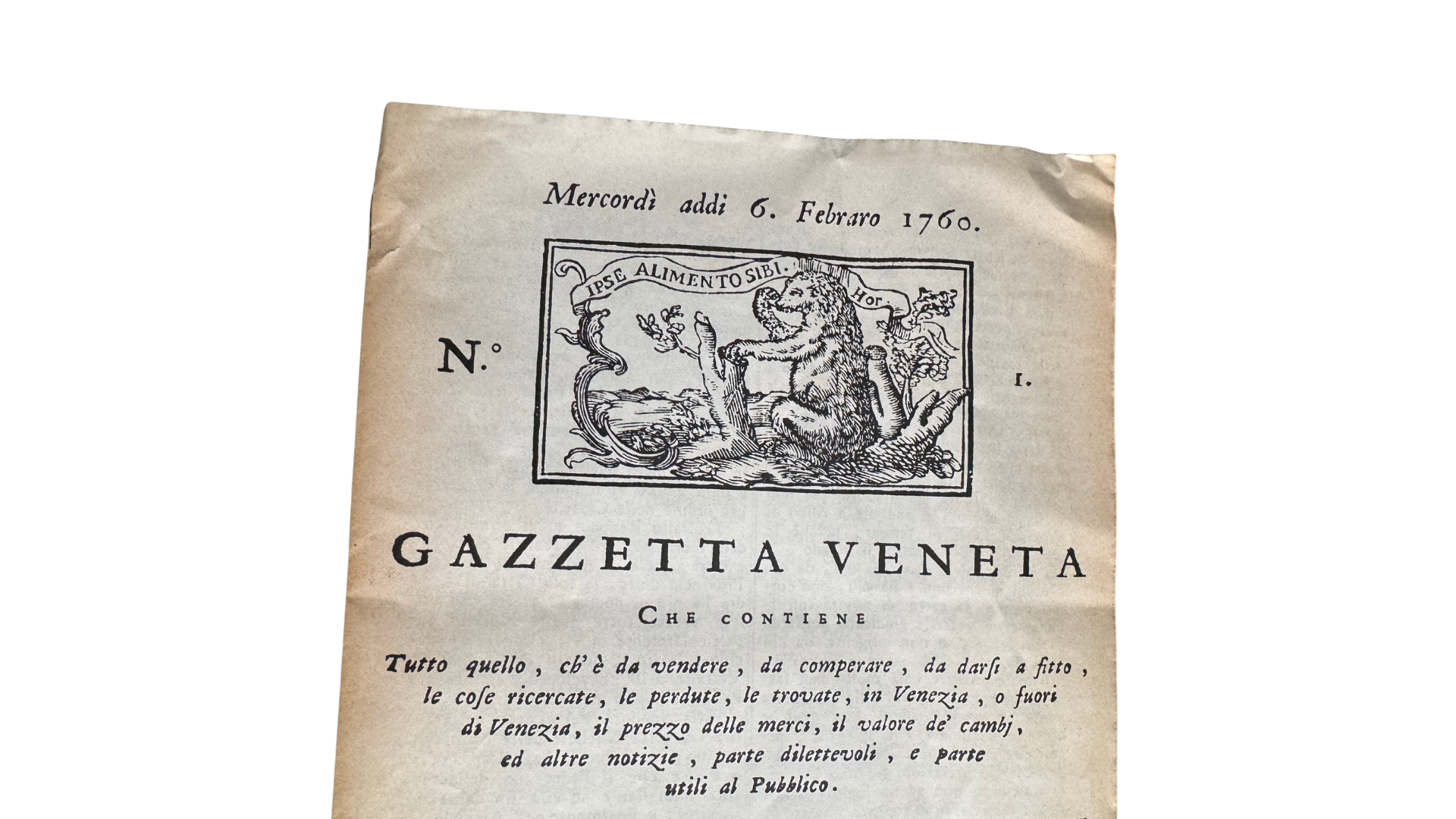
GAZZETTA VENETA
which contains
Everything that is for sale, to be bought, to be let; things sought, lost and found, in Venice or outside Venice; the price of goods, the value of the exchanges, and other news, partly entertaining and partly useful to the public.
Letter received by the printer, Signor Marcuzzi. 2 February 1760.
Courage, my Marcuzzi. Set your hand to your enterprise. Hope for the best. I have read the notice you published for the edition of the Gazzetta Veneta. I like the paper and the type, besides the subject matter, which I think will please the public. As you go forward, do not let the printing get worse; for I see that posters and announcements are all handsome and well printed, but the many promises they make are rarely kept. Remember that serving the public well and punctually brings profit home, and earns whoever does so the name of an honest and discreet spirit. I also want to tell you a few small things which, in my opinion, will improve your sheet. For example, I would put at its head some little allegorical figure, say a bear cub sucking its paw, with some Latin saying beneath it signifying the nature of your gazette,
which feeds and nourishes itself on its own things, and does not seek its food, that is its material, from afar. Besides this, I would not print the pages full-width, with lines running from one edge of the page to the other, but in two columns, following in this the manner most used in the other gazettes, to which readers' eyes are already accustomed. As for me, I would decide to bring it out at once rather than wait until Lent, especially knowing that certain notices have been sent to you which in a few days will no longer be of any use; and you would run the risk of printing them out of season, for houses empty today are rented tomorrow, and whoever needs a thing now no longer needs it a few days hence, so that you would fill the paper with fruitless novelties and be judged a liar by the reader, or negligent by whoever gave them to you.
It would also be a very good thing if the writers of your gazette began it with some short preface explaining, so to speak, the genealogy of gazettes. Oh, someone will say, prefaces are made for books, not for a single sheet. But in twelve months there will be one hundred and four sheets, so that at the year's end the Gazzetta Veneta will be a thick volume, enough even for three tomes if need be. So you see that a small proem would not be out of place. It could be said in it that the first gazette published in Europe came out in Venice in 1600. I have heard some who believe its name derives from gazza (magpie); and because this bird talks, and gazettes chatter about everything, they think they find a certain fitness of name in it. But they are mistaken: it was so named because when it was first invented and published in Venice, one paid a gazzetta for it, and it took its name from the coin given in payment. (a) It then came out once a week, and was a report of all the events of Europe. All the more notable cities soon adopted this custom afterwards. I speak of European cities, for in China memory cannot go back far enough to establish when these journals were founded, and there the gazette is printed every day by order of the court.
Théophraste Renaudot was the first to bring out gazettes in France, in 1631; and besides those of Amsterdam and of the United Provinces, the city of London alone has more than twelve gazettes. If you wish to see all this laid out in greater detail, read the article Gazette, written by Monsieur de Voltaire in the Encyclopédie printed in folio at Paris in 1757.
Michel de Montaigne speaks of precisely the kind of your gazette in the first book of his Essays, chapter XXXIV, where he says that his father wished for something similar to it as far back as around 1560; and finally, in the cited article of the Encyclopédie there are these words:
A kind of most useful gazette in great cities, of which the first example was given in London, is that in which citizens are given notice of what will take place in the course of a week, for their interest and pastime.
There are noted in it spectacles, new works of every kind, whatever private persons wish to sell or buy, the price of goods and of foodstuffs, and in short everything that can contribute to the comforts of
(a) In those days the rags from which paper is made were cheap; today there is a scarcity of them, and paper is dearer. Moreover, the gazette was then only four pages. Printer's note.
...life. Paris and many other cities have recently imitated this example.
You can therefore make use of such materials for the proem; and remember to see to it that your Philosopher and your Poet insert among the notices some pleasantry for entertainment, and that each sign his observations, the Philosopher with an F, the Poet with a P; and if you need to write something yourself, put an S beneath it, that is Stampatore (Printer), so that in this too the public's curiosity may be satisfied, for in your gazette it ought to know everything clearly; obscurity and masks must not begin with the one who writes it. Keep well, and set the presses to work with good fortune. Farewell, new gazetteer.
"My two assistants approved the present letter, and said that, without racking one's brains any further to make it more elegant, it can serve as a preface; and they are content to sign with the F and the P, and I confirm these few lines with my S, and open the Gazette."
Things for sale.
A four-wheeled calash with many conveniences for travelling, made in the German fashion. Whoever wants it should inquire of Casarini, who lives at San Fantino.
Two snuffboxes are for sale, one of porcelain and the other of polished rock crystal, both rimmed with gold. The price is 40 zecchini each. Whoever desires them should inquire of Signor Antonio Zatta, printer, who lives at the San Barnaba ferry landing.
I once heard in conversation a person of much wit and liveliness, who maintained very stoutly that the nose, though it may seem a piece of flesh attached to the face only to lend it grace, takes no little trouble to be well treated and sumptuously maintained. His Lordship has so many wants that they can scarcely all be satisfied. Consider the variety of tobaccos, which are brought expressly for him from as far as Brazil, not to mention Spain. And of the sumptuousness of handkerchiefs, what is one to say? Upon them scented waters are sprinkled, and these are kept in little flasks of gold, silver or other precious material, composed with fine mastery. As for the boxes in which the tobacco is shut, this sheet would not suffice to describe them. A certain wag, to demonstrate a kind of lordship that the nose holds, perhaps in imitation of the military exercise of the fans that one reads of in the English Spectator, has described the military exercise of the snuffbox, and it is printed in a book entitled L'art de désopiler la rate (the art of venting the spleen).
Military exercise of the snuffbox.
- Take the snuffbox with the right hand.
- Pass the snuffbox into the left.
- Tap on the snuffbox.
- Open the snuffbox.
- Present the snuffbox to the company.
- Draw the snuffbox back to yourself.
- Gather the tobacco and tap on the rim of the snuffbox.
- Take a pinch of tobacco with the right hand.
- Hold it a moment between the fingers before presenting it to the nose.
- Present the tobacco to the nose.
- Sniff properly with both nostrils.
- Do not make a face.
- Close the snuffbox. Sneeze, spit, blow your nose.
Houses to let.
- A house to let with all its conveniences, water landing and well. In Campo San Polo. Rent 120 ducats a year. The keys are at Ca' Donà in the said campo.
- A properly furnished room to let, in Calle dei Cerchieri, or at the Squero della Toletta at San Trovaso. Speak with Signora Francesca Pisenti, who lives in the same calle as the Squero.
- San Bortolamio, Calle della Bissa. A fourth-floor apartment to let, with terraces, stone floors, well and its conveniences; rent 56 ducats a year.
- In the same place. A fifth-floor apartment to let, with terraces, stone floors, well and its conveniences; rent 50 ducats a year.
Whoever wants either of these two apartments should speak with Signor Tommaso Menegati, apothecary of medicines, in Campo San Bortolamio.
Houses sought.
Two furnished rooms are wanted in the parish of San Polo or thereabouts; whoever has them and wishes to let them should leave notice at the coffee shop on the Riva del Vino.
Persons wanted.
Someone is wanted to copy an Italian manuscript in a good hand. Whoever has such skill should leave a sample with his address at the coffee shop on the Riva del Vino.
Persons offering their abilities.
There has arrived in this city Signor Isidoro Filtri, a Neapolitan, master of music, who wishes to employ himself in teaching his profession in private houses to anyone desiring to learn it. He asks a modest fee. Whoever wishes may obtain sufficient information about him from the most illustrious Signor Ferdinando Uccelli, public notary, under the Procuratie Nuove.
On the Riva del Vino, next to the Paradiso apothecary shop, lives a person in whose family caps, flowers of every kind, and other trimmings and apparel for ladies are made. The neighbours will point out the dwelling to anyone wishing for such work.
The ladies, who are no small aid to the circulation of merchandise and of money, deserve above all that notices be given here which concern them and serve to satisfy good taste and delicacy in dress. Many rigid men, cast in the old mould, blame the variety of fashions and call it caprice and fickleness. But let them call it what they will, it is a very great support to human industry, which, labouring at inventions to serve the ladies, gives a livelihood to a great number of people. Necessity has never managed to make men find so much as the feminine genius for furnishing itself with fineries has managed to make them find. I leave aside the innumerable arts that have been devised in their service, and the endless craftsmen who study thousands of subtleties to please them. But who could recount merely the variety of the ribbons, of the damasked veils, of the brocaded veils, of silk and thread or of silk alone, which, to see them being worked, require so many implements and a fabric so fine that it would have been a great feat even for Archimedes to invent it. Without the ladies, who would have imagined those little laces called blondes, of which universal use is made today? How many craftsmen work at those fineries which are called by the foreign word agrémens, and which in our language might be called galanteries or graces? For proof of the great traffic stirred up by women I ask nothing more than the Ascension fair. All the other shops find buyers with difficulty; the crowd is seen in that street where the ladies' mercers are; and there people buy and sell from daybreak until dark night. In the rest of the year all the shopkeepers are ready to serve you, and you find them idle; but with the sellers of fineries you must watch for the right moment to get a hearing and to order what you need, because they always have work in hand, and are bound to deliver such and such a piece of work by such and such a day, and you can scarcely find a day in the almanac on which to have what you require. In short, I see no one who gives others more earnings than the ladies, nor anyone who has more sharpened men's wits and made them inventive. Had it not been for the great desire they have for new fashions, the craftsmen would have had a long wait indeed for the men to awaken so broad a trade. I believe, Heaven forgive me, that we sluggards would still be covered in goatskins and smeared with grease like the Hottentots. But they chose to shake off the rust, and have spurred us too to polish ourselves. Whoever denies them the praise of this fine deed desires, without realizing it, that entire families of spinners, of weavers, of workwomen and workmen of fashion, and of thousands of other artisans should die of hunger, artisans whom I have no time to inventory here, and through whose hands, on account of the ladies, money circulates like blood through the veins of the human body.
Books in the press.
The adventures of Lillo, little dog of Bologna. This most agreeable little novel, translated from the English, is being printed by Antonio Zatta, who has already made a considerable name for himself with his two editions of Petrarch and of Dante. It contains a delicate irony and a satire of various customs. Lillo is carried away from Bologna, where he was born, by an English gentleman, and goes with him to London. He enters various houses, whose masters are described by the author in an ever-varied portrayal of different characters. Fine among the rest is the first chapter, in praise of dogs, and charming is the preface to the second book, written On nothing. The invalid without an illness, that is, the woman assailed by convulsions, also furnishes matter for a fine chapter; and no less fine is that of a sanctimonious prude, in whose house Lillo, already ill-accustomed among worldly pastimes, learns philosophy from Mopsa, the old cat of the household. Among all his adventures, Lillo never found himself in a worse state than in the house of a man of letters, whence he fled so as not to die of hunger, or rather so as not to be eaten by his master. The book closes with a lawsuit between two ladies over the possession of Lillo; but while the pleadings begin and the advocates prepare to speak, and the two ladies are resolved to spend their very selves, not to mention the eyes out of their heads, as the saying goes, Lillo dies of consumption and is buried with an affectionate epitaph.
Carriages and vessels arrived, or ready to depart.
The small ship named Diamante, Captain Francesco Giansich, has begun loading for Smyrna and Constantinople, and will depart by the end of next March.
Usages and terms of payment of bills of exchange on the Venice exchange.
Amsterdam, Antwerp, Hamburg, Cologne } and all Flanders and Holland: two months after date.
Augsburg, Nuremberg, Ulm, St Gallen, Vienna } and all Germany: 15 days after acceptance.
London, and all England: three months after date.
Bolzano, Bisenzone, Paris, Lyon } and all France keep no fixed usage, but the bills are customarily drawn at so many days' sight.
Rome, Ancona, Senigallia } and all Romagna: 10 days after the bills are accepted.
Naples, Lecce, Bari, Lanciano, Nocera, Messina, Palermo, Genoa } and all the Kingdom of Naples: 15 days after acceptance.
Bologna, Ferrara, Florence, Livorno, Lucca } and all Tuscany: 5 days after acceptance.
Turin: 10 days after acceptance.
Milan, Mantua, Bergamo, Cremona, Brescia, Crema, Verona, Vicenza, Udine, Rovereto, Villach } and all Lombardy: 20 days after date.
Lisbon, and all Portugal: 3 months after the date of the bills.
Exchange rates for foreign places, current on 1 February 1760.
Lyon: 59 bank ducats per 100 gold écus au soleil of 3 lire each. Bisenzone: 132¼ soldi for one scudo of 93 carantani. Rome: 62¼ scudi "oro stampe" per 100 bank ducats. Naples: 121¼ Kingdom ducats per 100 bank ducats. Florence: 80 gold scudi of 7 lire per 100 bank ducats. Livorno: pieces of eight [reading uncertain], 103¾ per 100 bank ducats. Milan: 157¼ soldi for one scudo of 117 imperial soldi. Genoa: 95⅛ soldi for one scudo of 4 lire 12, outside the bank. Antwerp: 93¾ groschen for one bank ducat. Amsterdam: 90¾ groschen for one bank ducat. Hamburg: 91¼ Reichstaler per 100 bank ducats. London: 51 pence sterling for one bank ducat. Augsburg: 99½ groschen for one bank ducat. Vienna: 191¼ florins per 100 bank ducats. Ancona, Bari, Lecce } nothing this week.
Prices of goods at the Rialto, 5 February 1760.
Alexandria coffee: 50 ducats per 100 pounds. Worked wax: 48 soldi per pound. Wax in cakes: 48 soldi per pound. Cloves: 17 lire per pound. Cinnamon: 24 lire per pound. Caracas cacao: 58 ducats per 100. The same, of Portugal: 48 ducats per 100. Cottons of Smyrna: 17 ducats per 100. Cottons of Salonica: 18½ ducats per 100. Cottons of Cyprus: 19½ ducats per 100. Verzino (Brazil) sugar: 20 ducats per 100. Muscovado: 17 ducats per 100. Refined: 24 ducats per 100. Wools of Salonica: 150 to 155 ducats per miero. Wools of Albania: 145 to 150 ducats per miero. Salonica cloths: 8 lire 10 soldi per piece. Oils of Corfu: 108 ducats per miero. Oils of Zante: 100 ducats per miero. Oils of the Morea: none. B. V. Musts: 101 ducats per miero.
The present gazette is sold at 5 soldi, and news items are received:
At San Marco: at Florian's coffee shop. At the Rialto: at the coffee shop on the Riva del Vino. At San Stefano: at the coffee shop in the campo. In the Merceria: at the shop of Paolo Colombani, bookseller. On the Riva degli Schiavoni at the Bragora: at the shop of Giuseppe Foccheri, paper seller.
WITH PRIVILEGE.
Notes and annotations
This is issue no. 1 of the Gazzetta Veneta, the periodical written by Gasparo Gozzi and printed by Pietro Marcuzzi, which ran twice weekly in Venice from February 1760 to January 1762. The opening letter is a staged preface: the anonymous "correspondent" proposes the bear emblem, the two-column layout and the F/P/S signature system that the issue itself already uses.
The bear emblem. "Ipse alimento sibi" plays on the folk belief that bears sustain themselves through winter by sucking their paws; the gazette likewise "feeds on its own material", meaning local Venetian news rather than foreign dispatches.
Historical claims in the letter. The letter's claims (first gazette in Venice in 1600, the coin etymology, Renaudot 1631, Voltaire's Encyclopédie article of 1757, Montaigne, Essays I.XXXIV) are Gozzi's, reproduced as printed; the Venice date and the etymology were already debated then and are not settled fact. Montaigne's essay is "Of a defect in our polity", where he reports his father's wish for a register of city notices.
"Merluzzi, che chiamansi biondi:" Biondi almost certainly refers to blonde lace, the silk bobbin lace fashionable from the mid-18th century; "merluzzi" appears to be a playful diminutive for small laces or trimmings. Translated as "little laces called blondes". If you need certainty, this would be worth checking against a critical edition of Gozzi.
"Agremani". The French agrémens (agréments), decorative trimmings.
"Fatti all'anticaccia". An augmentative of "all'antica", old-fashioned in the extreme; rendered "cast in the old mould".
"L'art de desoppiler la rate" French: "the art of unclogging (venting) the spleen", i.e. of dispelling melancholy.
Units and money. Soldo, lira, ducato (ducat), zecchino (sequin) are Venetian money; "Banco" refers to bank money of the Banco del Giro. "Carantani" are kreuzer. "Reistalari" is the Reichstaler. "Mier" is the Venetian miero or migliaio, a thousand-pound weight. "Bisenzone" designates the exchange fairs historically named after Besançon. "Pezze" at Livorno are the pezze da otto reali (pieces of eight); the fraction printed after "da" is hard to read and marked [?].
Gazzetta Veneta, N. 1
Mercordì addi 6. Febraro 1760. N.° 1.
GAZZETTA VENETA
CHE CONTIENE
Tutto quello, ch'è da vendere, da comperare, da darsi a fitto, le cose ricercate, le perdute, le trovate, in Venezia, o fuori di Venezia, il prezzo delle merci, il valore de' cambj, ed altre notizie, parte dilettevoli, e parte utili al Pubblico.
Lettera capitata allo Stampatore
SIGNOR MARCUZZI.
Addì 2. di Febbrajo 1760.
Animo, Marcuzzi mio. Mano alla vostra impresa. Sperate bene. Ho letto l'avviso da voi dato in luce per l'Edizione della Gazzetta Veneta. Mi piacciono carta, e caratteri, oltre alla materia, che mi pare dovrà essere gradita dal pubblico. Nell'andare avanti non peggiorate la stampa; perchè tutti i Manifesti, e gli avvertimenti, gli veggo belli, e bene stampati; ma le molte promesse che fanno, di rado sono effettuate. Ricordatevi, che il servir bene, e puntualmente al Pubblico, arreca guadagno a casa, e acquista a chi così fa, nome d'animo onesto, e discreto. Certe cosette voglio anche dirvi, che secondo l'opinion mia miglioreranno il vostro foglio. Per esempio, io vi metterei sopra qualche figuretta allegorica, supponete un orsacchino, che si succiasse una zampa, con sottovi qualche detto latino, che significasse la natura della Gazzetta vostra, la quale si pasce, e nudrisce delle cose sue proprie, e non cerca gli alimenti, cioè le materie da lontano. Oltre a ciò non stamperei le facciate intere per larghezza, con le linee, che scorressero da un capo all'altro della pagina, ma le stamperei a due colonne; tenendo in ciò il modo più usitato nell'altre Gazzette, alle quali sono già accostumati gli occhi de' Leggitori. Quanto è a me poi delibererei di darla fuori subito, piuttosto, che indugiare a Quaresima, massime sapendo, che vi sono state mandate certe Notizie, le quali fra pochi giorni più non vi servirebbero; e andreste a risico di stamparle fuori di tempo; perchè le case oggi vote, domani si fittano, e chi ha bisogno d'una cosa ora, da quì a pochi giorni non l'ha più, ond'empiereste poi la carta di novità infruttuose e ne verreste giudicato bugiardo da chi legge; o non diligente da chi vi le diede.
Sarebbe inoltre cosa molto ben fatta, che gli Scrittori della Gazzetta vostra la cominciassero con qualche breve prefazione, che spiegasse, per così dire, la Genealogia delle Gazzette. Oh! le prefazioni si fanno a' libri, dirà alcuno, non ad un foglio. Ma in dodici mesi saranno cento e quattro fogli; sicchè in capo all'Anno la Gazzetta Veneta sarà un grosso Volume da farne anche tre Tomi se abbisognasse. Sicchè voi vedete, che un picciolo Proemio non sarebbe slogato. Si potrebbe dire in esso, che la prima Gazzetta pubblicata in Europa, uscì in Venezia nel 1600. Io ho sentito alcuni, i quali si credono, che il nome suo derivi da Gazza; e perchè quest'uccello parla, e le Gazzette chiacchierano d'ogni cosa, par loro di ritrovarvi una certa convenienza di nome. Ma sbagliano, essendo essa così stata intitolata perchè quando venne inventata, e pubblicata in Venezia la prima volta, pagavasi una gazzetta, e acquistò il nome dalla moneta che davasi per pagamento. (a) Usciva allora una volta la Settimana, ed era una Relazione di tutti i fatti d'Europa. Tutte le Città più notabili, presero subito dopo questo costume. Parlo delle Città Europee, che per altro nella China, non può andare la memoria tanto indietro, che basti per sapere il tempo, in cui vennero questi giornali stabiliti, e ogni giorno vi si stampa la Gazzetta per ordine della Corte.
Teofrasto Renodot fu il primo, che desse fuori Gazzette in Francia nel 1631. e oltre a quelle d'Amsterdamo, e delle Provincie unite, la sola Città di Londra ha più di dodici Gazzette. Se volete vedere tutte queste Notizie più particolarmente distese, leggete l'articolo Gazette, scritto dal Signor di Voltaire nell'Encyclopedia stampata a Parigi in foglio nel 1757.
Parla appunto del genere della vostra Gazzetta Michele della Montagna nel suo primo Libro de' Saggi Cap. XXXIV. ove dice che il Padre suo desiderava cosa somigliante ad essa fin dal 1560. in circa; e finalmente nell'Articolo citato dell'Encyclopedia vi sono queste parole.
Spezie d'utilissima Gazzetta nelle Città grandi, e della quale fu dato il primo esempio in Londra, è quella in cui si da avviso a' Cittadini di quanto si farà nel corso d'una Settimana per loro interesse, e passatempo.
Notanvisi spettacoli, opere nuove d'ogni genere, quanto i privati vogliono vendere, o comperare, il prezzo delle merci, delle robe da mangiare, e in breve tutto quello, che può contribuire agli agi della
(a) In quel tempo gli stracci de' quali si fa la carta trovavasi a buon mercato; oggidì c'è carestia, e la carta è più cara. Poi la Gazzetta era di sole quattro facciate. Nota dello Stampatore.
... della vita. Parigi, e molte altre Città hanno da poco tempo in quà imitato tale esempio.
Di tali materiali potete dunque valervi per fare il proemio: e ricordatevi di far sì, che il vostro Filosofo, ed il Poeta frammettano tra le Notizie qualche galanteria da ricreare, e che l'uno e l'altro alle loro osservazioni si sottoscrivano, il Filosofo con un F. il Poeta con un P. e se a voi abbisogna di scrivere qualche cosa, mettetevi sotto un S. cioè Stampatore, acciocchè anche in ciò sia appagata la curiosità del Publico, il quale nella vostra Gazzetta dee sapere il tutto chiaramente, è l'oscurità, e le maschere non debbono cominciare da chi la scrive. State sano, e fate dar mano a' torchi con la buona fortuna. Addio Gazzettiere novello.
„I miei due Assistenti approvarono la presente lettera, e dissero, che senza altro stillarsi il cervello per farla più elegante può servire di prefazione; e si contentano di soscriversi con l'F. e col P. ed io queste poche linee confermo con la mia S. e apro la Gazzetta.
Cose da vendere.
Un Calesse a quattro ruote con molte comodità per viaggiare, fatto alla Tedesca. Chi lo vuole ne domandi al Casarini, che sta a San Fantino.
Si trovano due tabacchiere da vendere l'una di porcellana, e l'altra di pulito cristallo di monte, tutte due cerchiate d'oro. Il prezzo è di 40. zecchini l'una. Chi le desiderasse, ne domandi al Signor Antonio Zatta Stampatore, che sta al traghetto di San Barnaba.
Io udì già in una conversazione una persona di molto spirito, e vivacità; la quale sosteneva assai validamente, che il naso, benchè paja un pezzo di carne attaccata al viso solo per dargli grazia, da non poco da fare per essere ben trattato, e mantenuto profumatamente. La Signoria sua ha tante voglie, che appena tutte gli possono esser cavate. Considera la varietà de' tabacchi, i quali si fanno venire a posta sua fin dal Brasile, non che dalla Spagna. E della sontuosità de' fazzoletti, che s'ha a dire? Sopra a' quali si spruzzano l'acque lavorate, e queste tengonsi in vasettini d'oro d'argento, o d'altra preziosa materia, con fina maestria composta. A dire poi delle scattole, nelle quali si chiude il tabacco, non basterebbe questo foglio. Un certo bell'umore, per dimostrare una spezie di Signoria, che ha il naso, forse ad imitazione dell'esercizio militare de' ventagli, che leggesi nello Spettatore Inglese, ha descritto l'esercizio militare delle Tabacchiere, e trovasi stampato in un Libro intitolato L'art de desoppiler la rate.
Esercizio militare della Tabacchiera.
- Prendi la tabacchiera colla dritta.
- Passa la tabacchiera nella sinistra.
- Batti sulla tabacchiera.
- Apri la tabacchiera.
- Presenta la tabacchiera alla Compagnia.
- Ritira a te la tabacchiera.
- Raduna il tabacco, e batti sul cerchio della tabacchiera.
- Prendi una presa di tabacco con la dritta.
- Tienlo un poco fra le dita prima di presentarlo al naso.
- Presenta il tabacco al naso.
- Annasa giusto con tuttadue le narici.
- Non far brutto viso.
- Serra la tabacchiera. Starnuta, sputa, soffiati il naso.
Case da Fittare.
- Una Casa d'affittare con tutte le sue comodità Riva, e Pozzo. In Campo a San Polo. Paga duc. 120. all'anno. Le chiavi sono a Cà Donà in detto campo.
- Una camera fornita propriamente, da fittare, in calle de Cerchieri, o allo Squero della Toletta a San Trovaso. Si parli con la Signora Francesca Pisenti, che sta nella stessa calle dello Squero.
- San Bortolamio Calle della Bissa. Quarto appartamento da fittar con Terrazzi, Lastre, Pozzo, e sue comodità paga all'anno duc. 56.
- Nello stesso luogo. Quinto appartamento da fittar, con Terrazzi, Lastre, Pozzo, e sue comodità, paga all'anno duc. 50.
Chi vuole o l'uno, o l'altro di questi due appartamenti, parli col Signor Tommaso Menegati Speziale da Medicine in Campo a San Bortolamio.
Case ricercate.
Si bramano due Camere fornite nella Contrada di San Polo, o in tal vicinanza, chi le avesse, e volesse darle a fitto, lasci l'avviso alla bottega da Caffè sulla riva del vino.
Persone desiderate.
Si vorrebbe far ricopiare un Manuscritto Italiano con buon carattere. Chi ha tale abilità ne lasci una prova col suo ricapito alla bottega da Caffè sulla riva del vino.
Persone, ch'esibiscono la loro capacità.
E' capitato in questa Città il Signor Isidoro Filtri Napolitano Maestro di Musica, e brama d'impiegarsi nell'insegnare la sua professione in Case private a chi avesse desiderio d'impararla. Ricerca una mediocre ricompensa. Chi vuole averà del suddetto sufficienti notizie dall'Illustriss. Signor Ferdinando Uccelli Pubblico Nodaro sotto le Procuratie nuove.
Sulla riva del vino appresso alla Spezieria del Paradiso abita una persona, nella cui famiglia si lavora in cuffie, fiori d'ogni qualità, e altri fornimenti, e abbigliamenti per le Donne. Da' vicini sarà insegnata l'abitazione a chi desiderasse tali lavori.
Le Signore Donne, le quali sono un ajuto non picciolo al corso delle Mercanzie, e del danaro, meritano principalmente, che qui si dieno notizie, che loro appartengano, e servano ad appagare il buon gusto, e la dilicatezza nell'abbigliarsi. Molti uomini rigidi, e fatti all'anticaccia biasimano la varietà delle mode, e la chiamano capriccio, e volubilità. Ma la chiamino, come vogliono, essa è grandissimo sussidio all'industria umana, la quale affaticandosi nelle invenzioni per servire alle Donne da di che vivere ad una gran quantità di persone. La necessità non ha saputo mai fare agli uomini trovar tanto, quanto ha saputo far trovare il genio femminile del fornirsi di gentilezze. Lascio stare le innumerabili arti, che sono state trovate in servigio di quelle, e gl'infiniti Artefici, che studiano in migliaja di sottigliezze per appagarle. Ma chi potrebbe dire solamente la varietà delle cordelle, de' veli damascati, de' veli broccati, di seta e filo, o di seta sola, che a vedergli a lavorare vi vogliono tanti ordigni, e una fabbrica così sottile, che sarebbe stato gran cosa ad Archimede l'inventarla. Senza le Donne, chi avrebbe immaginato que' merluzzi, che chiamansi biondi, e de' quali si fa oggidì un uso universale? Quanti Artefici lavorano in quelle gentilezze, che chiamansi con forestiero vocabolo Agremani, e galanterie, o grazie si potrebbero dire nel nostro linguaggio? Io non voglio altro per prova del gran traffico destato dalle femmine, fuorchè la Fiera dell'Ascensione. Tutte l'altre botteghe con difficoltà ritrovano comperatori: La calca si vede in quella via, ove sono i Merciaj per le femmine; e quivi si compera, e vende dallo spuntare del dì, fino alla buja notte. Nel restante poi dell'Anno tutti gli bottegai sono pronti a servirti, e i trovi sfaccendati; co' venditori di galanterie devi studiare il punto per avere udienza, e per ordinare il bisogno tuo, perchè hanno sempre che fare, e sono obbligati a dare tale, o tal manifattura per tale o per tal dì, e a pena trovi un giorno nel lunario per poter avere quanto t'occorre. In somma io non veggo chi più delle Donne dia altrui guadagno; nè chi più di loro abbia aguzzati gl'ingegni, e resigli inventivi. Se non fosse stata la gran voglia, ch'esse hanno di fogge nuove, gli Artefici avrebbero avuto un bello attendere, che i maschi avessero risvegliato così largo traffico. Io credo, il Cielo me lo perdoni, che noi altri infingardi saremmo ancora coperti di pelle di capra, e unti di grasso, come gli Ottentotti. Ma esse hanno voluto uscire della ruggine, e hanno animati noi ancora a dirozzarci. Chi nega ad esse la lode di questo bel tratto, desidera, senza avvedersene, che muojano di fame le famiglie intere delle Filatrici, de' Tessitori, delle lavoratrici, e de' lavoratori di mode, e delle migliaja d'altri Artisti, de' quali non ho quì tempo di fare un inventario, e nelle cui mani, a cagione delle Donne gira il danaro, come il sangue per le vene del corpo umano.
Libri sotto il Torchio.
Le avventure di Lillo Cagnuolo Bolognese. Questo piacevolissimo Romanzetto tradotto dall'Inglese viene Stampato da Antonio Zatta; che si fece già nominar molto per le due pubblicazioni del Petrarca, e di Dante. Contiene una delicata ironia, e Satira di varj costumi. E' portato Lillo via da Bologna, ove nacque, da un Signore Inglese, e va seco a Londra. Entra in diverse Case, i Padroni delle quali vengono dall'Autore descritti, con una pittura sempre varia di caratteri diversi. Bello fra gli altri è il primo Capitolo della lode de' Cani, e graziosa è la Prefazione del secondo Libro scritta Sopra nulla. L'inferma senza malattia, cioè la donna assalita dalle convulsioni, da anch'essa materia ad un bel Capitolo; e non men bello è quello d'una Bacchettona, nella cui casa Lillo già male accostumato fra i passatempi mondani impara Filosofia da Mopsa Gatta vecchia della famiglia. Fra tutti i suoi accidenti, non si trovò mai Lillo in peggiore stato, che in casa d'un uomo di lettere, donde si fuggì per non morir di fame, o piuttosto per non esser mangiato dal Padrone. Chiudesi il Libro con un litigio fra due Dame per aver Lillo; ma mentre, che si cominciano le scritture, e s'apparecchiano gli Oratori per parlare, e le due Dame sono risolute di spendere se medesime, non che gli occhi della testa, come si dice, Lillo muore tisico, e con un affettuoso Epitaffio vien seppellito.
Vetture, e legni arrivati, o pronti a partire.
La Naveatta nominata Diamante Capitan Francesco Giansich, si è messa al Carico per Smirne, e Costantinopoli, e sarà di partenza per la fine di Marzo prossimo.
Usi, e termini de' pagamenti delle Lettere di cambio nella Piazza di Venezia.
Amsterdam, Anversa, Amburgo, Colonia } e tutta la Fiandra ed Olanda due mesi dopo la data.
Augusta, Norimberga, Ulma, Sangallo, Vienna } e tutta la Germania giorni 15. dopo accettate.
Londra, e tutta l'Inghilterra, tre mesi dopo la data.
Bolzano, Bisenzone, Parigi, Lione } e tutta la Francia non tengono uso, ma sogliono fare le Lettere a tanti giorni vista.
Roma, Ancona, Sinigaglia } e tutta la Romagna a giorni 10. dopo accettate le Lettere.
Napoli, Lecce, Bari, Lanciano, Nocera, Messina, Palermo, Genova } e tutto il Regno di Napoli a giorni 15. dopo accettate.
Bologna, Ferrara, Firenze, Livorno, Lucca } e tutta la Toscana a giorni 5. dopo accettate.
Torino a giorni 10. dopo accettate.
Milano, Mantova, Bergamo, Cremona, Brescia, Crema, Verona, Vicenza, Udine, Roveredo, Villacco } e tutta la Lombardia a giorni 20. dopo la data.
Lisbona, e tutto Portogallo mesi 3. dopo la data delle Lettere.
Cambj per le Piazze estere, corsi addì 1. Febbrajo 1760.
Lione Ducati 59. Banco per Scudi d'Oro Sole N. 100. da Lire 3. l'uno. Bisenzone Soldi 132¼ per un Scudo da Carantani 93. Roma Scudi Oro Stampe 62¼ per Ducati 100. Banco. Napoli Ducati Regno 121¼ per Ducati 100. Banco. Firenze Scudi 80. Oro da Lire 7. per Ducati 100. Banco. Livorno Pezze da 8/r [?] 103¾ per Ducati 100. Banco. Milano Soldi 157¼ per un Scudo di Soldi 117. Imperiali. Genova Soldi 95⅛ per un Scudo da Lire 4:12 Fuori Banco. Anversa grossi 93¾ per un Ducato Banco. Amsterdam grossi 90¾ per un Ducato Banco. Amburgo Reistalari 91¼ per Ducati 100. Banco. Londra Sterlini 51. per un Ducato Banco. Augusta grossi 99½ per un Ducato Banco. Vienna Fiorini 191¼ per Ducati 100. Banco. Ancona, Bari, Lecce } nulla in questa settimana.
Prezzi delle Merci a Rialto addì 5. Febbrajo 1760.
Caffè d'Alessandria — Duc. 50. per 100. Libre. Cera lavorata — soldi 48. } la Libra Cera in formelle — soldi 48. } Garofoli — Lir. 17. la Libra. Canella — Lir. 24. la Libra. Caccao di Caraca — Duc. 58. } il 100. detto di Portogallo — Duc. 48. } Gottoni di Smirne — Duc. 17. } — di Salonichio — Duc. 18½ } il 100. — di Cipro — Duc. 19½ } Zucchero verzin — Duc. 20. } Mascabà — Duc. 17. } il 100. Raffinà — Duc. 24. } Lane di Salonichio — Duc. 150. in 155. il Mier. — di Albania — Duc. 145. in 150. il Mier. Salonichj — Lir. 8:10. la pezza. Oglj di Corfù — Duc. 108. } — di Zante — Duc. 100. } per Mier — di Morea — nulla. B. V. — Mosti — Duc. 101.
Vendesi la presente Gazzetta a 5. soldi, e si ricevono le Notizie.
A San Marco. Nella Bottega da Caffè di Florian. A Rialto. Nella Bottega da Caffè sulla Riva del Vino. A San Steffano. Nella Bottega da Caffè in Campo. In Merceria. Nella Bottega di Paolo Colombani Librajo. Sulla Riva degli Schiavoni alla Bragola. In Bottega di Giuseppe Foccheri Cartajo.
CON PRIVILEGIO.