
How to design distribution as a service, not a channel
Designing a service encounter that survives a hostile environment
Distribution in journalism is rarely an afterthought in practice. Most journalists care about it intensely because they can feel, immediately, what it costs when a story doesn’t land. But we tend to take it for granted and not think about it critically.
We often treat distribution as a given: the channels are there, the pipes more or less work, and the remaining task is tactical optimization: pick the right platform, the right time, the right format, the right spend.
That assumption shows up in media strategy documents, which still frame distribution as a shipping problem: we do the hard work of reporting and writing, then push the link out and hope the platforms carry it to the right people, reassuring ourselves with reach and cost numbers in spreadsheets instead of interrogating the actual conditions under which a reader encounters, evaluates, accesses, and uses what we made.
But in environments where information is a contested resource, the shipping lane framework is not only too simple but also assumes that the content is the product. In any information service worth running, the content is raw material, and the product is the interaction a reader has when the content arrives: what they understood, whether they trusted it, whether they could act on it, whether they shared it, and whether they came back.
If you optimise for shipping lanes, you optimise for whether the content moved. If you optimise for interactions, you optimise for whether anything changed as a result. Those two goals may look the same on a quarterly deck, but they come apart almost immediately in the field.
For those running an information service, especially one trying to reach people in constrained environments, the more useful frame is to treat distribution as a service.
This is not a branding change. It is a different way to decide what you are building, who you are building it with, and what counts as evidence that you are succeeding. Treating distribution as a service is uncomfortable at first because it makes some things harder to report and harder to defend to funders.
It is also the only frame we have seen that survives contact with real readers in constrained environments.
Service design treats distribution as an end-to-end encounter that unfolds over time, from discovery to evaluation, access, and interpretation, and returning again.
Distribution encompasses the moments when a person:
- Encounters a message
- Decides it is relevant and safe to engage
- Can access it with available devices, connectivity, and accounts
- Can return to it later
- Can share it within their social context without raising risk
The people you are trying to reach experience a moment of attention inside a routine, a judgment about legitimacy and risk, a handoff that may trigger identity or device checks, an interface that may refuse or down-rank, and the question of whether the pathway remains available tomorrow.
This post introduces distribution from a service design perspective and shares our experience navigating this process in a restrictive information environment that subjects us to technical and security challenges. The previous phases in our process, from Audience Research, Reporting, and Product Ideation, only matter if the information actually reaches the person who needs it.
Jump: WHAT service design changes for distribution | WHICH new dimension service adds | HOW to conceptualize service design | WHAT exercise you can try
What changes when you treat distribution as a service
Your unit of analysis changes from channel to interaction
Channels stop being the thing you manage. Interactions become the thing you manage. An interaction is a whole moment: the setting a reader is in, what they were trying to do, what they did instead, and how they felt at the end. Channels are still in the picture, but they are the stage, not the story. Two readers on the same platform in different settings are two interactions, not one. This matters because the interventions available to you are specific to interactions, not to channels.
You cannot "fix Facebook." You can fix the specific moment when a reader in a specific context opens a specific piece of content on Facebook. If you cannot point to an interaction, you cannot improve anything. Operators who never switch to this unit of analysis end up running generic campaigns that work generically, which means badly.
Your list of actors changes to include operators and intermediaries
When you treat distribution as shipping, your actors are staff, platforms, and audience. When you treat it as a service, the list expands.
It includes the people who are not on your team but who quietly decide whether your content moves:
- The group admin who approves a share
- The local shop owner whose WiFi the reader is using
- The translator who reframes a headline when forwarding
- The friend who screenshots and sends
These actors are not superfluous. They are operators in your service, and their roles cannot be ignored for successful distribution.
Mapping these actors will allow you to know who your allies are. That means you can invest in the relationships that do most of the actual distribution work. That, in turn, avoids over-relying on paid lanes that are more expensive and less trusted.
The risk is not that you fail to notice these actors. The risk is that you build an entire strategy as if they did not exist, and then wonder why your reach numbers look good and your impact numbers do not.
Your definition of an opportunity changes to include points to reduce friction
In the shipping model, an opportunity is a new channel to plug in. But in the service model, an opportunity is a gap or friction in an existing interaction that, if resolved, would move someone from "saw the thing" to "used the thing."
You start noticing opportunities that do not look like distribution at all:
- A landing page that is too slow on a cheap phone,
- A caption that does not survive machine translation,
- A share link that breaks when it crosses apps,
- A title that loses meaning in the preview card.
These are distribution opportunities because they decide whether the interaction completes.
If you only look for new channels, you miss interventions that are cheaper, faster, and higher-confidence than any channel expansion. The risk of missing them is that you keep adding surface area instead of fixing the surface area you already have, and your team spreads thin across lanes that leak in similar ways.
Your evidence of success changes to include interaction metrics
In the shipping model, good numbers are reach, impressions, and click-through rates. These are what platforms give you, and they are easy to report.
In the service model, the numbers you care about describe the shape of the interaction:
- Did the interaction complete?
- Did the handoff survive?
- Did the reader come back?
- Did they bring someone?
These are harder to measure, which is why most teams avoid them, and why teams that do measure them pull ahead.
If you keep reporting on reach, you will keep being evaluated on reach. You will keep making decisions that optimise for reach even when reach is not what you actually want. The evidence you choose shapes the strategy you can defend.
The property that trips almost everybody up
Services have a property that content does not have: They happen in time, not in space.
A magazine sits on a shelf. A service only exists while it is being delivered. If you walk away, it stops existing until the next reader arrives.
This is a boring distinction in the abstract and a very expensive one in practice, because it changes what failure looks like and what evidence you can collect after the fact.
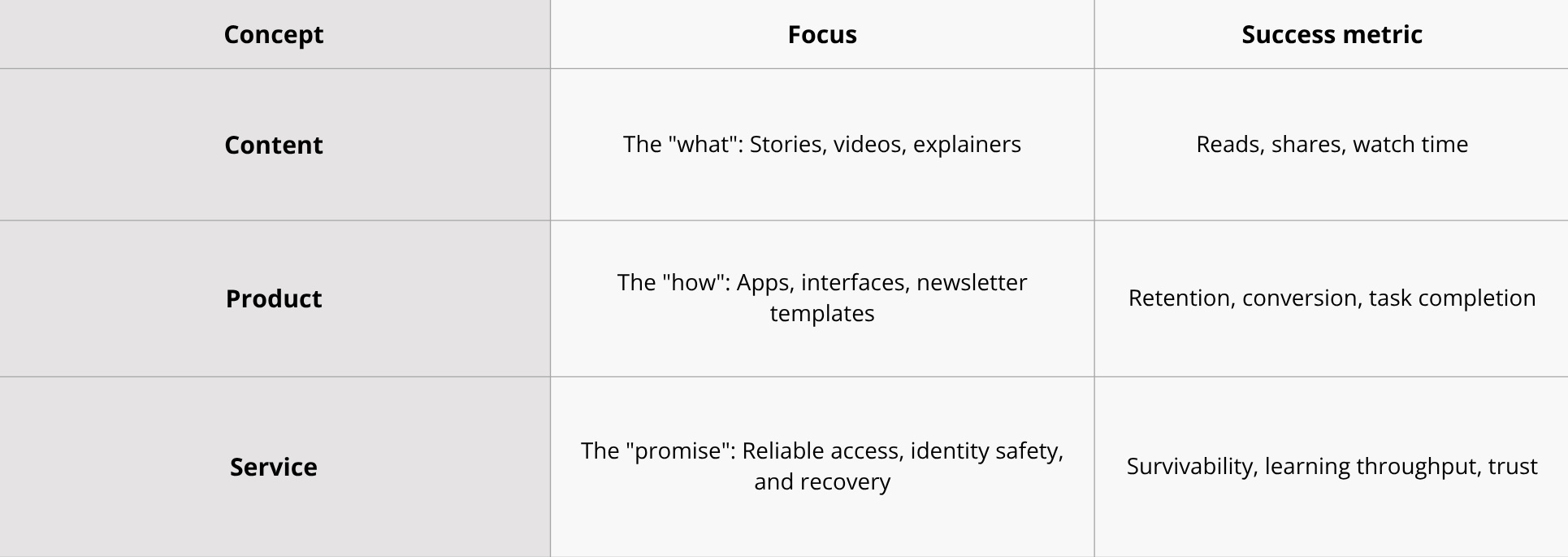
The implication is that distribution failures rarely look like failures. Instead, they look like nothing happening: No complaint, no bounce, no explicit refusal, just a quiet non-delivery that leaves no forensic trace. By the time you notice, the interaction is long gone.
This is why operators who treat distribution as shipping can run a plan for months without realizing it is not working. The dashboards show motion because the content went out, but nobody is on the receiving end of anything.
If you skip this layer of thinking, you risk mistaking activity for delivery, which is the single most expensive mistake in civic media strategy. Activity can be ordered, measured, and reported. Delivery can only be observed while it is happening. Teams that forget this end up defending quarterly numbers that describe a service nobody is actually receiving.
The response is not more dashboards. It is designing the interaction so that pieces of it are visible while they are happening. That means shorter loops, smaller experiments, and direct contact with actual readers in the form of conversations, not surveys.
It also means accepting that some of what you want to know you can only find out by being in the room (physical or digital) when the interaction is taking place. If you are not willing to pay that price, you are not running a service. You are running a broadcast. In a constrained environment, a broadcast is an expensive way to feel busy.
The frontstage and the backstage
One of the most useful ideas from service design is the distinction between the frontstage and the backstage.
The frontstage is what the reader touches, like the caption, the landing page, the video, the comment thread, and the moment of "oh, this is for me." The frontstage is where most teams spend their budget and their meetings, because it is the part a funder or a board member can see. It is also, in most cases, where the least improvement is available for the effort. Frontstage changes are visible but shallow.
The backstage is what makes the frontstage possible, but the reader never sees:
- The moderation call that let the post go up
- The ad account that did not get flagged
- The translator who caught a phrase that would have tripped the platform filter
- The newsroom that decided not to use a specific keyword in the title
- The editor who rewrote the share caption so it would survive being forwarded across three messaging apps
- The hours somebody spent keeping a payment rail open so the ad budget could clear in the last hour before launch
The backstage is where most of the real improvement lives, and it is where most teams look last.
The backstage matters because every frontstage moment depends on a chain of backstage work. The reader never sees that chain, and often neither does the team, because the backstage lives in different job descriptions and different tools.
If you cannot draw your backstage on a single page, you cannot improve it. If you can, you will often find that the biggest available improvement has nothing to do with creative and everything to do with an upstream decision that quietly decides whether the frontstage happens at all.
If you skip this mapping, you risk paying your best people to polish frontstage details while the backstage is breaking under them. That is how teams ship beautiful work that nobody sees and do not understand why.
A small exercise to try
Pick one piece of content you “shipped” recently. Not the most successful one, not the most interesting one, just any that went out. Write down the full interaction a reader has to complete to get value from it, step by step.
Each step is a touchpoint. Each arrow between two touchpoints is a handoff.
Mark anything that happens on a device the reader owns, and anything that happens on someone else’s device. Mark anything that happens in a community space, and anything that happens in a paid or transactional space. Mark every actor involved in each touchpoint, including the ones who are not on your team.
Now look at the map and find every place the interaction hands off from one actor to another. Those handoffs are where most services fail. They are also where most improvement is available, because no single team owns them, which is why nobody is watching them.
Pick the three handoffs you are least confident about and write a sentence for each explaining what you would do to strengthen it if you had half a day.
The exercise takes under an hour, and it is worth your time because once you have done it for one piece of content, you start seeing handoffs in every new plan before you ship it.
That habit is what treating distribution as a service looks like in practice. It is not a framework you roll out in a quarterly plan. It is a way of looking at the work that, once adopted, makes it hard to go back to the shipping-lane frame without noticing what you are giving up.
If you have feedback or questions, don’t hesitate to get in touch at hello@gazzetta.xyz.