
How to find attention touchpoints by mapping lived routines
Touchpoints are found on- and off-device, and in community or paid spaces
When publishers plan distribution, they usually list channels: Facebook, WhatsApp, Telegram, TikTok, the website, a newsletter, a podcast... The list is long, the categories are platform names, and the plan becomes an allocation problem across that list. This is a bad unit of analysis.
Platform names tell you almost nothing about the interaction a reader is actually in, and a plan built on platform names ends up funding a mix of lanes that behave unpredictably, because the behavior was never about the lane names in the first place.
A more useful tool is a simple grid with two axes. One asks whether the touchpoint sits on the reader’s own device or on someone else’s surface. The other asks whether the touchpoint lives in community space or in paid or transactional space.
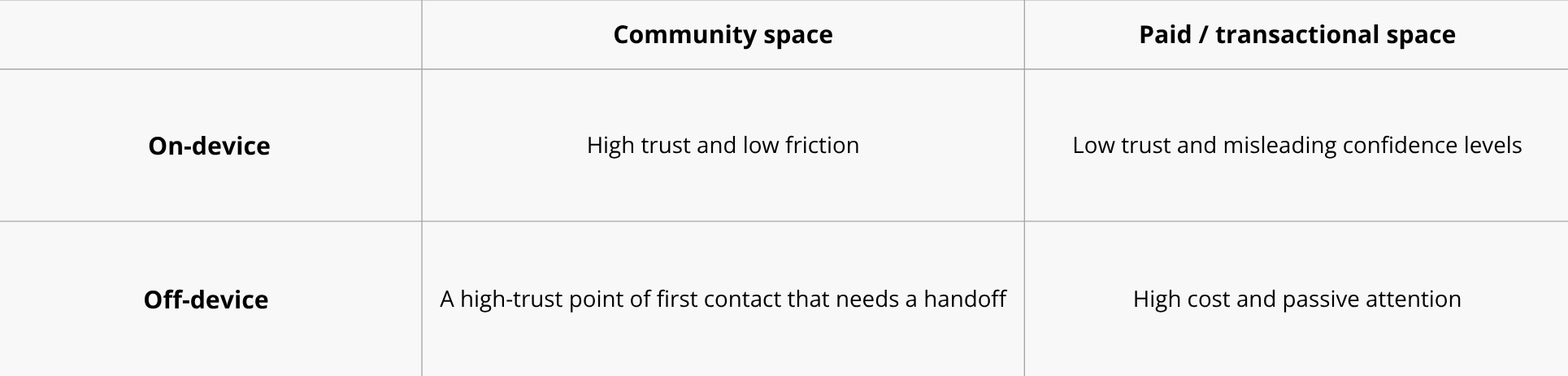
Every real-world touchpoint sits in one of the four combinations, and the combination it falls into tells you more about how the touchpoint behaves than the platform name ever will.
The grid is a thinking tool: Its value is in what it forces you to notice about the interaction, not in the neatness of the box.
Jump: WHAT are the two axes | WHAT are the four combinations | HOW to use the grid | WHY to build this habit
To find touchpoints in our project on blue-collar workers in a major Asian city, we brainstormed the daily routines of people in our intended audience, from the moment they wake up to the moment they fall asleep.
Just a few of the many touchpoints we identified are as follows:
- Waking up and checking texts from family and friends, scrolling headlines and short videos.
- Leaving the apartment and taking the elevator to the lobby, reading the ads or notices posted inside.
- Saying good morning to a neighbor or building security, getting breakfast handed off from a delivery driver, and engaging in small talk at work.
- Using a map app to check traffic or transit conditions, or confirm which station or exit to use.
- Swiping in to the bus or train, and seeing ads on the walls and doors.
- Swiping on dating apps to find someone to chat with, or a companion for the weekend.
- Eating in the canteen, or ordering a meal through an app.
- Checking mobile apps and notifications during downtime at work, or while using the restroom.
- Reading a longer article or watching videos while eating meals or commuting home.
The dozens or hundreds of touchpoints you come up with can then be categorized according to where the touchpoints live and whether they are community spaces or transactional ones.
The two axes: on/off device and community/paid spaces
On-device versus off-device: How easily does this translate to a click?
A touchpoint is on-device when it happens on a phone or computer the reader owns. It is off-device when it happens on a surface somebody else controls: an ad screen, a printed poster, a friend’s phone, a public kiosk, a shop till.
Why this distinction matters: The device determines what you can and cannot ask the reader to do next.
On-device touchpoints can hand off directly into a click, a save, a follow.
Off-device touchpoints cannot. They have to convert into an on-device action through memory, transcription, or physical interaction with something like a QR code. That introduces friction and attrition at every step.
If you ignore this cut, you will plan as if every touchpoint is a click away from a landing page, and you will be wrong most of the time. Off-device touchpoints are easy to underestimate because they do not show up in platform analytics. In many of the environments we work in, they do more first-contact work than anything else, which means ignoring them is the same as ignoring the top of your audience funnel.
Community versus paid: Trust levels and transactional costs
A touchpoint is in community space when the reader is there for social or informational reasons and the content arrives through people they already know or trust.
It is in paid or transactional space when the reader is there because somebody bought attention: an ad placement, a sponsored post, a search position, an affiliate link.
Why this distinction matters: Community touchpoints and paid touchpoints carry different levels of earned trust, and the difference decides how hard the content has to work to land.
In a community touchpoint, the reader is already half-leaning in. In a paid touchpoint, the reader is usually half-leaning out, because they can tell somebody paid to be there. Ignoring this cut leads to a common mistake: treating a paid placement as if it were a community recommendation, and being surprised when conversion rates are an order of magnitude worse.
Community space is cheaper per unit of trust and harder to scale. Paid space is more scalable and leaks trust at every step. A plan that refuses to choose between these trade-offs, or refuses to braid them together intentionally, pays both costs at once.
The value of the grid is that you can plot any touchpoint quickly, and the combination it falls into tells you more about how to work with it than the platform name does.
The four combinations: Every touchpoint lives in one of them
On-device, community: High trust and ready to share
A link from a trusted friend in a chat. A post in a community group the reader already belongs to. An alert from a creator they already follow. A share from a family member who curates their feed.
These are your highest-conversion touchpoints by a large margin. They are also the hardest to engineer, because they move through decisions nobody on your team controls.
Why it matters: a trusted share does in one step what a paid ad struggles to do in five.
A single trusted forward from a respected community member will outperform a large ad buy, because it compresses the work of trust-building into one gesture. The strategy is to make the content share-ready: easy to forward, clear in isolation from context, unlikely to embarrass the person who sends it.
Operators who invest in the shape of a share (headline, preview image, opening line, the first phrase somebody copy-pastes) outperform operators who invest in the body of the content.
If you skip this investment, you risk producing good content that is hostile to being shared, which means your best advocates will hesitate to pass it along, cutting off your cheapest growth lane.
On-device, paid: Leaking trust and misleading confidence levels
Targeted ads, sponsored posts, paid placements in apps the reader already uses, push notifications bought at cost, search ads.
These scale and they measure, which is why budgets accumulate here. The trap is that they leak trust at every step: the reader knows this was bought, and the handoff from ad to landing page is where most of the spend is wasted.
Why it matters: paid on-device is the lane most operators over-invest in, because it has the clearest metrics and the most obvious reporting line.
That confidence is misleading. High reach at low conversion is still a failed plan, and dashboards will not say so out loud. The strategy is to accept that you are buying attention, not conviction, and design everything after the ad to convert that attention into something useful before it evaporates.
If you skip this discipline, you risk running a plan that looks impressive in a monthly report and accomplishes nothing, because the readers you reached never crossed the threshold into actual engagement.
Off-device, community: A point of first contact that needs a handoff
A poster in a community centre. A pamphlet passed around a workplace. A word-of-mouth recommendation at a family meal. A notice on a bulletin board in a building the reader walks through. A mention at a religious service.
These touchpoints are almost invisible in dashboards and almost impossible to attribute, which makes most operators ignore them. In constrained environments they are often the difference between reaching people and not.
Why it matters: off-device community touchpoints are where first contact happens for audiences that are suspicious of advertising, wary of unfamiliar links, or working on devices they do not fully trust.
They are the lane through which an information service earns the right to be looked up later, which is the precondition for any on-device engagement at all.
The strategy is to design for the handoff from off-device to on-device: a QR code that survives a photo, a short URL a person can type from memory, a phone number that is memorable, a search phrase that reliably finds you when the reader gets home.
If you skip this lane, you risk being invisible to exactly the audiences for whom direct online outreach does not work, which in a constrained environment is often the audiences that matter most.
Information moves through the physical world on plastic bags, elevator walls, and bulletin boards. These channels are off-grid relative to digital censors but rely heavily on local intermediaries.
The execution economy
In many major cities, a vast gig economy executes physical tasks. You can hire gig workers to distribute materials in specific neighborhoods or dorms. The catch is intermediary risk: you rely on a third party who might be questioned or might fake the results.
Packaging as media
You can use e-commerce platforms to print custom items like tissues, paper cups, or tote bags with information or QR codes. These items travel into private spaces where digital ads cannot reach.
Professional out-of-home media
You can also use formal advertising networks like elevator screens and residential gate lightboxes. The constraint is high paperwork barriers, meaning this is only for safe, non-political content that builds general trust.
Off-device, paid: High cost and difficult to measure
Billboards, transit ads, in-store displays, printed flyers distributed through a paid network, paid placements on public screens.
These are the most expensive per interaction and the worst-measured, which is why they are the easiest to misuse.
Why it matters: paid off-device is the lane where operators can burn the most money fastest while feeling like they are doing something substantial.
The physical presence feels like a statement of intent, and the costs feel like evidence of commitment, which makes them hard to cut even when they do nothing. They earn their keep when the audience is hard to reach on-device (because of platform gaps, language barriers, or identity friction) and when the creative is disciplined enough to carry a single clear handoff. They fail when operators try to replicate on-device creative on a physical surface.
If you skip the discipline, you risk a budget line with no feedback loop, which means you will keep renewing it long after it has stopped working, because there is no signal strong enough to kill it.
How to use the grid to maximize your distribution plan
Step 1: Audit your current mix
Write down the touchpoints that your current plan depends on. Put each in a combination.
If more than seventy per cent of your touchpoints are on-device paid, you are running a pure performance play, and you should ask whether that is actually what your mission requires.
If the community combinations are empty, your plan has no trust surface, and you are spending more than you need to.
Why it matters: the imbalance is almost always invisible until you force it onto a page.
Most plans are imbalanced because nobody asked the question, not because somebody made a deliberate trade-off.
The risk of not auditing is that you keep spending into whichever lane the team is already comfortable with, which is rarely the lane the audience needs you in.
Step 2: Plan in pairs, not in lanes
The strongest plans braid combinations together.
An off-device community touchpoint hands off to an on-device community touchpoint. An on-device paid touchpoint hands off to an on-device community touchpoint once the reader has arrived.
The art is in the handoff, not in the choice of lane.
Why it matters: readers do not live in a single box.
A reader will encounter your work on a bulletin board, search for it on a shared phone, sign up for your newsletter through a friend, and then share a piece with a family member in a chat group.
Each of those steps is a handoff between two lanes. If you plan lane by lane, you leave every one of those handoffs to chance. If you plan in pairs, you take responsibility for the arrow between two lanes, which is the arrow the reader actually travels.
The risk of planning in lanes is that each lane looks fine in isolation and the reader never makes it between them.
Step 3: Budget by handoff, not by combination
Most distribution budgets are organized by channel or by combination. That is a legacy of the shipping-lane model.
A more useful budget is organized by handoff: how much you are spending on the moment an ad becomes a landing page, the moment a poster becomes a search, the moment a forwarded link becomes a first read.
Why it matters: handoffs are where readers drop out.
Budgeting them directly forces you to invest in the places where the plan actually breaks, and it makes the invisible work (the landing page tuning, the QR code testing, the share-caption rewrite) fundable in its own right.
If you do not budget for handoffs, nobody owns them, which is the default state of most distribution plans we see.
One habit worth building
The grid is a tool for thinking, and is a great habit to use to look at any new channel, new partnership, or new creative idea.
Use the grid to ask three questions:
- Which combination does this sit in?
- What are the trust and friction properties of that combination?
- What does the handoff in and out of it need to look like?
Most of the bad distribution decisions we see are made because these questions never got asked. The reason they never got asked is that the conversation started with a platform name.
Start with the grid and the conversation gets sharper immediately, which saves you from spending anything funding lanes that were never going to work for the audience you have.
If you have feedback or questions, don’t hesitate to get in touch at hello@gazzetta.xyz.