Moving journalism from content creation to concrete outcomes
Over the past year we've been testing what it takes to implement service-based strategies inside news organizations.
This isn't as obvious as many would assume: while many news organizations have good intentions to genuinely serve audiences, there's a widespread disconnect between write-publish-and-repeat cycles and how that actually achieves something for communities covered.
With The Service Desk, we've set out to use service design principles to guide newsrooms develop real strategy between audience and business needs, with the intent to help people, not just get them to consume.
Our work so far has consisted of a beta with The Lenfest Institute for Journalism, including three group workshops, dozens of one-on-one discussions about organizational constraints, and lessons from service design in other industries.
We’re so grateful to the newsrooms and independent creators who have shared their time, questions, and work-in-progress with us over the past year. This has been broad, public-facing work: three open workshops, plus dozens of one-on-one conversations with newsrooms across four continents, with 70+ audience practitioners contributing insights along the way.
A pattern kept coming up: when everything feels broken, teams get stuck. The temptation is to respond with bigger plans, more content, or better distribution tactics. But what we consistently saw was that progress usually starts with a smaller, clearer promise.
Instead of starting with outputs (a podcast, a newsletter, a site redesign, an influencer engagement strategy), start with outcomes: what your work enables people to do in their lives.
That shift may sound conceptual, but it fundamentally changes the day-to-day decisions you make. It pushes you to ask: what do we help people accomplish, repeatedly, in a way that can actually be sustained?
As we noted before, this reflects an exciting and (we think) liberating evolution from a priesthood mentality that worries about reach toward greater impact and revenue. And we think we're just seeing the beginning.
Here's what we've learned so far:
Where journalists typically get stuck
Across the workshops and 1:1s, the blockers were often less about a lack of ideas and more about a lack of usable starting points. With the help of dozens of audience practitioners, we heard five challenges come up again and again:
- We often feel paralyzed: When everything needs overhauling, even small changes feel impossible.
- We’re held back by our own limits of imagination: It is easy to default to familiar formats and platforms instead of rethinking the value we create.
- We’re stuck in tactical thinking: SEO and social debates can hijack the strategic conversation.
- The trust equation is broken: Transparency alone does not rebuild trust if people do not feel the work is relevant or useful.
- We have a measurement problem: Default metrics can feel precise while missing the actual value people get.
What helped was not finding the perfect strategy. It was picking a specific service-shaped problem and making it testable.
Defining a value proposition
For many news organizations and creators, this is the core question that needs to be solved: What is the repeated promise you can make and keep for a defined group of people?
As one workshop participant last year put it: “the conflict between ‘journalism’ and providing service and value to consumers [is] not as obvious as you think.”
In practice, we kept returning to four starting points:
- Start from people’s needs, not media gaps: What are people trying to do, decide, or navigate, rather than what’s missing in the ecosystem as starting point.
- Name the benefit in everyday language: Relegate format language to tactical observation. Focus on what becomes easier, safer, or clearer for people in their lives.
- Don’t mistake distribution for service: New channels do not fix an unclear promise.
- Treat uncertainty as a design constraint:. If you cannot answer key questions with confidence, design a small test to learn.
What service-based strategies have looked like in our workshops so far
We helped participants move from theory into planning and offered five criteria for doing so:
- Needs vs. content: What underlying need does this meet beyond just publishing content?
- Actionable: Does this help people act on information, not just consume it better?
- Measured change: Can we measure success through real-world behavior change, not just media consumption?
- Utility-based: Is this helping people navigate systems or just covering them?
- Sustainability: Does this create ongoing community value beyond breaking news cycles?
The strongest ideas had something in common: they were specific enough to try without needing major intervention or new resources. They were immediately doable.
A few examples:
- Turning recurring reporting areas into practical guides that help people take an action.
- Creating structured listening loops, such as office hours or small community conversations, that generate ongoing insight rather than one-off engagement, and build trust.
- Partnering with local organizations already doing direct service so the newsroom’s information fits into real support pathways, to immediately and meaningfully be of use.
- Defining a small number of signals of usefulness (confidence, follow-through, repeat use), instead of only defaulting to traffic for greater clarity.
None of these are silver bullets. But they are ways to start small without falling back into unintentional content creation. If you have other suggestions, please let us know by emailing us at servicedesk@gazzetta.xyz.
What’s next
Over time, the questions in our workshops moved beyond audience tactics to service questions. They centered less on “how do we grow reach?” and more on what a newsroom can reliably do for people week after week, and how to make that work sustainable inside a team.
That is where service design became useful for us in our conversation as a set of practical methods for turning a good intention into something people can actually use and teams can actually run. In our work, that often means getting specific about the end-to-end experience: how people discover the service, what they need in the moment, what happens when something goes wrong, and what internal workflow makes the promise repeatable.
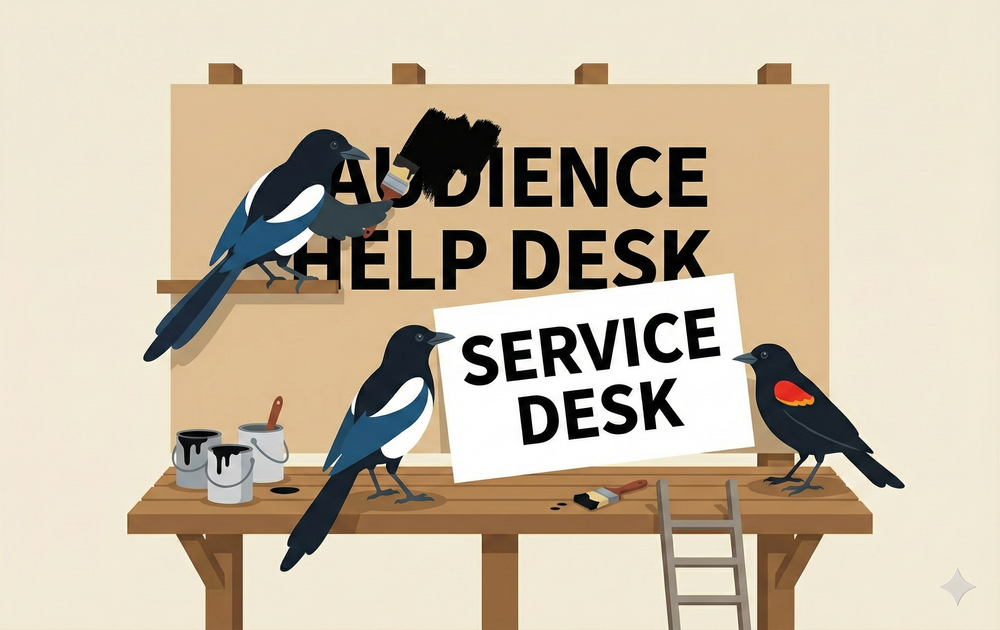
As we did this work, we gradually updated how we describe it. We initially called our project the Audience Help Desk, because many newsrooms were being pushed to “do audience” without the time, staff, or support to do it well. The work kept pulling toward repeatable service promises, supported by clear workflows. That is why we now call this the Service Desk.
We will continue running workshops in Philadelphia and across the U.S. this year (get in touch if you’re interested!), and you can book virtual slots anytime with us.
You just read about how we're re-starting in earnest after a small break.
- Book a slot.
- Read more about what The Service Desk is.
- Read more on what we do.
- Read more on how we work.
Questions? Suggestions? Ideas?