
Maintenance is a strategy too
Mierle Laderman Ukeles, 1969: who picks up the garbage on Monday morning?
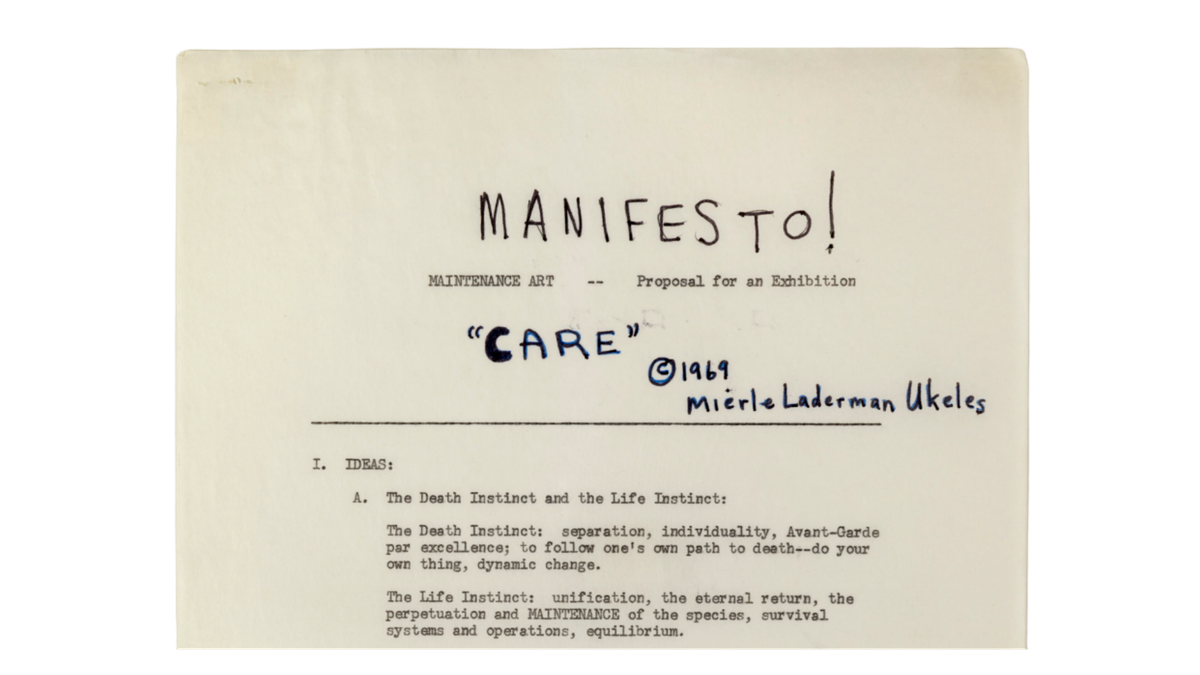
In 1969, Mierle Laderman Ukeles wrote a four-page typed manifesto she titled by hand on the cover sheet:
MANIFESTO! MAINTENANCE ART – Proposal for an Exhibition "CARE"
She opens by naming two instincts:
The Death Instinct: separation, individuality, Avant-Garde par excellence; to follow one's own path to death – do your own thing, dynamic change.
The Life Instinct: unification, the eternal return, the perpetuation and MAINTENANCE of the species, survival systems and operations, equilibrium.
She translates the instincts into systems:
Two basic systems: Development and Maintenance. The sourball of every revolution: after the revolution, who's going to pick up the garbage on Monday morning?
Development: pure individual creation; the new; change; progress, advance, excitement, flight or fleeing.
Maintenance: keep the dust off the pure individual creation; preserve the new; sustain the change; protect progress; defend and prolong the advance; renew the excitement; repeat the flight.
show your work -- show it again keep the contemporaryartmuseum groovy keep the home fires burning
She names the cost:
Maintenance is a drag; it takes all the fucking time. The mind boggles and chafes at the boredom. The culture confers lousy status on maintenance jobs: minimum wages, housewives = no pay.
And then she lets the list of a day speak for itself:
clean your desk, wash the dishes, clean the floor, wash your clothes, wash your toes, change the baby's diaper, finish the report, correct the typos, mend the fence, keep the customer happy, throw out the stinking garbage, watch out don't put things in your nose, what shall I wear, I have no sox, pay your bills, don't litter, save string, wash your hair, change the sheets, go to the store, I'm out of perfume, say it again -- he doesn't understand, seal it again -- it leaks, go to work, this art is dusty, clear the table, call him again, flush the toilet, stay young.
Her diagnosis of the avant-garde:
Avant-garde art, which claims utter development, is infected by strains of maintenance ideas, maintenance activities, and maintenance materials. Process art especially claims pure development and change, yet employs almost purely maintenance processes.
The exhibition she proposes has three parts.
The Personal Part:
I am an artist. I am a woman. I am a wife. I am a mother (random order). I do a hell of a lot of washing, cleaning, cooking, renewing, supporting, preserving, etc. Also, (up to now separately) I "do" Art.
Now, I will simply do these maintenance everyday things, and flush them up to consciousness, exhibit them, as Art. […] My working will be the work.
The General Part: interviews with fifty kinds of workers, from sanitation man to nurse to bank president to artist, asking among other things "what is the relationship between maintenance and freedom; what is the relationship between maintenance and life's dreams."
The Earth Maintenance Part:
Everyday, a container of the following kinds of refuse will be delivered to the Museum: 1) the contents of one sanitation truck; 2) a container of polluted air; 3) a container of polluted Hudson River; 4) a container of ravaged land. Once at the exhibition, each container will be serviced: purified, depoluted, rehabilitated, recycled, and conserved by various technical (and/or pseudo-technical) procedures either by myself or scientists.
I read this with media development and media support in mind. Most of what we fund is shaped like Development in her sense: launches, pilots, accelerators, sandboxes, scale.
Most of what makes any of it work is shaped like Maintenance: sustaining a relationship with a community, keeping a database accurate, replying to a tip line for years, mending trust when something breaks. The vocabulary of the field belongs to the first. The work belongs largely to the second.
Ukeles went on to become the unsalaried artist-in-residence at the New York City Department of Sanitation in 1977. In one of her major works there, "Touch Sanitation" (1979–80), she set out to shake the hand of every sanitation worker in the city, around 8,500 people, and to say, "Thank you for keeping New York City alive."
She closes the Personal Part of the manifesto with this:
My working will be the work.
Thanks to John Hernandez for sharing.